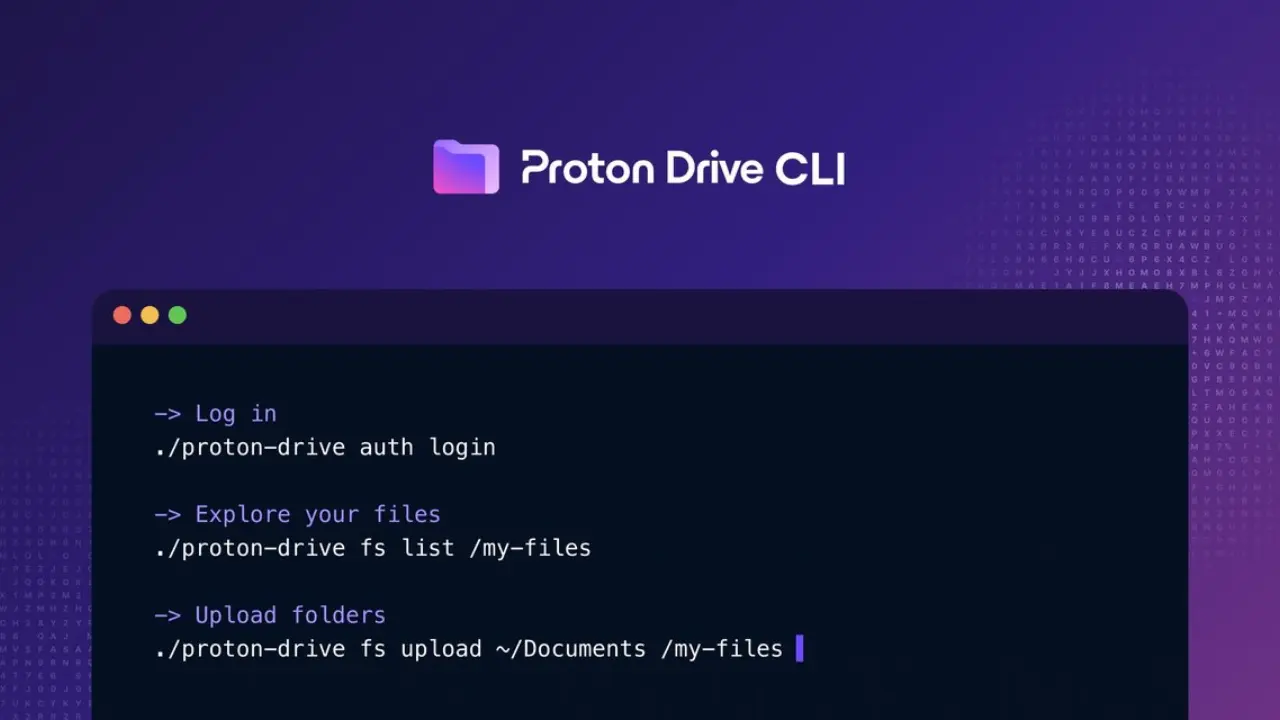
The team at Proton has released a command-line interface for Proton Drive to let users manage their encrypted files directly from a terminal across all major platforms: Windows, macOS, and Linux.
The CLI supports the usual filesystem tasks like listing directories, moving files to the trash, downloading remote folders, handling invitations, and exporting these outputs with the --json flag to pass structured data directly into automated deployment scripts or run scheduled backups through cron.
Here are some commands you can run with Proton Drive CLI:
-
proton-drive auth loginstarts authentication through your browser. -
proton-drive filesystem upload ./reports/* /my-files/Reports --conflict-strategy skipuploads local documents while skipping files that already exist on the server. -
proton-drive sharing status /my-files/Reportschecks the sharing status and permissions of a folder. -
proton-drive sharing invite --user [email protected] --role editor --message "Please review reports" /my-files/Reportsinvites a collaborator to a shared folder with editor access and a custom message.
Proton said that in the future, the CLI will gain support for managing photos, sharing files and folders via secure public links, creating custom albums, and switching between multiple accounts.
To install the tool on macOS and Linux, you download the pre-built binary and make it executable by running chmod +x proton-drive in your terminal. The operating system stores your active login session securely using native tools like macOS Keychain or Windows Credential Manager. Alternatively, those who prefer building the program from source can clone the repo, install dependencies using Bun, test the build, and compile the TypeScript code directly.
The new CLI lands just days after Proton announced that it had completely rebuilt Drive's engine from scratch to make the cloud storage "3x faster on all platforms." This performance jump comes from a unified Drive SDK that replaces legacy platform-specific codebases and executes cryptographic tasks four times faster to reduce battery drain and heat generation on mobile devices. This shared engine also allows Lumo, Proton's AI assistant, to read and process drive files without breaking the system's end-to-end encryption protocols.

















0 Comments
Load the comments and join the conversation!
Read the comments, ask the editors questions, show respect and join the conversation.