Anthropic has unveiled Claude Haiku 4.5, which marks the latest addition to its Claude 4 model family. The company is positioning the Haiku 4.5 model as its fastest and most cost-efficient model in its lineup, offering $1 per million input tokens and $5 million output tokens.
Anthropic claims that Haiku 4.5 nearly matches the coding and reasoning capabilities of the much larger Sonnet 4.5, while operating at double the speed and one-third the cost. The company further says that this makes it suitable for real-time tasks such as chat assistants, customer service bots, and pair-programming tools.
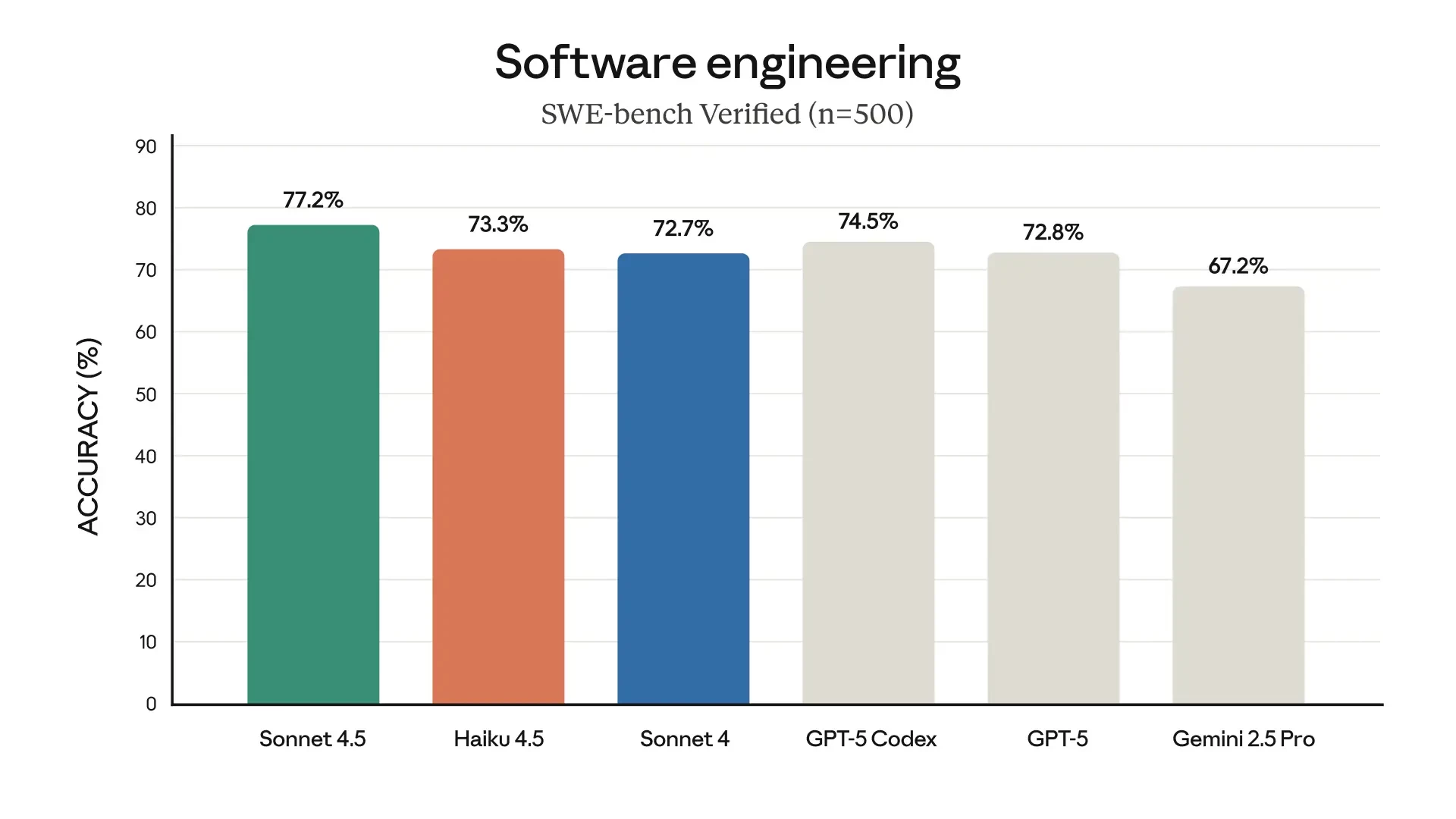
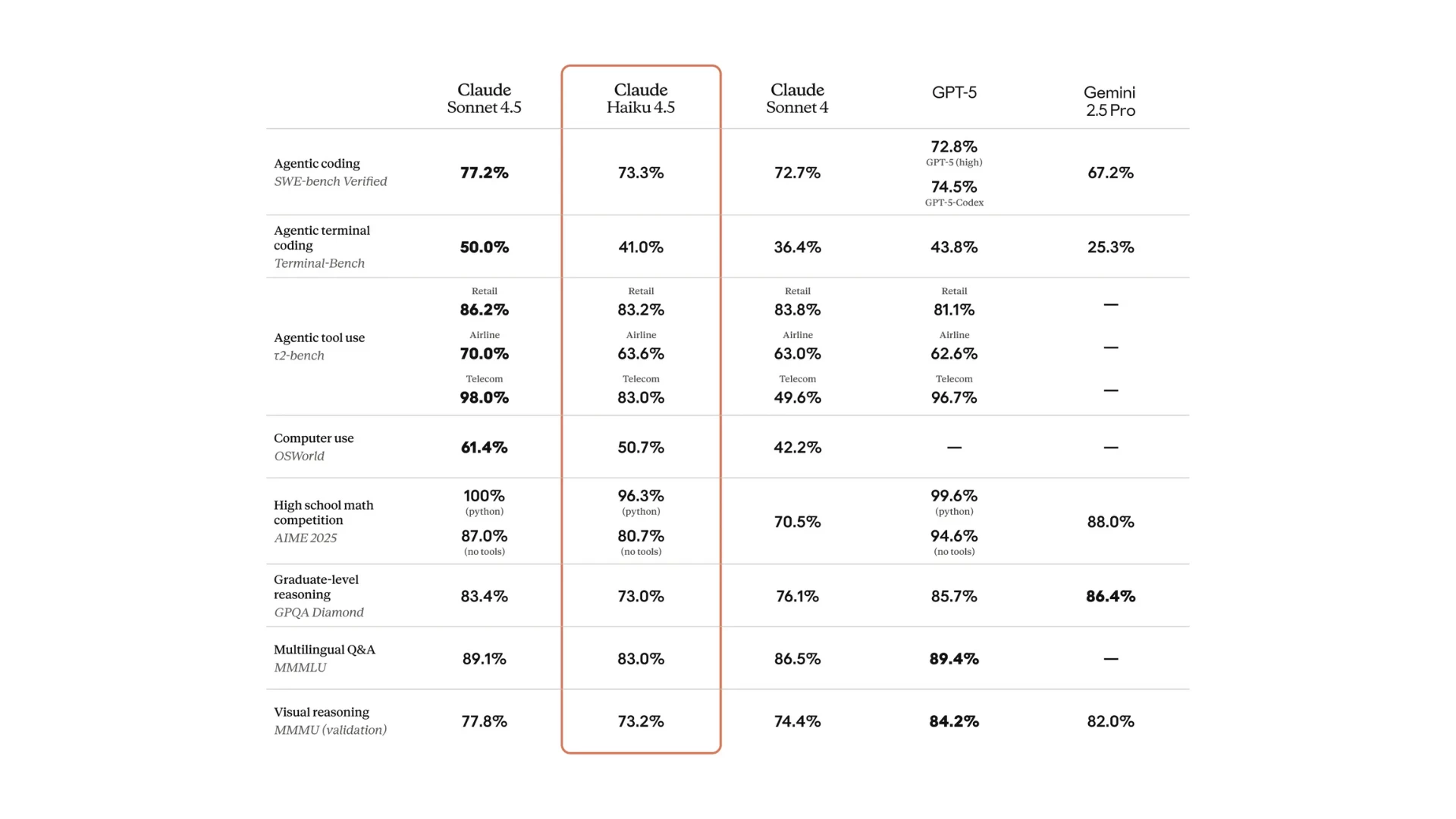
For the benchmarks, Anthropic shows that Claude Haiku 4.5 achieves a 73.3% score on SWE-bench Verified, a dataset widely used to test software engineering capabilities, slightly behind its frontier model Sonnet 4.5, which scores 77.2%.
The model also demonstrates notable improvements in the sub-agent orchestrations, where multiple smaller models collaborate on different aspects of a larger workflow. For instance, a Claude Sonnet 4.5 instance could oversee complex project planning while delegating certain computations or subtasks to multiple Haiku 4.5 agents for faster execution.
On the safety front, Anthropic says that Claude Haiku 4.5 exhibited fewer misaligned behaviors than its predecessors and other models in the Claude 4 family. The company reports statistically significant improvements in automated alignment assessments, resulting in classification under the less restrictive AI Safety Level 2 (ASL‑2) standard. This contrasts with the tighter ASL‑3 designation used for larger models like Sonnet 4.5 and Opus 4.1.
Anthropic says that these results make Haiku 4.5 its safest model to date, particularly in mitigating misuse risks related to sensitive topics such as chemical, biological, radiological, or nuclear data generation.
Developers can start using Claude Haiku 4.5 via the Claude API, Amazon Bedrock, and Google Cloud"s VertexAI platform, with support for backward compatibility for developers already using Haiku 3.5 as well as Sonnet 4 models.