Nearly a year after Microsoft Word celebrated its 41st anniversary in November 2024, another cornerstone of productivity software, Microsoft Excel, is marking a major milestone. Excel turns 40 this year, having first launched for the Apple Macintosh in September 1985, and continues to play a central role in how businesses, students, and analysts manage and analyse data.
The spreadsheet software launched at a time when personal computers were becoming more accessible and graphical user interfaces were replacing command lines. Excel introduced an intuitive grid system, advanced formulas, and charting capabilities, allowing users to manipulate and analyse data visually. It quickly became a popular tool for businesses, students, and analysts, establishing itself as a cornerstone of productivity software.
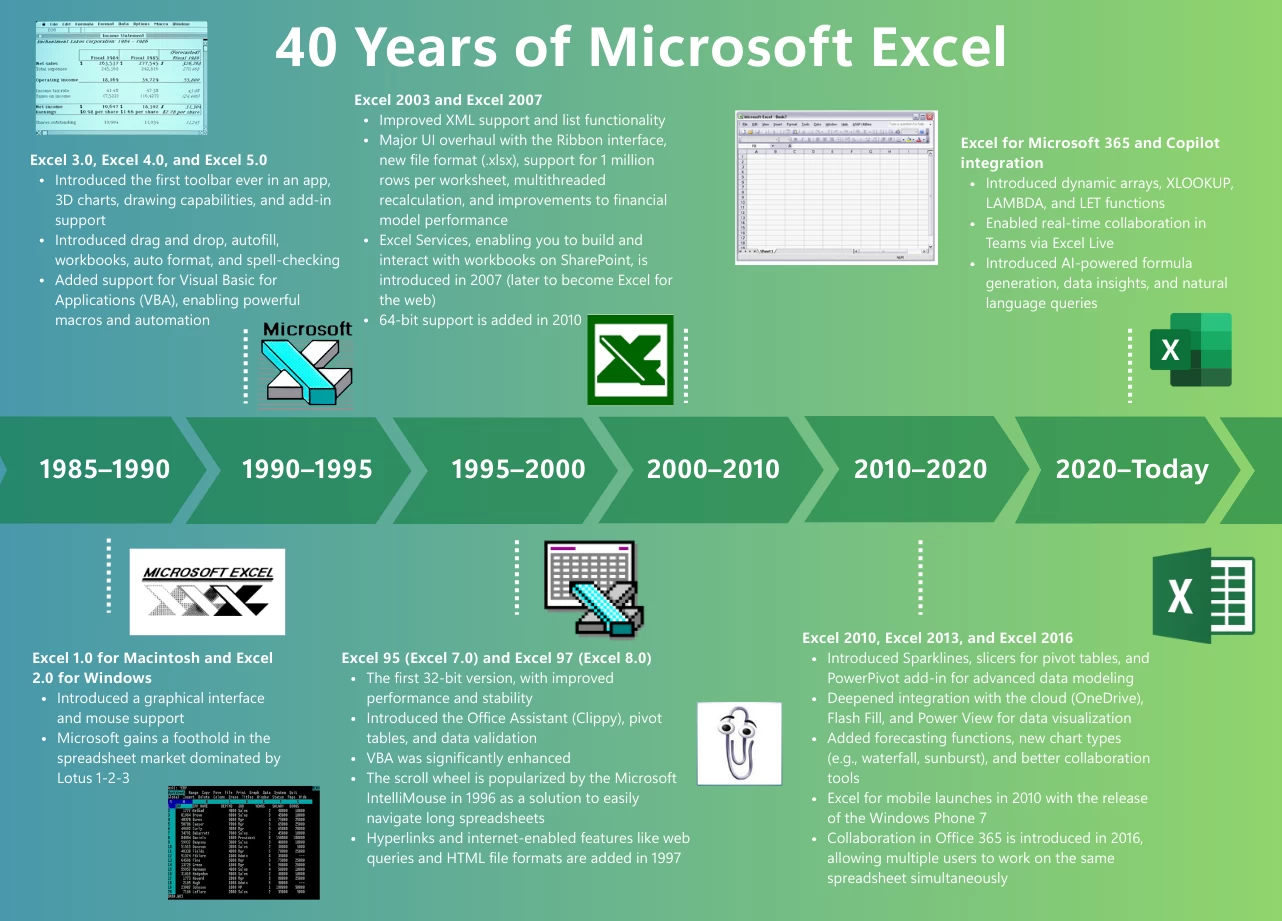
Since its launch, Excel has grown into one of the most widely used spreadsheet applications worldwide. Microsoft credits the continued support and feedback of Excel users as a driving factor in the software’s ongoing development. And, to mark its 40th anniversary, the tech giant has outlined plans for future updates.
Excel is integrating more AI-powered features through its Copilot tool, offering inline assistance and a new Copilot Chat to help users write formulas, correct data, and answer complex questions. The software is also introducing new agent features, including the Surveys Agent and Agent Mode, which aim to automate repetitive tasks, facilitate deeper data analysis, and make advanced workflows more accessible.
Microsoft emphasises that all updates are designed to be intuitive, high-quality, and practical for everyday use. These updates demonstrate the company"s ongoing dedication to evolving Excel in line with user needs and the demands of a data-driven world.
With AI-powered assistance, automated workflows, and advanced analysis tools, Excel continues to strengthen its position as a vital platform for productivity, enabling users to work smarter and more efficiently, and leaving them to imagine how the software might continue to transform the way we manage data in the decades to come.