Google has announced that it is handing over its Open Health Stack (OHS) project to the Linux Foundation. It"s a move that could help make digital healthcare tools more accessible and collaborative while also reflecting the tech giant"s growing focus on healthcare.
In recent months, the company has expanded its healthcare ambitions through AI-powered patient tools and partnerships, while now investing in the open infrastructure needed to support future digital health applications. The latest decision builds on work Google Research began with the World Health Organization (WHO) in 2023, when the two organisations launched Open Health Stack. The open-source project was created to give developers a common set of tools for building digital health applications, particularly in regions where healthcare infrastructure is still developing.
The announcement comes against the backdrop of a much bigger challenge. Google says an estimated 4.6 billion people worldwide still don"t have access to essential health services. While technologies such as smartphones and AI have the potential to improve healthcare, many digital health systems don"t work well together, making it harder to deliver those benefits where they"re needed most.
By moving Open Health Stack under the Linux Foundation, Google is stepping back from direct ownership and placing the project in the hands of a broader community. The foundation will launch the Open Health Stack Software Foundation (OHS-SF), which will oversee the project"s development through a community-governed model rather than one led by a single company.
A number of organisations have already expressed support for the initiative, including the WHO, Anthropic, Microsoft, Endless Health, PATH, and several regional health networks across Asia and Africa. Furthermore, Google.org is also contributing a $3 million grant to help support the foundation"s long-term development.
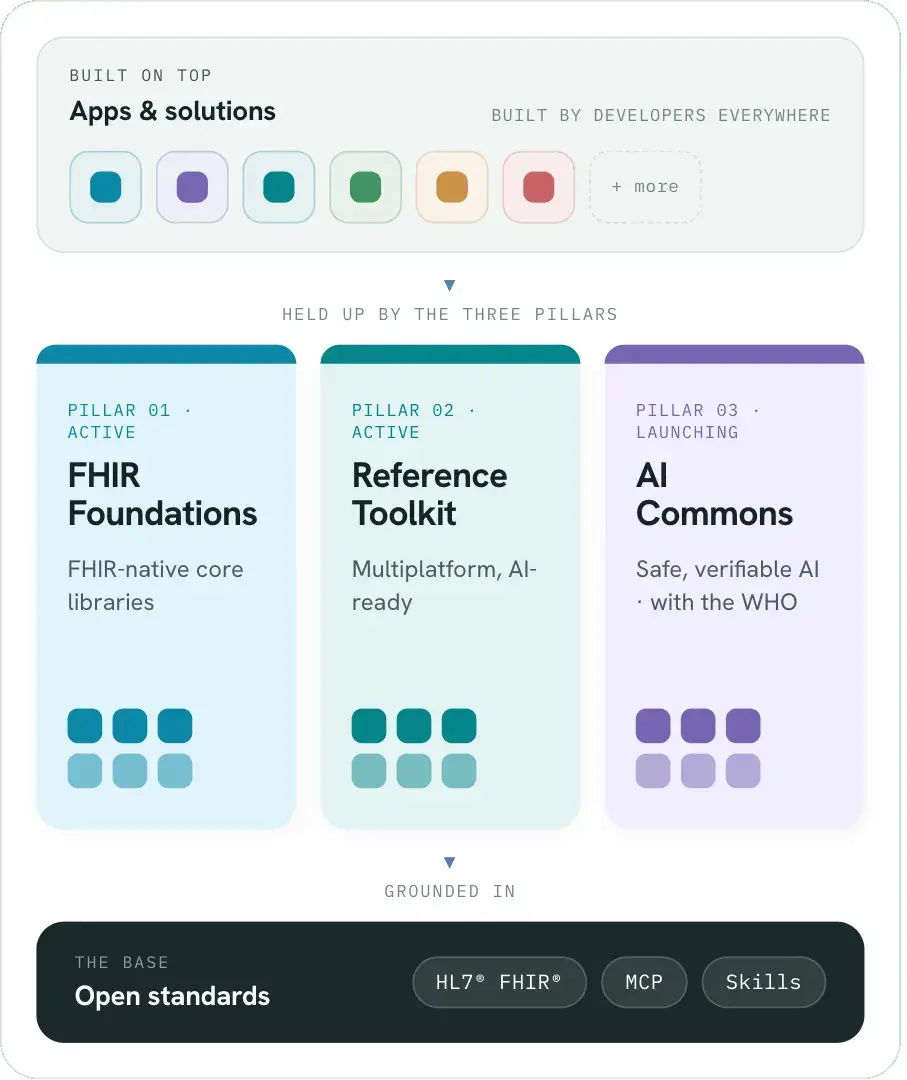
One notable part of the new structure is its focus on broader participation. The foundation plans to introduce a governance programme that allows startups, small businesses, and independent developers to take part without financial barriers. The foundation"s work will centre on three main areas. One focuses on expanding support for FHIR, the widely used standard for exchanging healthcare data. Another provides a cross-platform toolkit intended to make it quicker to deploy digital health applications.
The third, called AI Commons, is designed as a shared space where developers can collaborate on projects involving safe and responsible use of AI in healthcare. The focus on AI also comes as companies continue to build specialised healthcare models. Earlier this year, Anthropic introduced Claude for Life Sciences, a version of Claude tailored for biomedical research with integrations for tools commonly used by scientists.
Open Health Stack has already seen adoption beyond Google"s own projects. Over the past three years, partners including Argusoft, Ona, IntelliSOFT, IPRD Solutions, KushiBaby, and Living Goods have used the platform to build healthcare solutions across Sub-Saharan Africa, South Asia, and Southeast Asia. Google says these efforts have been supported by workshops and training programmes aimed at helping local developers build standards-based healthcare technologies.
The move also reflects a broader trend across the tech industry. Companies are increasingly investing in healthcare AI, whether that"s Microsoft"s AI system for assisting with complex diagnoses or virtual doctor visits through the Samsung Health app. Google"s latest announcement takes a different approach by focusing on the open-source infrastructure that developers can use to build those kinds of healthcare applications.