The KClock app for KDE Plasma over the years has received a number of updates, like better integration with KRunner and a dedicated background service (kclockd) for managing alarms. Now, it looks like KDE devs want to add something cool: pop-out timers using the new Picture-in-Picture protocol for Wayland.
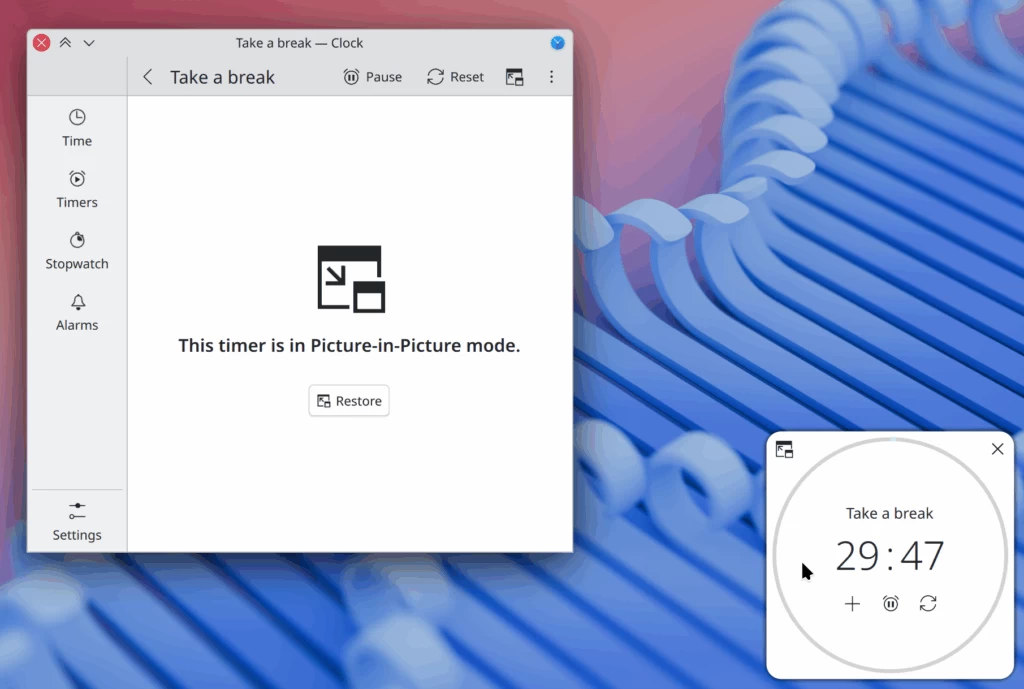
This all started from a simple observation. Kai Uwe Broulik, a KDE developer, saw someone using a small timer window during a presentation and thought it was a good idea. The problem is that achieving this kind of "always on top" behavior is handled differently between the old X11 display server and the newer Wayland.
With X11, an application could pretty much do whatever it wanted. If a program wanted to draw a drop-down menu, it would just create a borderless window, place it in a specific spot, and grab all user input. Wayland operates on a different philosophy.
As Broulik notes, under Wayland, the application describes what it wants, and the compositor gets to decide how to handle it. A drop-down menu is an XDG Popup. The application tells the compositor which button spawned it, and the compositor handles the placement and behavior.
This is much more secure and consistent. It also means an application cannot just decide to keep its window on top of everything else. This restriction prevents a web browser from implementing an overlay video player under Wayland.
To get around this in a standardized way, a proper Wayland support model for Picture-in-Picture, or PiP, was needed. Enter the **-pip-v1 protocol. It is a new protocol designed specifically for creating floating PiP windows, and KWin, Plasma"s compositor, recently gained support for it. Because it is an experimental protocol, its use is gated behind an environment variable, KWIN_WAYLAND_SUPPORT_XX_PIP_V1.
A new protocol is fine for demos, but it needs a real application to find its weaknesses. So Broulik implemented it in KClock. This work allows KClock to offer pop-out timers and even a pop-out stopwatch in a small PiP window.
The user could get system-wide options to control where the PiP window appears, or if it appears at all, and have that setting apply to every single application that uses the protocol. You can check out the merge request on GitLab for more technical details about this feature.