Early this year, during Build 2025, Microsoft first announced the public preview of Windows ML, a runtime optimized for on-device model inference that will allow developers to build AI applications for Windows 11 PCs without worrying about the underlying hardware.
Until now, developers who wanted to develop AI applications on Windows had to build their own custom support to make sure their app works on Windows 11 PCs running Qualcomm, Intel, AMD, and NVIDIA chipsets. Windows ML is solving this issue by providing a unified framework so developers can easily target Windows 11 PCs without hardware-specific optimizations.
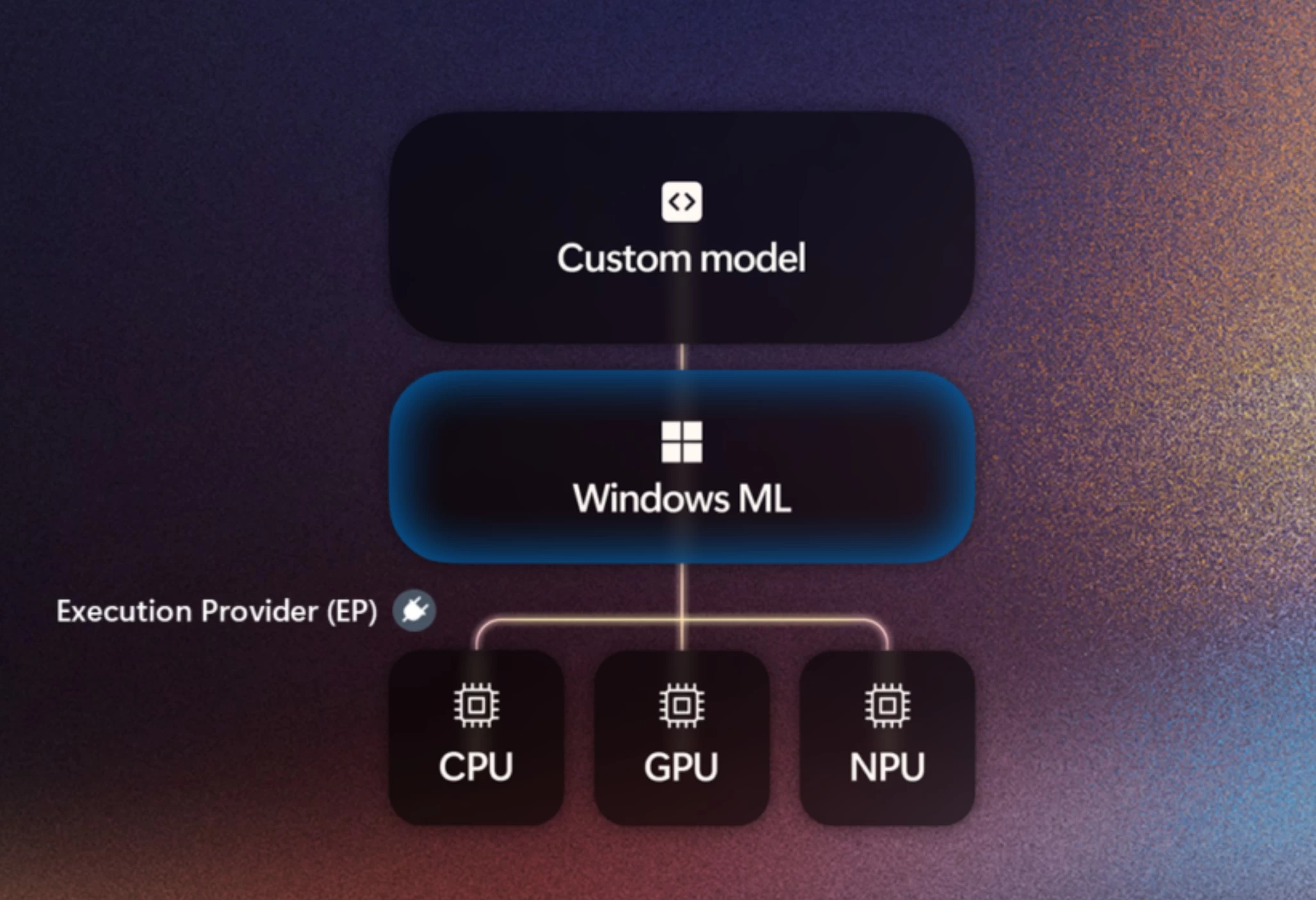
Today, Microsoft announced the general availability of Windows ML, allowing developers to build production-ready applications targeting millions of Windows 11 PCs. According to Microsoft, Windows ML offers the following benefits:
- Windows ML"s infrastructure APIs allow developers to support various hardware architectures without multiple app builds by making use of the execution providers already available on the device or by dynamically downloading them. Developers can even precompile their models (AOT) for a seamless end-user experience.
- Since Windows ML can automatically download the appropriate execution providers based on the PC hardware, developers need not bundle the runtime or EPs inside applications.
- Windows ML maintains conformance and compatibility, supporting ongoing updates. Therefore, developers need not worry about evolving hardware.
- Developers can assign device policies to optimize for low power (NPU), high performance (GPU), or specify the silicon used for a model.
Microsoft highlighted that several popular developers, including Adobe, BUFFERZONE, Dot Inc., McAfee, Reincubate, Topaz Labs, and Wondershare, have adopted Windows ML for their AI applications on Windows.
Developers can get started with Windows ML, which is now part of the Windows App SDK and supports all PCs running Windows 11 24H2 or newer.