Today, Microsoft revealed the next Fairwater site for Azure AI datacenters in Atlanta, Georgia. This new site will be connected to the existing Fairwater site in Wisconsin and to existing Azure AI supercomputers to create a planet-scale AI datacenter suitable for running a variety of AI workloads.
Based on the experience from creating datacenters for OpenAI"s training demands and other AI workloads, Microsoft is claiming that they have reinvented how they design AI datacenters. This new AI datacenter design uses a single flat network that can combine the power of hundreds of thousands of NVIDIA GB200 and GB300 GPUs.
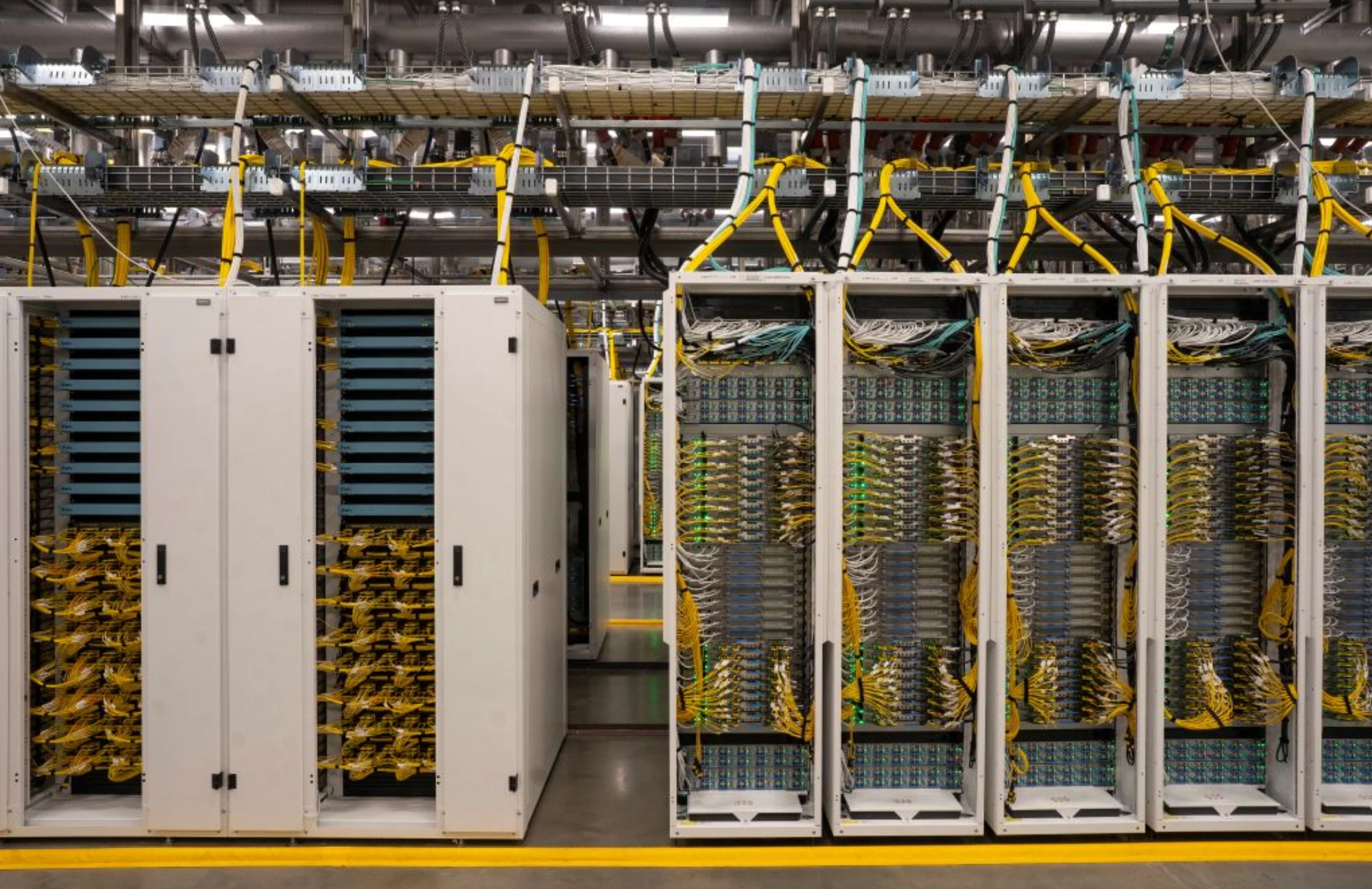
Microsoft highlighted that the following features differentiate this new datacenter from previous generations.
- Extreme GPU density - Custom racks with very high-density placement of NVIDIA Blackwell/GB-series GPUs to reduce latency and increase GPU-to-GPU communication efficiency.
- Closed-loop liquid cooling - A sealed cooling system that reuses the same water for 6+ years with almost zero evaporation, enabling sustainable support for very dense compute.
- Massive rack/row power delivery - ~140 kW per rack and ~1.36 MW per row, designed to support next-gen accelerators without traditional power bottlenecks.
- Flat, high-bandwidth networking - Two-tier Ethernet architecture with 800 Gbps GPU connectivity and SONiC-based networking to reduce cost, complexity, and vendor lock-in.
- Application-aware network optimization - Real-time packet trimming, packet spray, and advanced load balancing to keep huge GPU clusters highly utilized.
- Planet-scale AI WAN - Multiple sites (e.g., Atlanta + Wisconsin) connected via a dedicated, low-latency optical backbone to form one unified “supercomputer” across regions.
- Resilient grid-optimized power model - Makes use of strong local utility grids for high availability with energy-storage buffers for workload power swings.
- Built for every AI workload type - Pre-training, fine-tuning, RL, inference, and synthetic-data generation all run efficiently on the same unified infrastructure.
By creating a unified, multi-region supercomputer, Microsoft is positioning itself to handle the exponentially growing demands of large-scale AI workflows in the coming years.