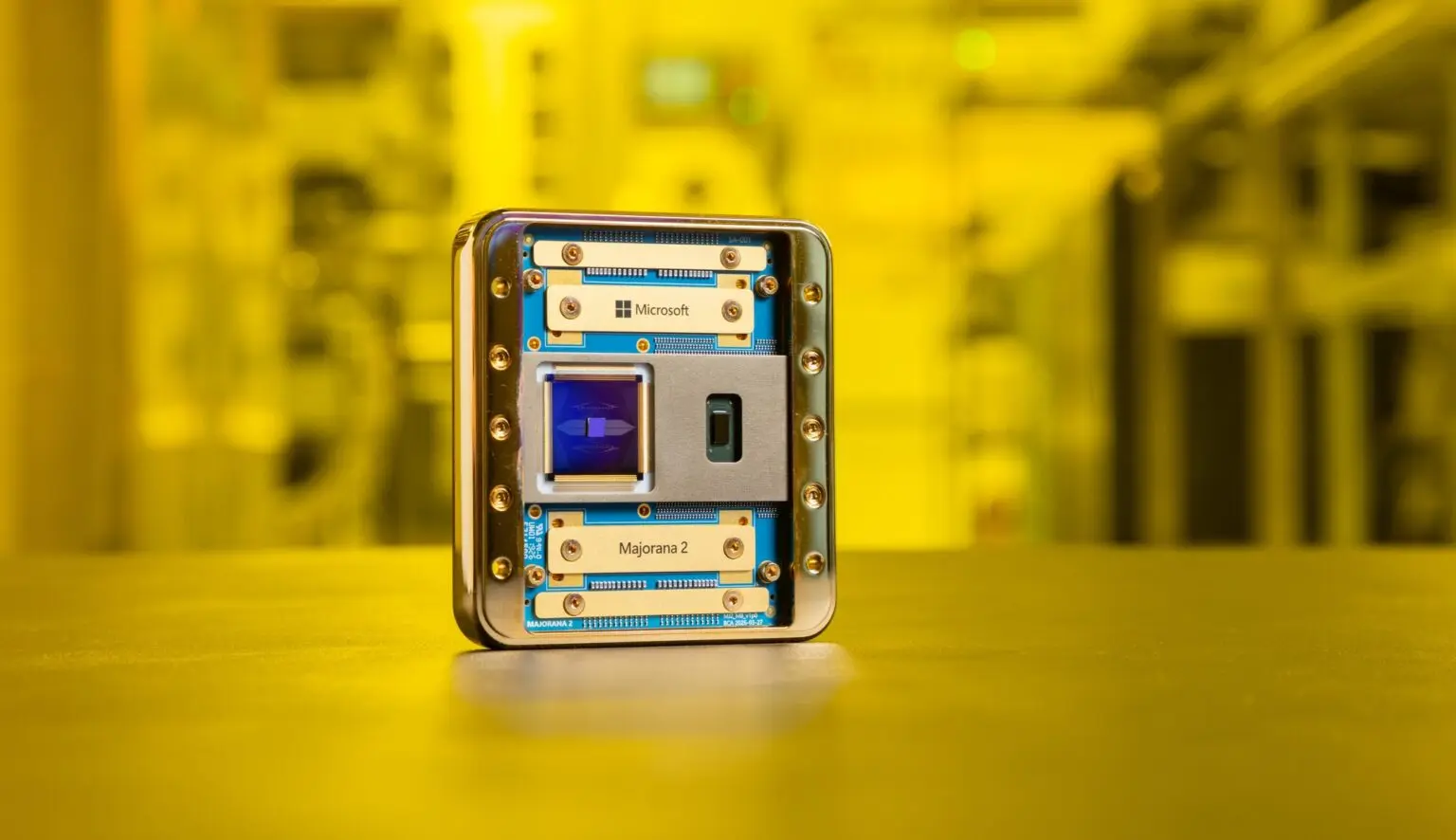
Microsoft has unveiled its latest topological quantum chip, Majorana 2. With this iteration, the Redmond giant has achieved a 1,000x improvement in reliability over the prior Majorana 1, which the company unveiled last year. Originally, the firm was planning to achieve practical quantum computing by 2035, but its latest work drastically shrinks this timeframe so that a scalable, commercial quantum computer is expected by 2029.
Majorana 2’s qubits claim to maintain their quantum state for 1,000 times longer than Majorana 1, which gives you more reliable computation. Microsoft says that while common approaches to quantum computing measure a qubit’s lifetime in microseconds, Majorana 2 can achieve a qubit lifetime of 20 seconds, with some instances even lasting as long as one minute.
With the reliability, one-microsecond operations, and small qubit size, the company says its team is on track to achieve a scalable quantum computer that will be commercially “valuable” by 2029. It says that such a device will help to tackle issues in global health, food supply, sustainability, energy production, and more.
Microsoft used agentic AI, consisting of autonomous AI agents guided by human scientists, to create Majorana 2. For example, Microsoft has been looking at the use of lead in its chip for years, but with the help of agentic AI, it was finally able to overcome significant tradeoffs and transitioned the manufacturing process from traditional aluminum to a lead superconductor materials stack.
Chetan Nayak, a Microsoft technical fellow, said: “That was actually a fairly large change, and it led to big, big improvements in device quality.”
Alongside Majorana 2, Microsoft announced the general availability of Microsoft Discovery, which allows external organizations to deploy AI agent teams for scientific research. Microsoft Discovery is the tool Microsoft itself used to make advancements introduced in Majorana 2, showing that it can deliver some big wins. Microsoft noted that Discovery can help to break down decades of siloed research and connect interdisciplinary gaps across fields like physics, engineering, and materials.
The Microsoft Discovery app is free to use now in early preview for individuals using GitHub Copilot.
Artificial intelligence and quantum computing are both major developments in technology, and it is interesting to see one being used to quicken up the development of the other. Microsoft Discovery is also interesting because it will help scientists around the world make new breakthroughs in other scientific fields.
This news should also act as a warning to all developers of apps and services that use encryption. They will need to introduce encryption methods that are secure against quantum computers a lot faster now, considering they are six years closer than they were a year ago.