Yesterday, OpenAI announced ChatGPT for Health, a dedicated experience focused on health and wellness. ChatGPT Health can connect with popular medical records and wellness apps to provide more personalized and better responses.
Today, OpenAI announced OpenAI for Healthcare, a set of products targeting healthcare organizations to help them deliver better care for patients with strict HIPAA compliance requirements.
ChatGPT for Healthcare is one of the main products and it is now available for leading health institutions like AdventHealth, Baylor Scott & White Health, Boston Children’s Hospital, Cedars-Sinai Medical Center, HCA Healthcare, Memorial Sloan Kettering Cancer Center, Stanford Medicine Children’s Health, and University of California, San Francisco (UCSF).
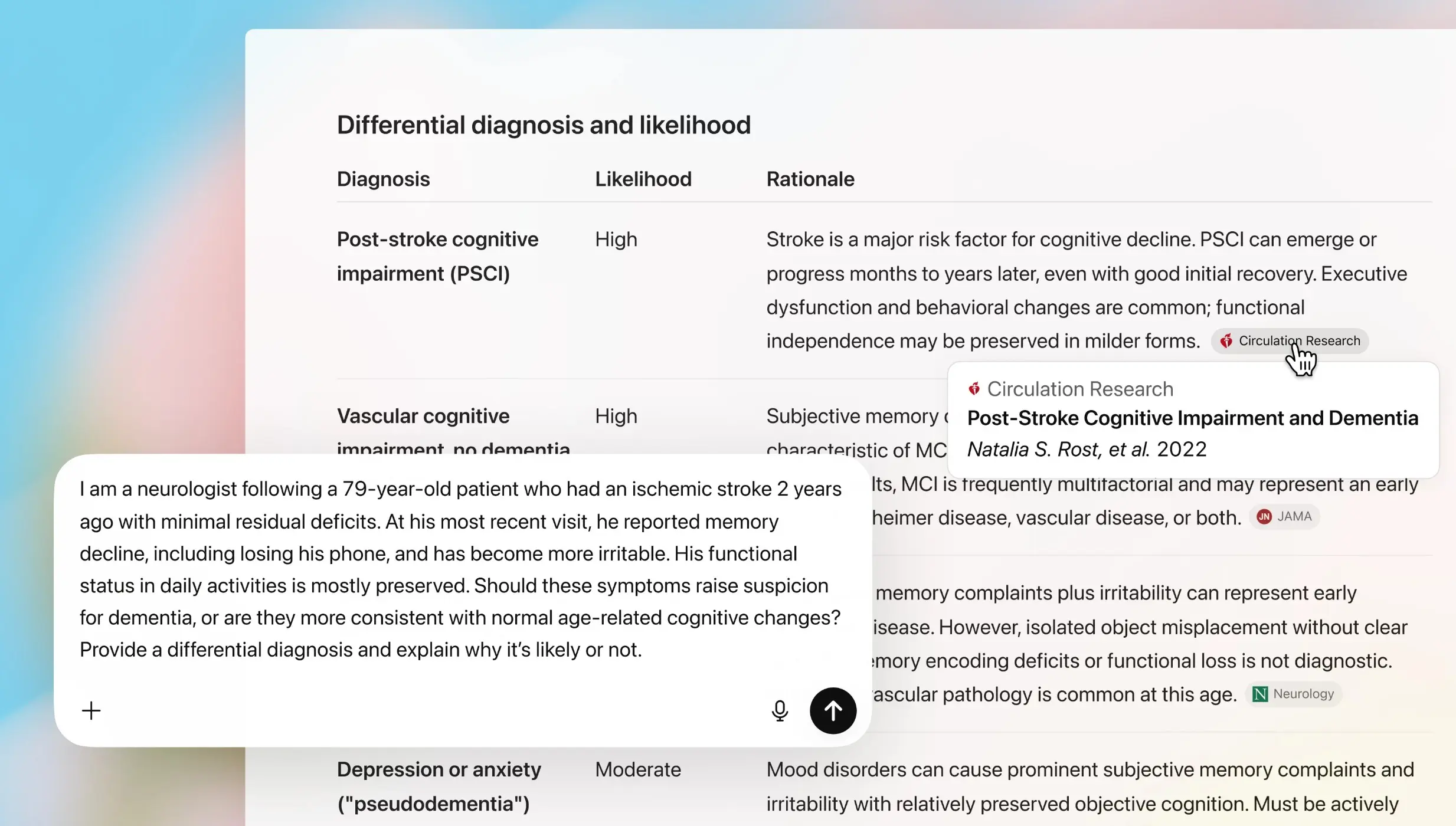
ChatGPT for Healthcare is built to provide evidence-based reasoning which is key in patient care and it offers the following features:
- Healthcare-specific AI models: GPT-5–based models optimized for clinical, research, and operational workflows, evaluated through physician-led testing using benchmarks and real-world scenarios (e.g., HealthBench, GDPval).
- Evidence-backed responses with citations: Answers are grounded in peer-reviewed studies, clinical guidelines, and public health sources, with transparent citations (title, journal, publication date) for verification.
- Alignment with institutional policies: Integrates with enterprise systems such as Microsoft SharePoint to incorporate organization-approved care pathways, policies, and operational guidance into responses.
- Workflow automation via reusable templates: Standardized templates for tasks such as discharge summaries, patient instructions, clinical letters, and prior authorization documentation.
- Centralized access control and governance: Role-based access management with SAML SSO and SCIM, enabling organization-wide user management and oversight across clinical, administrative, and research teams.
- Data control and HIPAA support: Patient data remains under organizational control, with options for data residency, audit logs, customer-managed encryption keys, and a Business Associate Agreement (BAA). User data is not used to train models.
OpenAI is also providing their GPT-5.2 model via APIs to build healthcare applications with HIPAA compliance requirements.