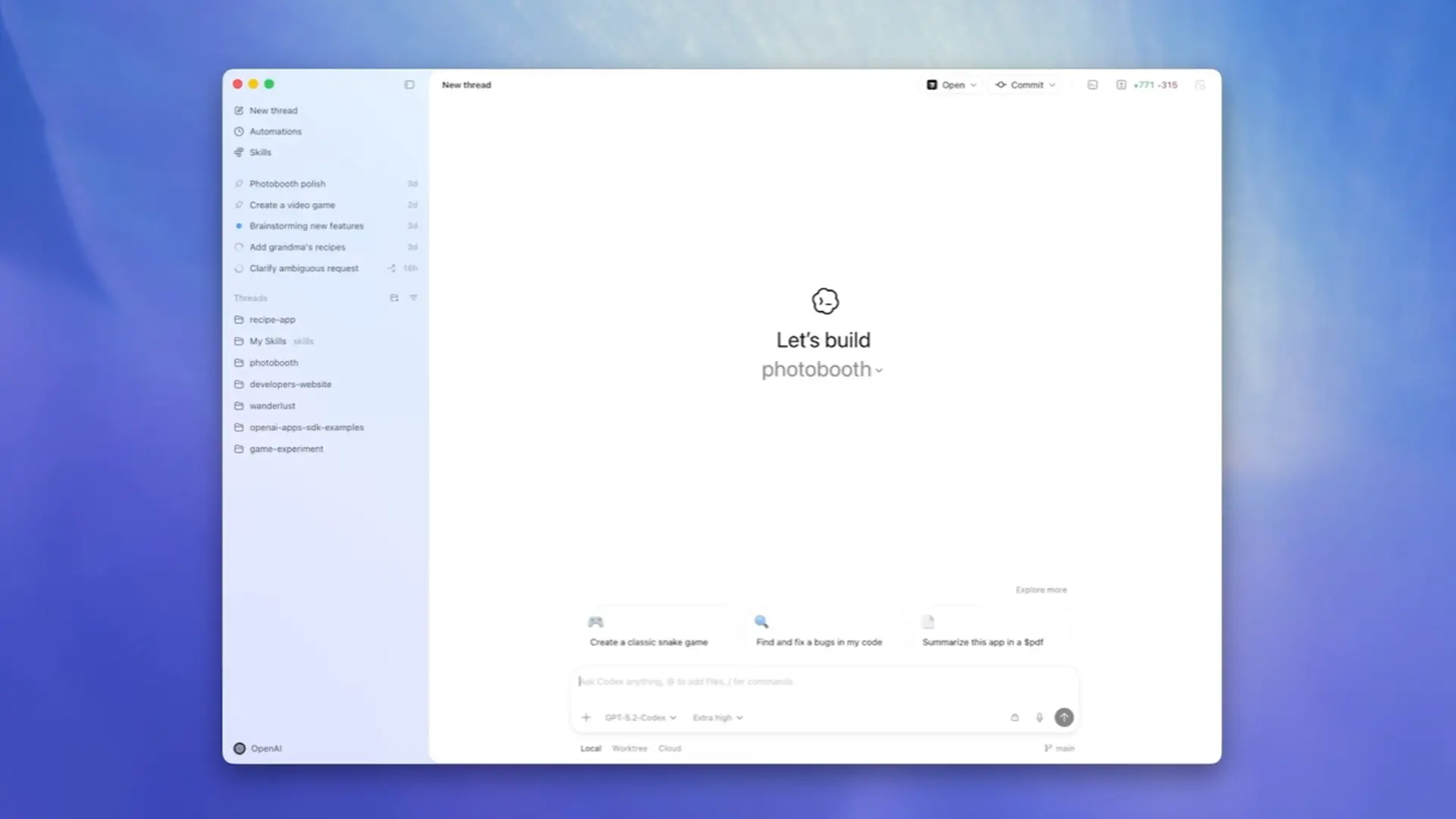
Today, OpenAI released Codex, its ChatGPT-powered coding tool, as a macOS app. Until today, users had to find alternative ways, mostly through a command-line interface (CLI) on the web, to use it.
Codex is OpenAI’s native tool for building and managing AI agents and “vibe coding.” It’s the company’s entry into the agentic AI race, as it’s trying to catch up with Anthropic’s Claude Code, which currently dominates the AI coding market.
OpenAI describes Codex as “a powerful new interface designed to effortlessly manage multiple agents at once, run work in parallel, and collaborate with agents over long-running tasks.”
Codex runs separate threads organized by projects, which means you can simultaneously work on multiple agents. Or even better, multiple agents can work on different parts of the same project without interfering with each other. The Codex macOS app also works in sync with IDEs, and the Terminal, so you can maintain context across multiple environments you’re working in.
Codex also supports Skills, which are special folders containing instructions, scripts, and resources that agents can use to perform specialized tasks like automated code reviews. You can use pre-made skills or create your own skills in a dedicated interface inside Codex.
OpenAI is celebrating the release of Codex for macOS by doubling the rate limits for all Plus, Pro, Business, Enterprise, and Edu subscribers and making it available to ChatGPT Free and GO users for a limited time.
The company has been busy with software releases lately, as it also introduced Atlas, its new AI-powered browser, a few months ago. However, OpenAI is facing constant pressures - experts predict a $14 billion revenue loss in 2026, and its biggest potential investor, NVIDIA, is reevaluating its decision to invest over $100 billion into the most valuable, private startup in the world.
You can download the official Codex macOS app on OpenAI’s website. OpenAI has yet to release the Windows version.
Source: OpenAI