Back in January, OpenAI announced Prism, an AI-native workspace designed for scientific writing and collaboration. Instead of jumping between multiple tools—including text editors, PDFs, LaTeX compilers, reference managers, and chat interfaces—to write a new scientific paper, researchers can use Prism to handle LaTeX editing, citations, figures, and real-time collaboration in one unified location.
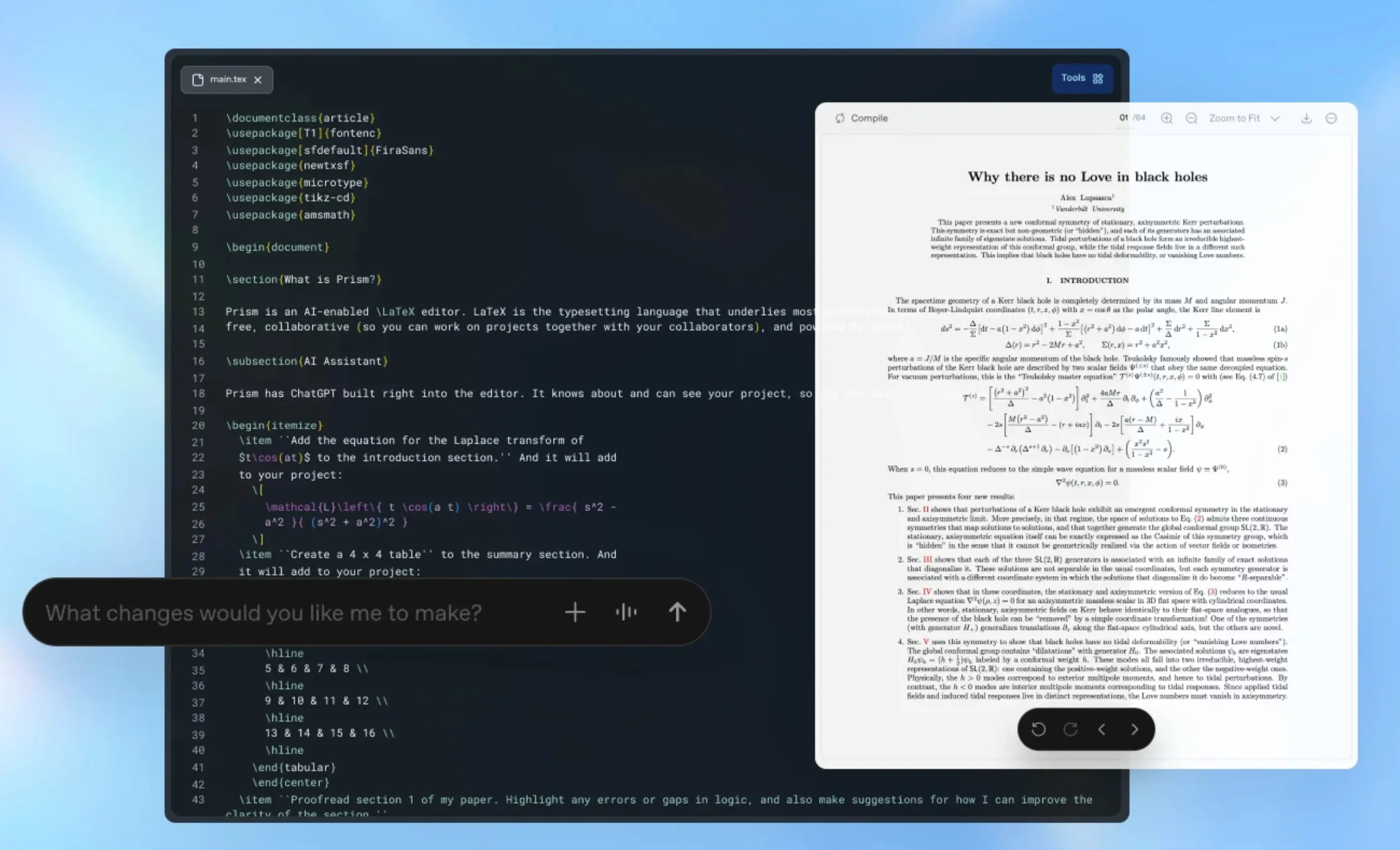
Today, OpenAI announced a major upgrade to Prism with Codex CLI integration. With this new update, researchers can now run code, compile large LaTeX projects, analyze data, generate figures, and refine documents without leaving Prism. Prism can now execute tasks, inspect the generated output, and refine the results automatically through "compile -> inspect -> revise" loops.
🧵1/ We"ve brought the most advanced AI to Prism by introducing Codex to Prism. Prism is already the best place for scientific writing to happen—and with Codex, now you can write, compute, analyze, and iterate all in one place. pic.twitter.com/cDCLYCj7tR
— Victor Powell (@vicapow) March 4, 2026
When Prism was launched in January, it was powered by the GPT-5.2 Thinking model. Now, OpenAI has upgraded the model to GPT-5.3 for improved performance. Thanks to the Codex harness, Prism is now said to handle longer-running and complex research workflows through improved context and memory compaction.
An OpenAI spokesperson highlighted the following about Prism"s latest upgrade:
"Designed for large, multi-file research projects, the system supports persistent sessions, direct file access, and longer-running tasks—helping scientists move more quickly from raw data or ideas to a finished paper while maintaining full control over their work."
OpenAI mentioned that it will continue to improve Prism with new capabilities for common research workflows and will also integrate it with popular tools scientists already use. Prism is now available globally for ChatGPT Free, Go, Plus, and Pro users.
As OpenAI continues to integrate Prism with existing research tools, the barrier to create academic papers will likely continue to shrink.