Outside of the heavy hitters, 2023 had some iconic indie game releases ranging from retro-inspired RPGs to addicting rogue-likes. After playing most of these titles, one of my favorite indie releases of the year was Planet of Lana, a puzzle platformer from a debut studio that delivered a gorgeous world full of nature but also otherworldly creatures and robotic kidnappers. Three years later, developer Wishfully is back, and it has a brand-new installment, aptly titled Planet of Lana II, to continue the sci-fi story and expand on almost everything the original offered.
Once I dived into the early review copy the publisher Thunderful provided in February, it was a difficult task to break away from the adventure. Its environments, puzzles, and quiet moments were a joy to play through. Surprisingly enough, I managed to finish the game within a couple of sessions.
I have tried to minimize mentioning the first entry. Even if you haven’t played the original, the studio says that the sequel can be enjoyed as a standalone game. Thanks to the recap video at the start of the game, this is largely true. It also helps that the series is focused on visual storytelling in a world where answers to questions are mostly thought of by the players themselves.
Keep reading for my full review of Planet of Lana II: Children of the Leaf. I have tried to keep spoilers to a minimum to keep the narrative intact, with only broad descriptions given for story beats and discoveries.
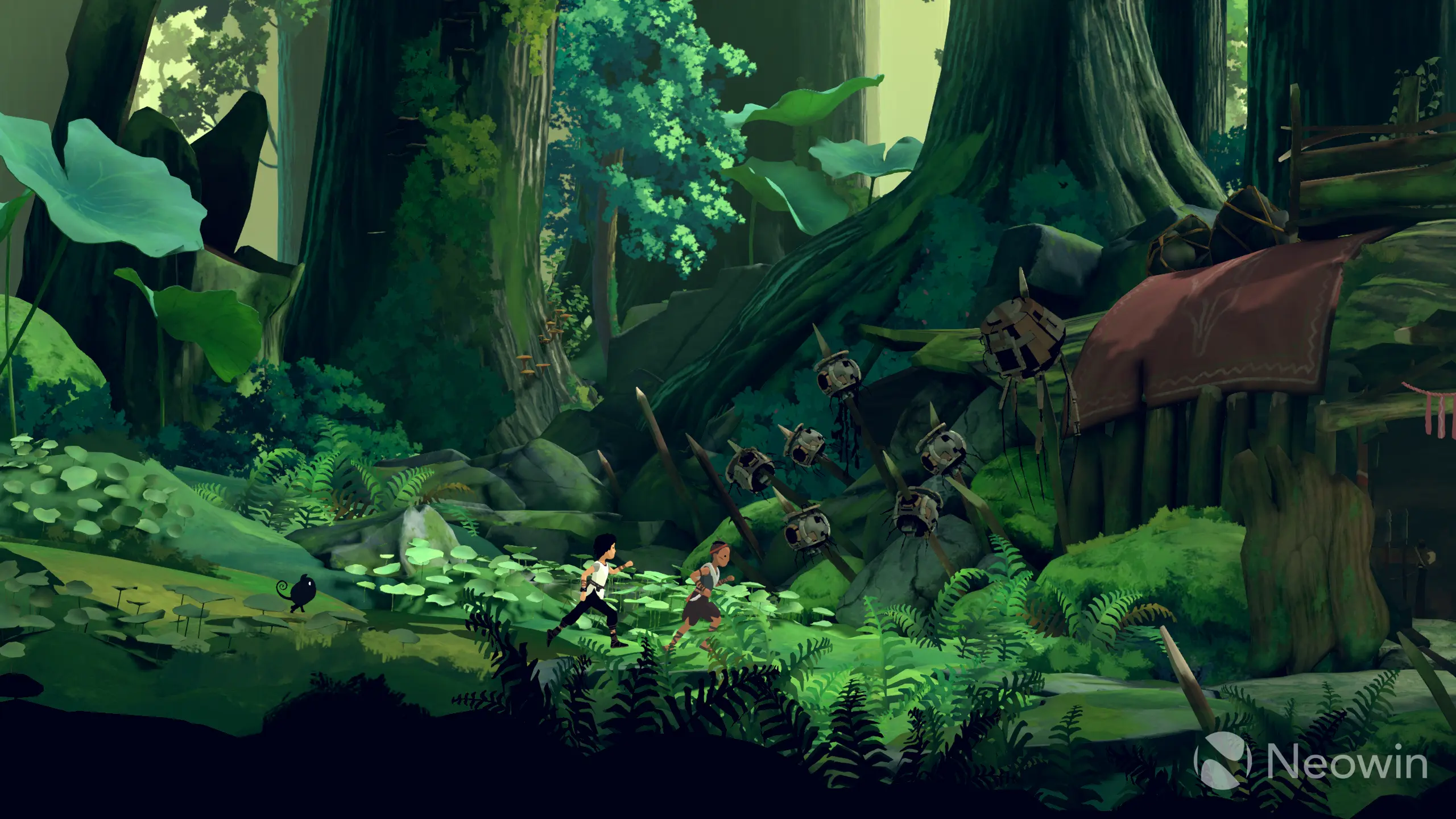
Lana and Mui
The first thing I have to say about Planet of Lana II is that it’s simply gorgeous. Playing the tutorial can give a false expectation of this being a game full of cramped, dark environments. Soon, the surface of this alien but earth-like world is revealed, and it’s breathtakingly beautiful. The rolling hills in the background, deep forests, and the quaint homes of a small village populate this lively part of the world. At the same time, mysterious but friendly robotic helpers are being used by the village inhabitants for tasks like fishing or pulling cargo, but with an old-world flair. Not every human faction in the storyline uses these machines to live harmoniously with nature, however, which I get to see as the story expands outward.
There are two protagonists. Lana is a human girl from a simple village, someone who doesn’t think twice about diving into danger if it involves a loved one. In fact, the vast part of the story has her traveling across the world to find a cure for a small child who has fallen ill. Her companion is Mui, a small cat-like being that is both ancient and highly advanced, offering sci-fi magic to help Lana in her journey while being wildly cute while doing so.
When controlling Lana, the side-scrolling adventure has the standard platforming setup. There are things to climb, things to press, things to avoid, and most importantly, things to properly time. Controls are satisfying and tight here, and I don’t think I ever blamed the game for a mistimed button press or the character not doing something I wanted it to do. The handful of chase sequences present in Planet of Lana II were a big highlight for me, with fast decisions, gorgeous backdrops, and tense music making for iconic levels. There are large swimming sections sprinkled here as well, which pose an interesting twist because Mui does not like the water at all. Lana has to find waterproof methods to get her companion through these levels, which helps tremendously to not keep platforming or puzzle levels from being too monotone.
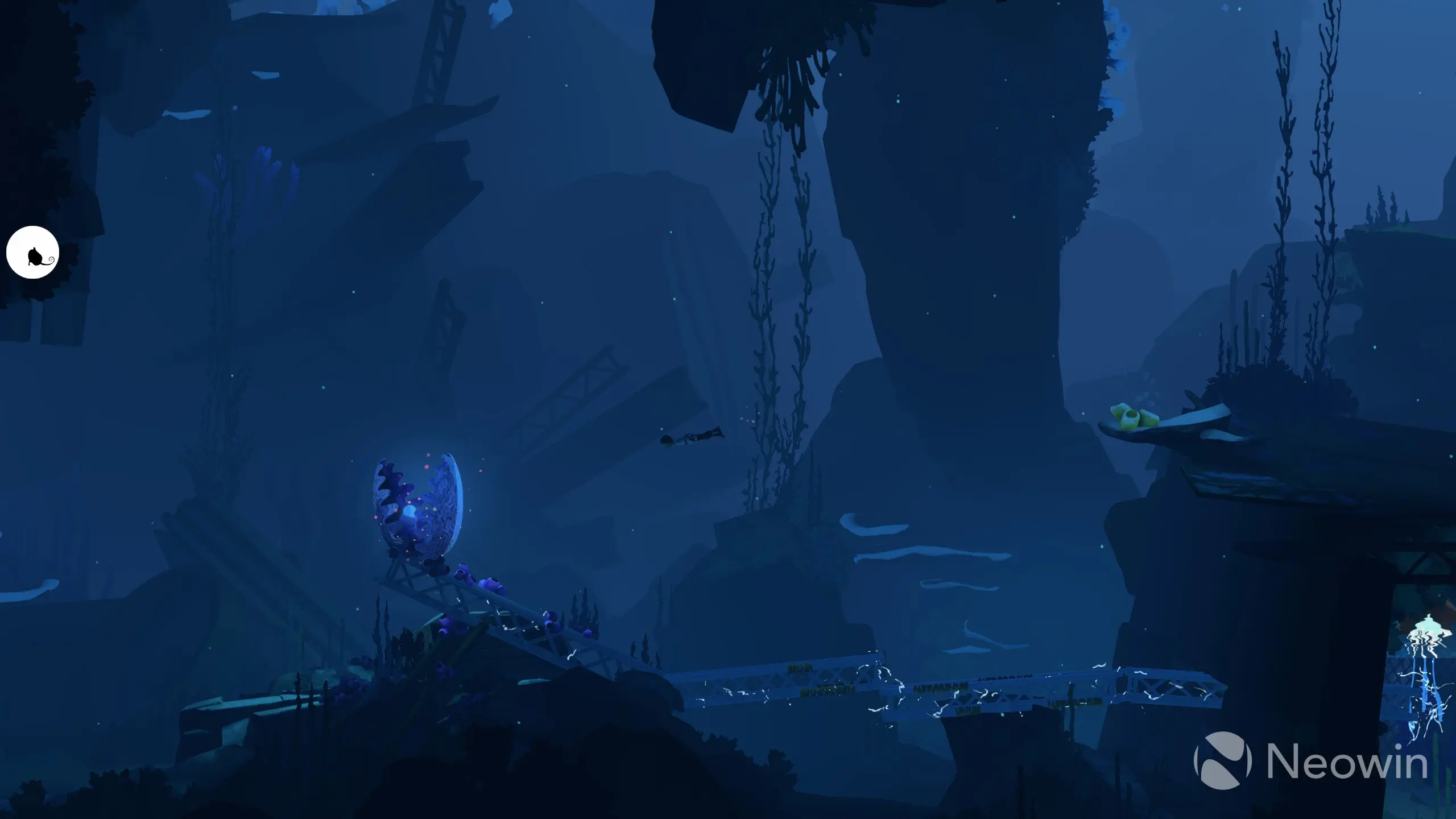
It’s Mui’s gameplay that makes the puzzle half of the game interesting, with machine and animal-control powers adding to the formula. Most mechanical elements and powered items can be activated/deactivated or outright remote controlled by positioning Mui at the right places. Combat is not an option, so getting past each level means controlling both characters to time their actions properly. It sounds tricky to keep track of two characters and work out when to use their actions at the right time, but the studio almost never had me scratching my head for too long or getting frustrated with failures. The points on the screen that need attention are always in sight, and never in multiple places, so the characters themselves become the controls for solving puzzles instead of individual elements that need constant attention.
The little critter can be controlled independently with a pointer system. It’s not the fastest way to control a character. I frequently had to wait for the cursor, controlled by the right joystick, to reach different points on the screen. At the same time, there aren’t any high-stakes sequences involving Mui’s movement controls, so it’s not an issue. Thoughtfully, the developer has also implemented small pathways that Mui can use automatically to catch up to Lana when she gets past an obstacle or level, getting rid of any extra fiddling around. I appreciate it when a puzzle game doesn’t cheapen a good level solve with a "but wait, there’s more!”
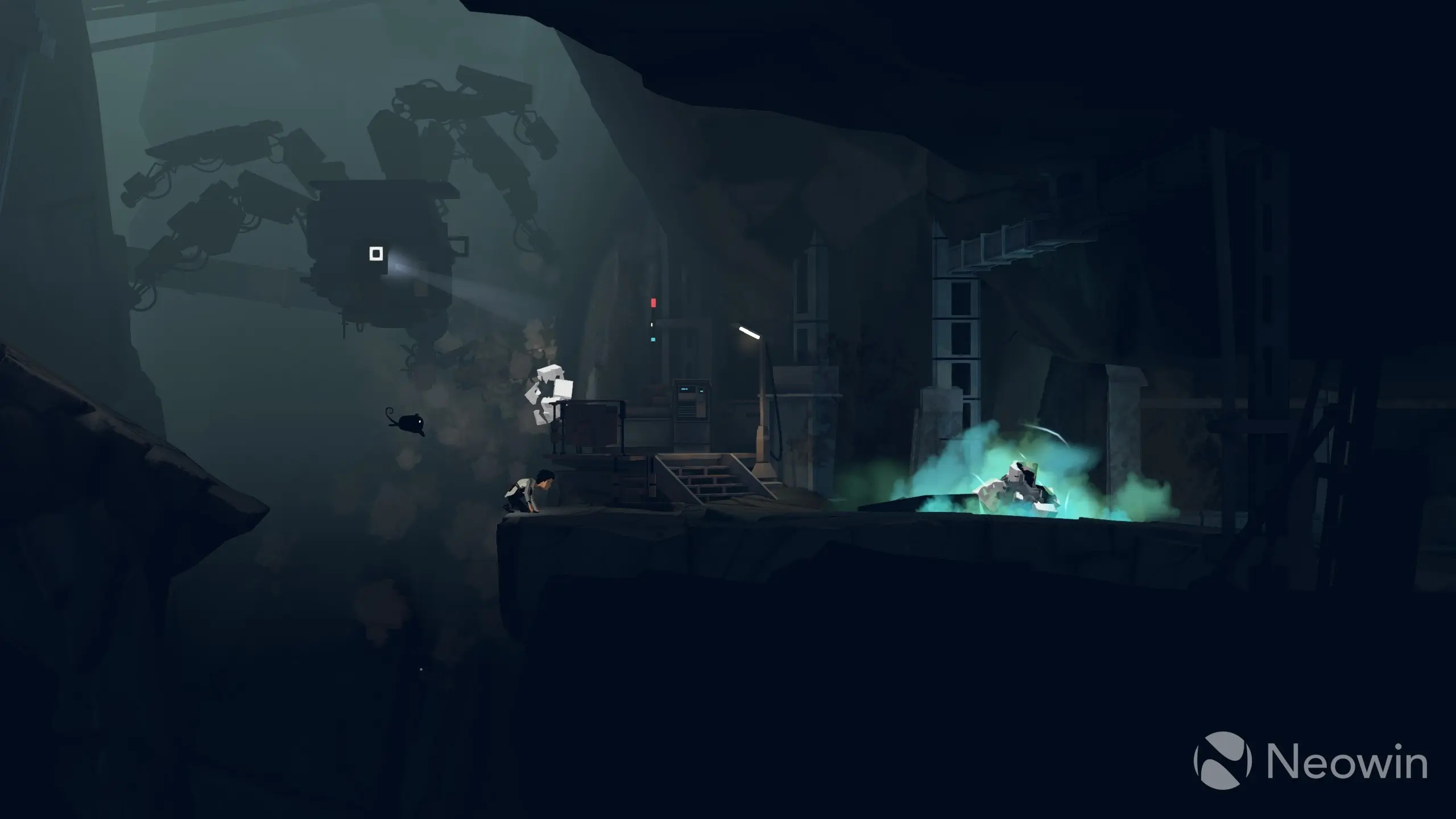
As for Mui’s special ability of controlling specific animals in the world, this can be things like speedy fish that can emit smoke screens or wall grabbing soot balls for transporting fire. These parts I wasn’t the biggest fan of, as the gameplay switches entirely to accommodate the available critter, with its own platforming puzzles. I found that sometimes they can drag for a little too long from needing very tight, timed movements in small spaces.
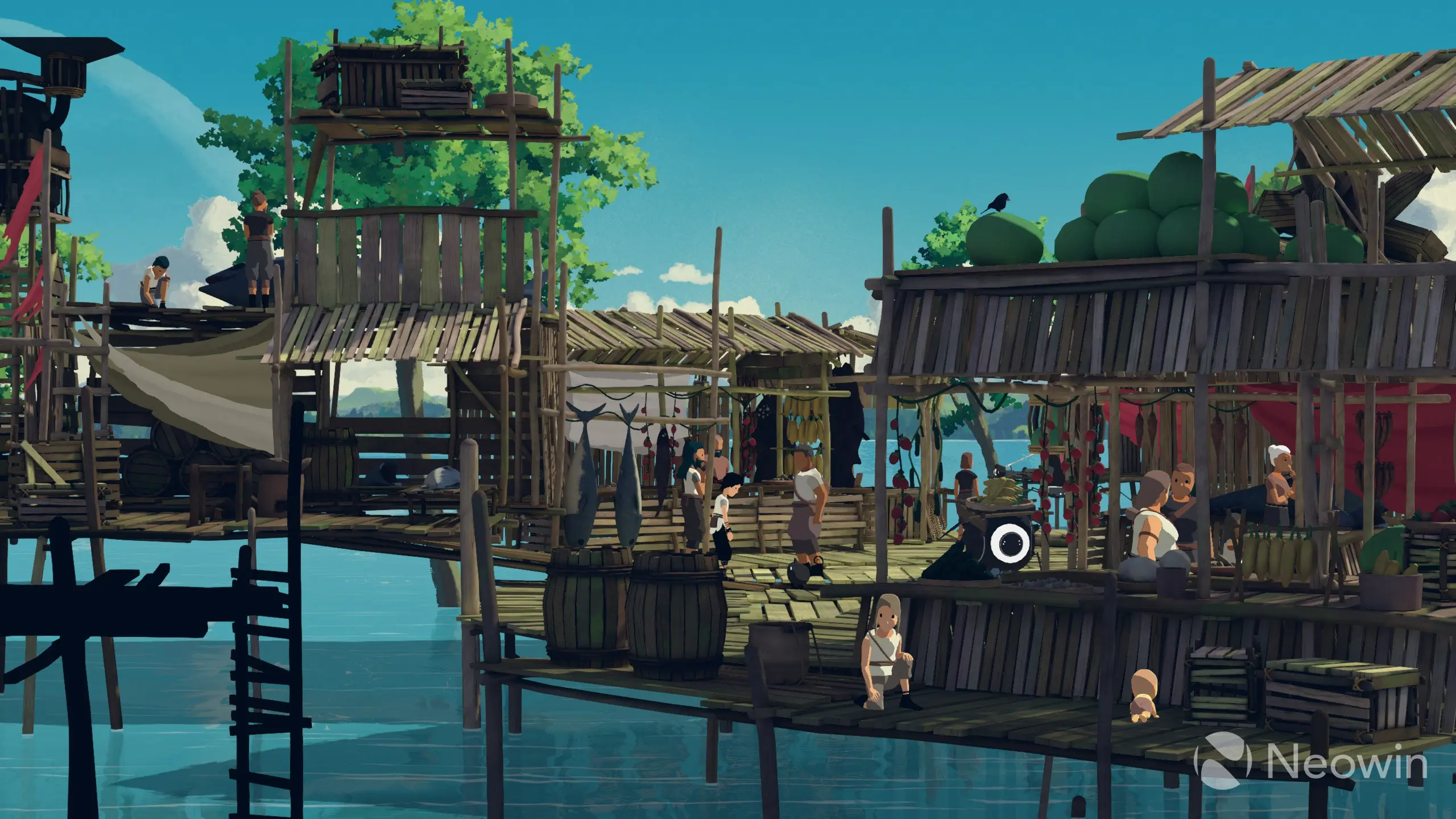
Charming and Reactive
Open the indie section on any gaming platform, and you’ll find dozens of side-scrolling platforms releasing every week. But Wishfully’s Planet of Lana series is one of the few that can stand out from the pack even if you were just browsing. It’s not only the hand-painted visuals that set it apart, but also the depth of every scene that makes it look like a painting come to life. I do not think I saw any outlines on any background, foreground, or character art. Every scene is textured, positioned, and lit by the development team to somehow highlight just the right things.
Lana and Mui fly through thunderstorms, brave through dangerous icescapes in distant lands, explore massive structures that have been buried underwater, and visit villages with their own cultures and customs. Some flashback scenes also present a look at the pristine machinery and structures, from what seems to be centuries ago, that I had been exploring throughout both games, adding another element to the continually impressive artwork.
There are no moments of losing sight of characters or dangers. Even the slightest distant movements are highlighted with great scene direction. Lana and Mui are used masterfully for this by the studio. They look towards important things happening on screen, usually with a gasp or a yelp, instantly drawing my eyes towards whatever is happening. The developer is masterful at this.

The twist is that none of the characters in this game actually speak a real language, with communication happening via The Sims-style conversations between humans and musical tones between robots. There aren’t even any subtitles. Even without an understandable language, what’s surprisingly well done is the expressiveness that still comes through. The amount of life that the studio has managed to cram into the “2D” characters with gestures, posture, and tone of voice is impressive, to say the least.
One of the most difficult things about this review was choosing what screenshots to embed. Almost every scene the game puts you through is gorgeous. I remember being impressed with the first game"s art direction, which gave environments primarily focused on forest landscapes coupled with futuristic robot designs. The sequel ramps up those factors and adds in fresh biomes from across the alien planet, flexing the studio’s hand-painted scenes full of nature and technology.
The sound design is another high point. The series composer Takeshi Furukawa, the award-winning talent behind The Last Guardian, has held nothing back from the grand orchestral soundtrack of Planet of Lana II. I was instantly transported back to the original game’s adventures when I heard the tiniest familiar tones at the start of the sequel. It flows into both the moments that need no descriptions as well as action-packed chases without ever being out of place. As a specific plus for me, music also serves as a major element of this universe and its occupants, and those exact tones are what the main musical theme of the game is built upon. I have always been a big fan of having an easily recognizable melody being attached to a piece of art.
Conclusion
Wishfully has knocked it out of the park with this sequel, offering beautiful environments that almost pop out of the screen. The masterfully animated characters, who use gibberish language to boot, manage to show more emotion in this side-scrolling adventure than most high-profile AAA games. I can’t compliment the sound design and soundtrack enough either. The protagonist duo’s adventures have them diving through real dangers, both natural and artificial, all the while making new friends, meeting new enemies, and discovering wondrous mysteries.
Looking back at the puzzles, I felt that the ramp-up of the difficulty was carefully controlled. The game doesn’t introduce a new mechanic with a never-before-seen puzzle and instead reuses items so that players can get familiar with their newfound abilities or revelations. This is a point that many puzzle games fail in my experience, but I don’t think Wishfully has managed to not fall into that trap of making seemingly “ingenious” puzzles that are simply Googled by their players at the end.
I do not mean every level was a masterpiece. But for at least 75% of the game, I instantly knew what had to happen to pass the level and had a good time spending a few minutes to work through the needed steps. The few levels that did get a little frustrating were due to the mind-control animal sections, where the long stretches of timed level navigation can get a little tiring.
The one point I would give as a negative for Planet of Lana II would be its length. The developer has repeatedly called this a longer experience than the original, calling it a 6-8 hour story. I managed to finish it in just five hours, which was the same amount of time it took me to go through the first game. This was at a casual pace too, where I was looking for secrets and not skipping cutscenes. The credits rolled at a point when I thought there would be another half of the game remaining.
With that said, for the asking price of $19.99, Planet of Lana II: Children of the Leaf gets a big recommendation from me. I hope to see the studio explore more of this universe, and even more Mui shenanigans, in the future.
Planet of Lana II: Children of the Leaf is releasing on March 5, 2026, on PC, Xbox Series X|S, Xbox One, PlayStation 5, PlayStation 4, Nintendo Switch 2, and Nintendo Switch for $19.99. It will also be a part of Xbox Game Pass.
This review was conducted on a pre-release PC copy of the game provided by the publisher.