Canonical has reported started redesigning the series page of its venerable software collaboration and PPA hosting platform, Launchpad.
In the original Discourse post announcing the redesign, UX designer at Canonical Enzo Deng, referred to this redesign as the start of "the journey of modernizing the Launchpad user experience." He promised that this is just the "first milestone" in a planned revamp of the entire Launchpad web app.
For many, the classic Launchpad interface is a reminder of the early days of the project. However, we know that for many contributors, that same interface has become a source of friction. Managing complex tasks should be as intuitive as the operating system itself, not a legacy challenge. We recognized that to better support the community, we needed to bridge the gap between Launchpad’s powerful backend and a modern user experience
Here"s a before and after of what the series page looked like:
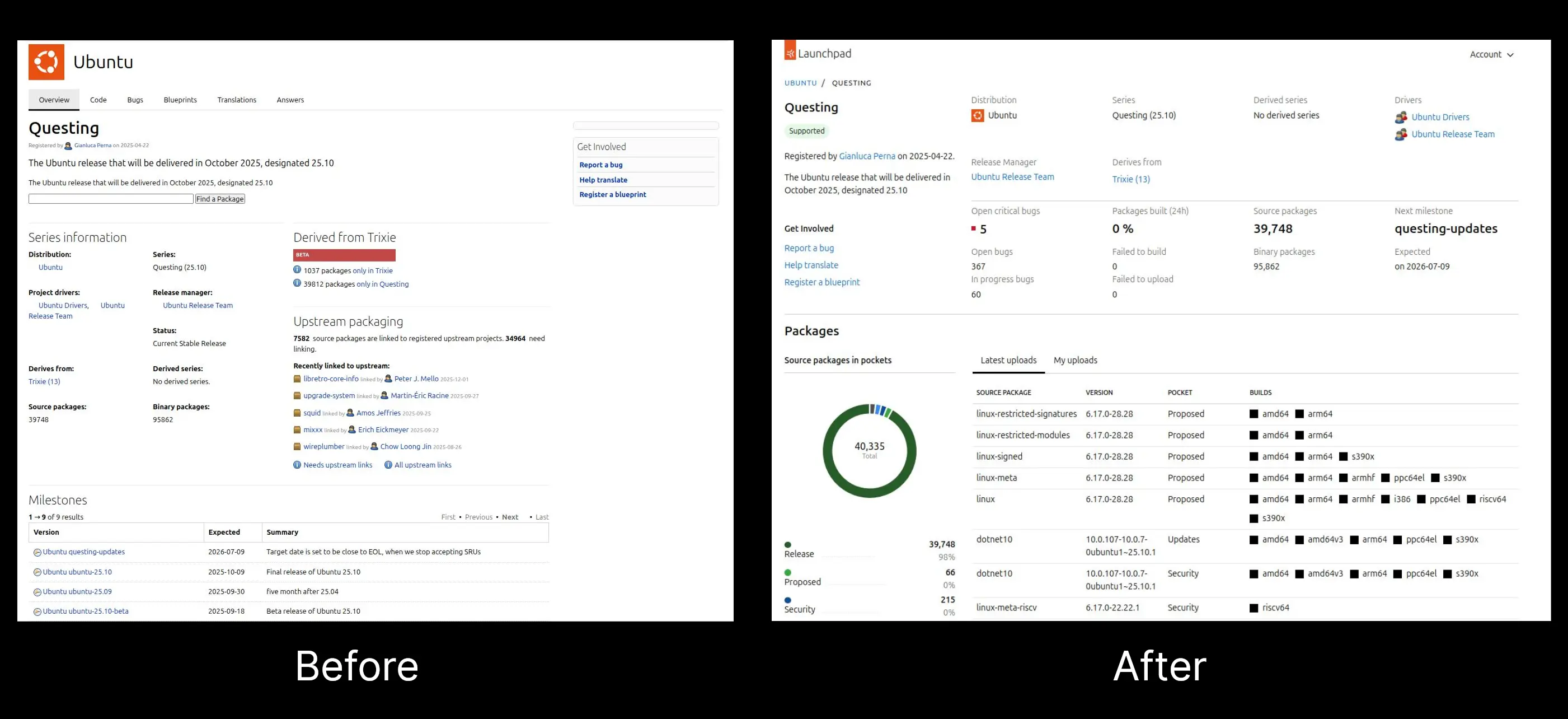
Two years ago, Canonical redesigned the Launchpad home page, bringing the platform"s fonts, button styles, padding, and color schemes in line with Canonical"s other web properties. The change gave the landing page a modern, new look and introduced proper mobile responsiveness.
Launchpad was created 22 years ago, with its super-popular Personal Package Archive (PPA) service going live in late November 2007. For a long time, the platform"s focus on Canonical"s own in-house version control system, Bazaar, kept many developers on other platforms like GitHub. The company eventually added Git support in 2015. In September last year, Canonical completely discontinued Bazaar hosting, forcing all remaining repositories to fully migrate to Git.
Because anyone can create a PPA, the Launchpad PPA system has frequently been criticized as a security vulnerability for Ubuntu users. Bad actors can host malicious packages that overwrite core system files if an unsuspecting user adds the wrong software source.
The platform used to allow GPG keys for PPAs to be signed using RSA1024, a weak encryption standard that had been deprecated for years. But in 2024, Canonical began migrating PPAs toward stronger signing keys like RSA4096.