At the ongoing CES 2026 tech extravaganza this year, AMD announced a bunch of new hardware while also touting superior performance and AI capabilities. Among these reveals were the latest Ryzen 400 AI series, new Max+ processors that are seemingly miles ahead of the competition in terms of benchmarks, the Ryzen 7 9850X3D as the "world"s fastest gaming processor", and a major update to its Radeon Open Compute (ROCm) software stack.
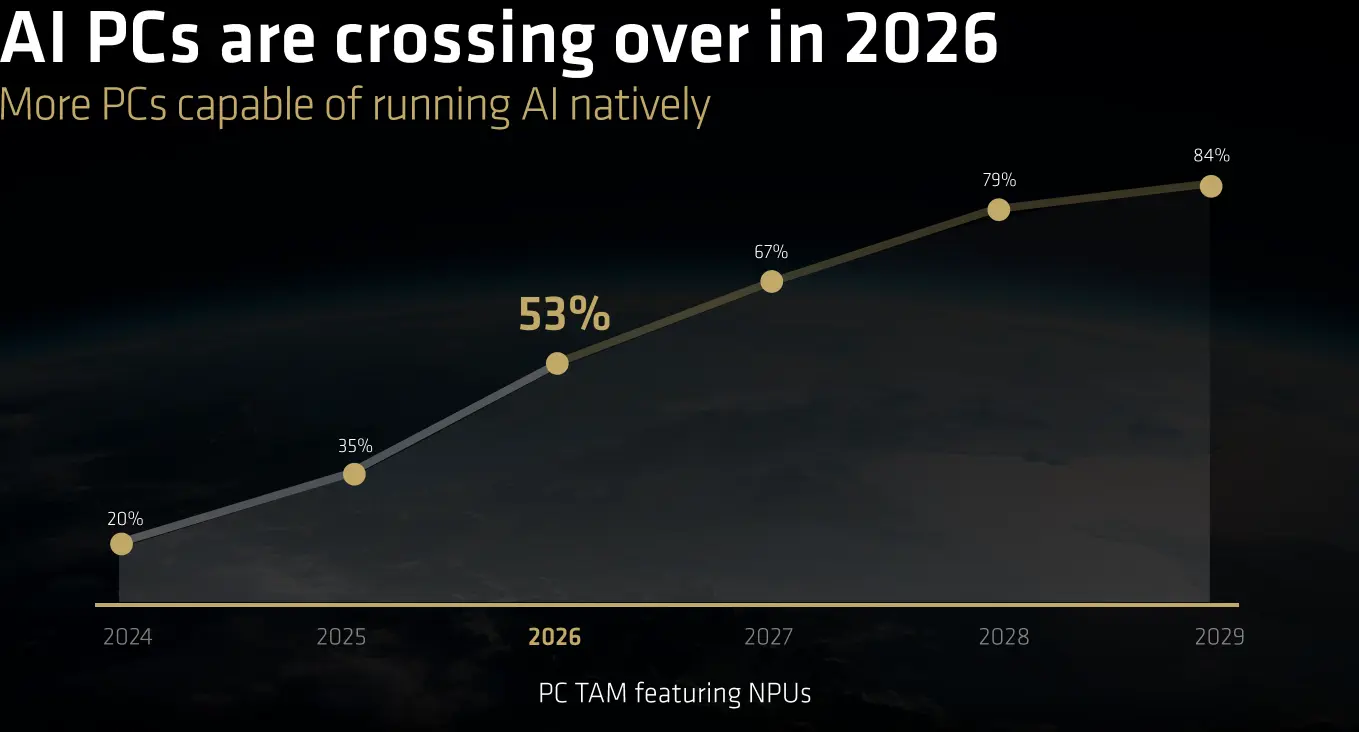
It"s clear that AMD believes that the future is all about AI, with the firm indicating that AI PCs will overtake the computing landscape in 2026, with 53% of PCs capable of running AI processes natively through Neural Processing Units (NPUs). It expects this number to grow to 84% by 2029.
To that end, it has announced that it is "expanding" its AI experiences through partnerships with firms like Adobe, Affinity, Epic Games, Blender, and more. An example of this is its collaboration with the Liquid AI platform, which enables custom models to run locally on Ryzen hardware so that there are no cloud fees or limitations.
AMD also announced a Personal AI Finance Manager as a free download for Ryzen AI processors. It offers flexible agents in a secure and private environment, without any subscription fees. Similarly, it has released a Personal AI Coach too, which can guide customers on nutrition and fitness, all while running completely locally.
Team Red claims that local models like GPT-OSS 120B running on local Ryzen AI Max+ hardware give powerful models on the cloud like ChatGPT o4 Mini a good run for their money, which means that local inference is pretty much a reality at this point. This is important for those who are conscious of the privacy risks associated with running AI models on the cloud, along with paying subscription fees.
Finally, AMD reminded gamers that its AI gaming hardware supports machine learning-powered FSR Radiance Caching too. For those unaware, this is a technology meant to speed up ray tracing in games by caching reusable ray-traced lighting effects. Frame Regeneration is in tow as well; it is an improvement upon the previous Frame Interpolation technology which did not use AI to do pixel processing. Together, all of these FSR "Redstone" advancements should present rather stiff competition to Nvidia.