
Alongside new hardware launches of the Ryzen AI 400 series, Ryzen 9850X3D, and new Max+ SKUs, AMD at CES 2026 today has expanded ROCm support across Windows and Linux, boosting AI performance in Ryzen and Radeon platforms.
The announcement is a major update to its ROCm (Radeon Open Compute) software stack, the open-source alternative to Nvidia"s CUDA, as the company today has debuted ROCm 7.2 with expanded platform support and significant performance gains, especially for AI workloads.
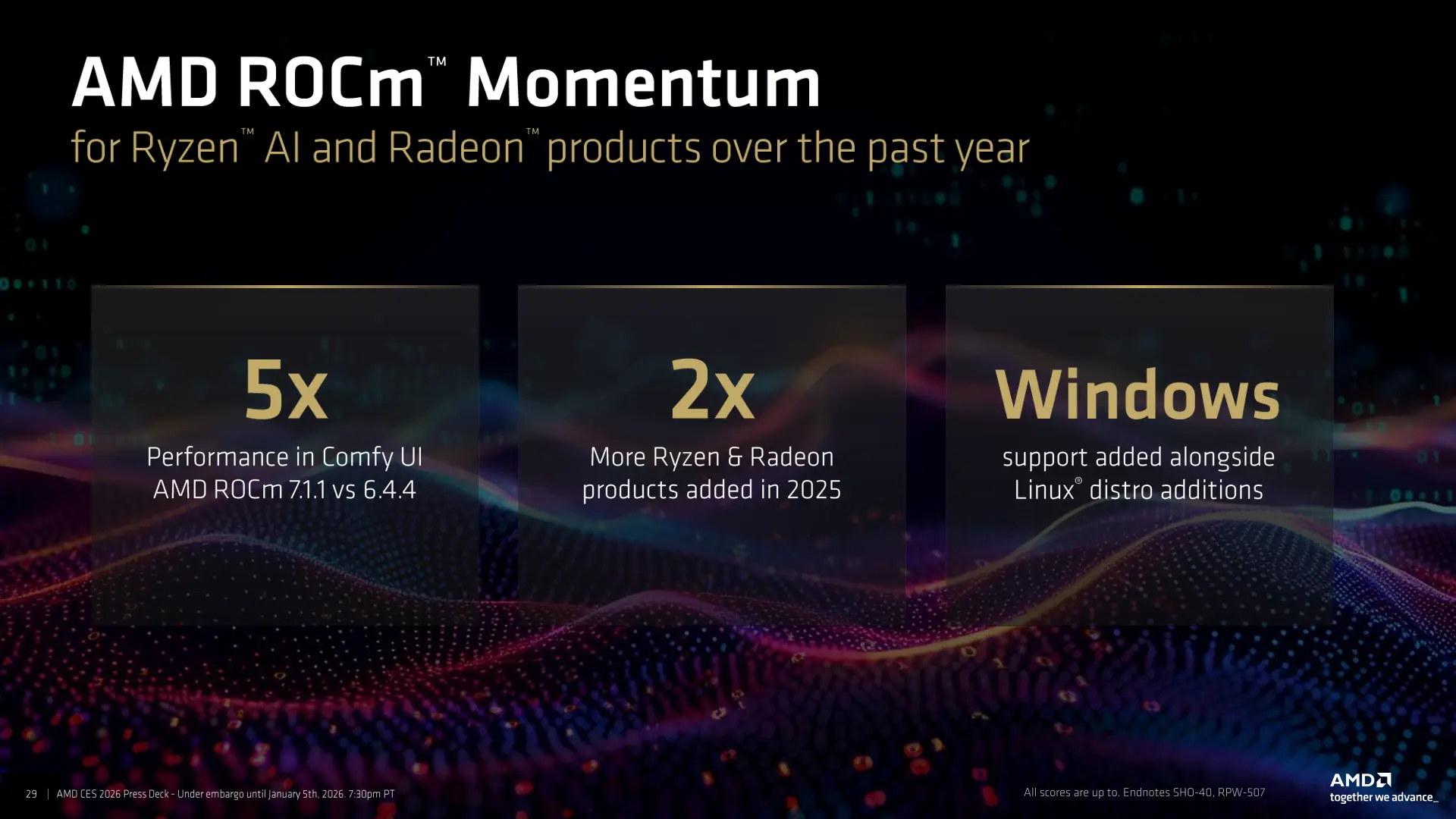
The biggest headlining feature is that ROCm 7.2 supports both Linux and Windows environments, a notable shift from its historically Linux-centric deployment. AMD also confirmed compatibility with its latest Ryzen AI 400 processors and Radeon AI PRO GPUs.

At its keynote today AMD stressed how ROCm has evolved rapidly over the past year as the ROCm 7.1.1 release delivered up to 5X performance uplift compared to ROCm 6.4.4 across key AI models. According to first-party benchmarks from the company, we see SDXL (Stable Diffusion XL) running 2.6 times faster and Flux S achieving a 5.2 times speed-up on Ryzen AI Max processors. Meanwhile, the WAN 14b model sees a 5.4X boost on Radeon AI PRO R9700 GPUs.
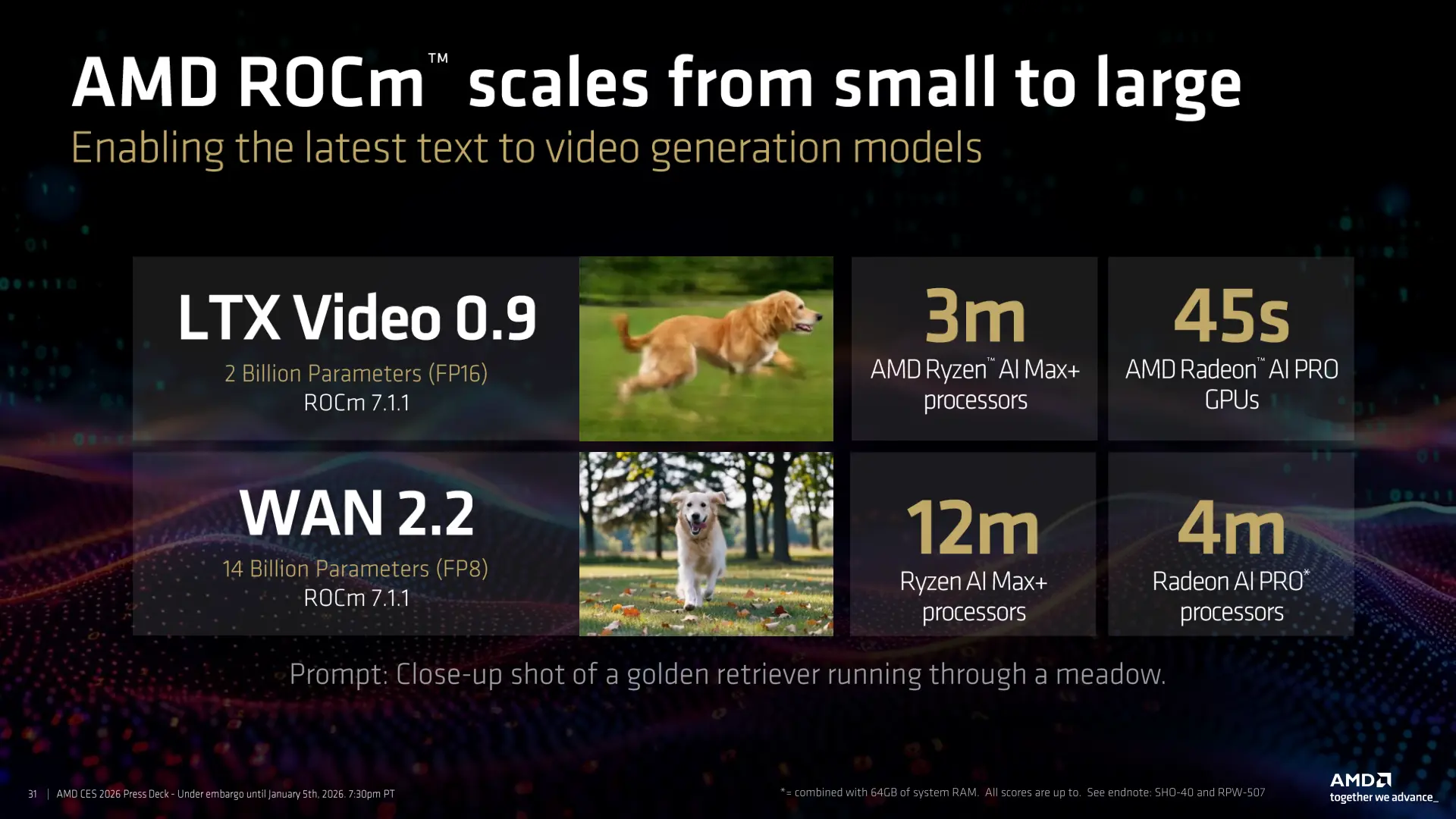
AMD also highlighted ROCm’s scalability in powering text-to-video generation models. LTX Video 0.9 (2 billion parameters, FP16) and WAN 2.2 (14 billion parameters, FP8) are now supported under ROCm 7.1.1. AMD claims generation times as low as 45 seconds on Radeon AI PRO GPUs and 4 minutes on Ryzen AI Max+ processors, when paired with 64GB of system RAM.
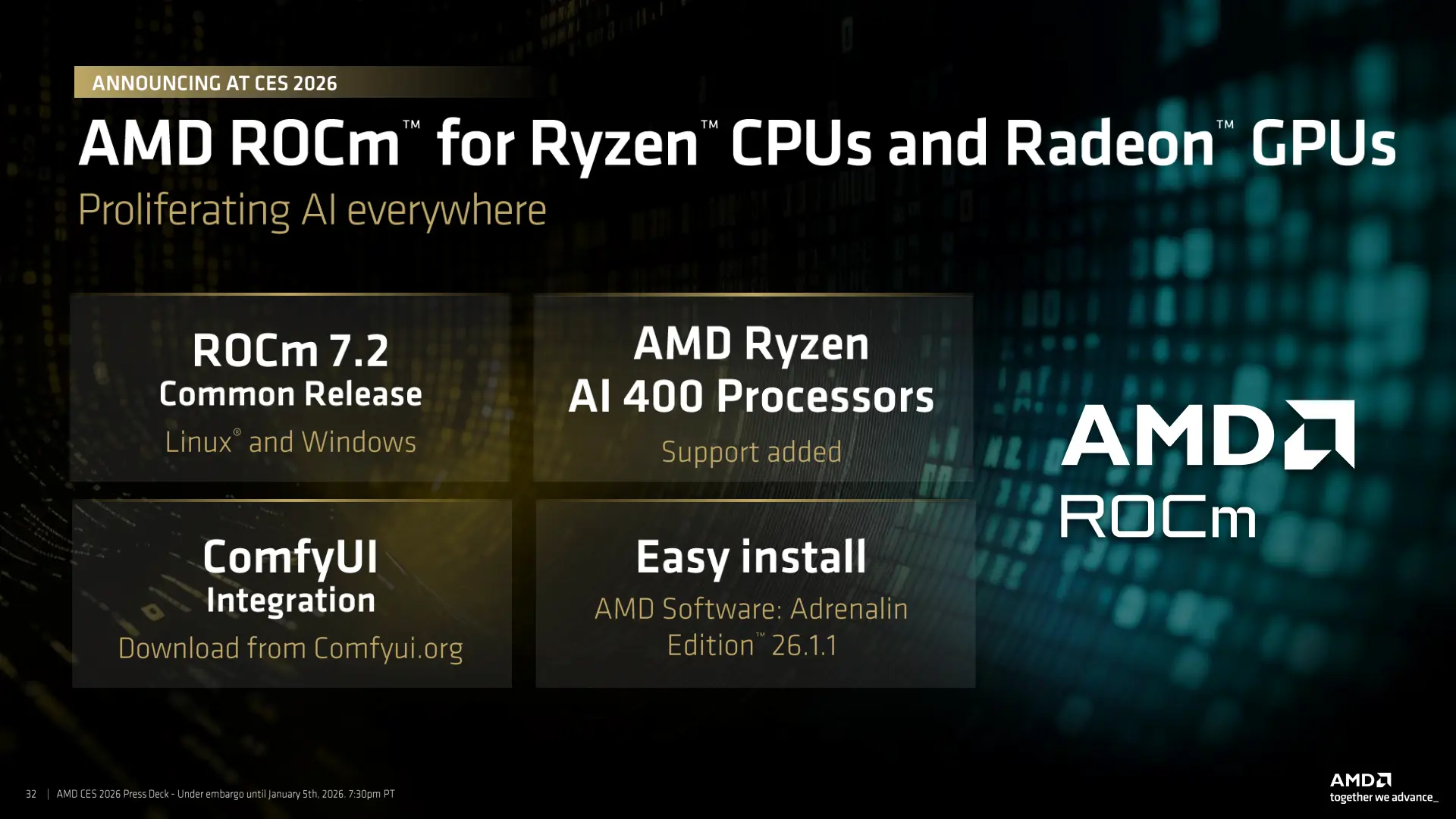
ComfyUI, a popular open-source interface for generative AI workflows, is now integrated with ROCm and available for download at Comfyui.org. Users can install the full ROCm stack via AMD Adrenalin 26.1.1 Windows driver.