
Google announced it is laying a new transatlantic subsea internet cable between the US and Europe, called Sol. The name of the fiber optic cable is derived from the Spanish and Portuguese word "Sol," which translates to "sun." It represents the cable system"s landing points in warmer climates.
The new subsea cable will connect the US state of Florida, Bermuda, the Azores, and Spain. Palm Coast in Florida will serve as the anchor point in the US, where Google will partner with DC BLOX to land the cable and create a new connectivity hub.
Google will then create a terrestrial route to link Palm Coast to its South Carolina cloud region. In Spain, the search giant will land the cable in Santander and connect it with its data centers in Madrid.
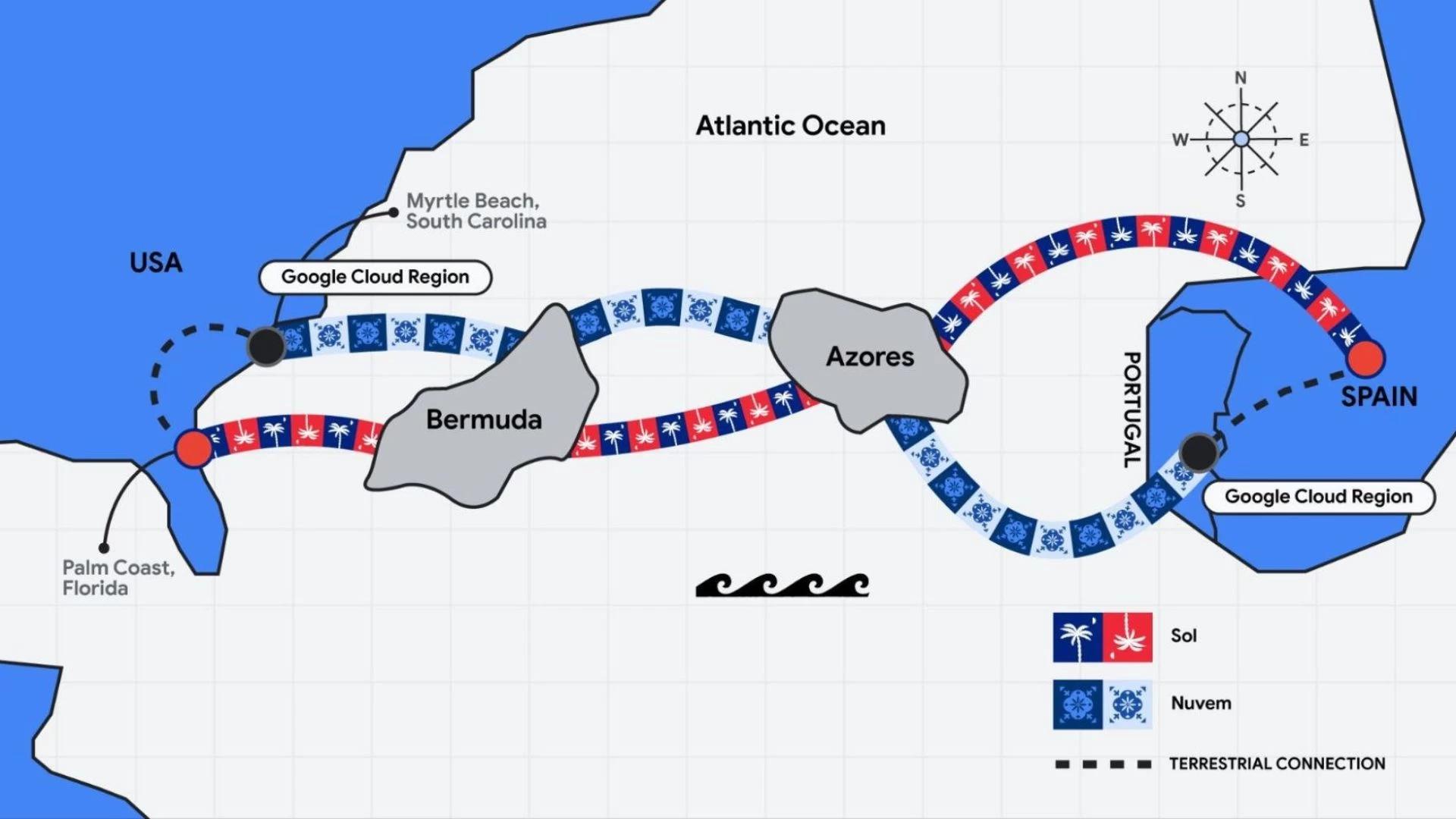
The search giant said that Sol will be manufactured in the US and will enhance the capacity of its data center network, comprising 42 Google Cloud regions. It will run in parallel with the previously announced Nuvem subsea cable, which connects South Carolina, Bermuda, the Azores, and Portugal. Nuvem is expected to be operational sometime in 2026.
When it launches, Sol will be the only in-service fiber-optic cable between Florida and Europe, as per the company. Its Palm Coast Cable Landing Station (CLS), being built on 20 acres of land, is expected to be operational by Q1 2027.
Google notes that the upcoming transatlantic subsea cable "will add capacity, increase reliability, and decrease latency for Google users" around the world. However, it hasn"t dropped any official word about the bandwidth or capacity of Sol.
The upcoming subsea cable will complement Google"s other cable systems like Equiano (Europe to Africa), Firmina (US to South America), and Grace Hopper (US to the UK and Spain). It"s interesting to note that Google is associated with over 30 submarine cable projects and owns several of them.
While it"s not a new concept, laying cables underwater is a growing trend among leading tech companies that aim to build data center networks and create more bandwidth for new AI-powered features. Microsoft and Meta have also been in the game for several years. Meta is investing billions of dollars in a new 50,000 km internet cable that will wrap around the world.