
After several delays, OpenAI today announced the release of gpt-oss-120b and gpt-oss-20b, two open-weight language models that deliver strong performance when compared to other open-weight models on reasoning tasks. OpenAI claims that these models are optimized for efficient deployment on consumer hardware.
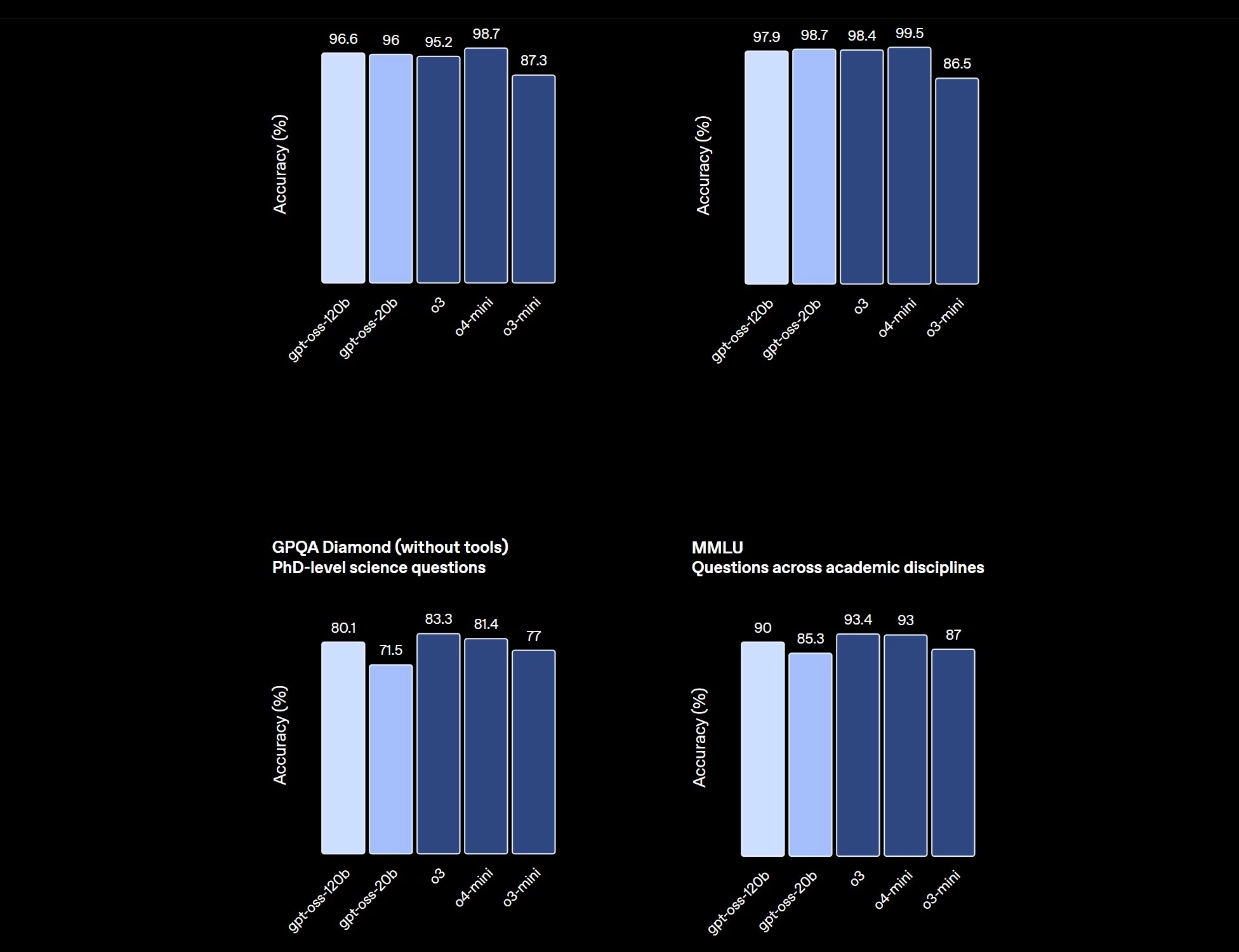
The gpt-oss-120b is the larger model and offers performance on par with o4-mini while running on a single 80 GB GPU. The smaller gpt-oss-20b model performs on par with o3‑mini on common benchmarks while running on devices with just 16 GB of memory. This makes it an ideal choice for on-device AI applications.
Apart from reasoning performance and low hardware requirements, these models perform strongly on tool use, few-shot function calling, CoT reasoning, and HealthBench. Similar to other OpenAI models, these open-weight models are compatible with the Responses API. Since safety is very important for open models, OpenAI has introduced an additional layer of evaluation by testing an adversarially fine-tuned version of gpt-oss-120b.
Developers can now download the weights for both these models on Hugging Face, and they come natively quantized in MXFP4. OpenAI is also open-sourcing a harmony renderer in both Python and Rust to make adoption easier. To make it easier for developers to get started, OpenAI is also releasing reference implementations for running inference with PyTorch and on Apple’s Metal platform.
OpenAI has partnered with Microsoft Azure, Hugging Face, vLLM, Ollama, llama.cpp, LM Studio, AWS, Fireworks, Together AI, Baseten, Databricks, Vercel, Cloudflare, and OpenRouter to make these open-weight models broadly accessible to developers. And these models are optimized to run on a variety of hardware platforms from NVIDIA, AMD, Cerebras, and Groq.
Microsoft is announcing GPU-optimized versions of the gpt-oss-20b model for Windows PCs to support local inference. These optimized models will be available through Foundry Local and the AI Toolkit for VS Code.
If you want to try the models without any download, you can check them out at OpenAI"s playground.