OpenAI recently revealed that researchers are already using AI as a day-to-day collaborator in scientific work. The company said around 1.3 million users worldwide discuss advanced hard science topics on ChatGPT every week. It also noted that advanced science and math users send about 3.5 times more messages than typical ChatGPT users.
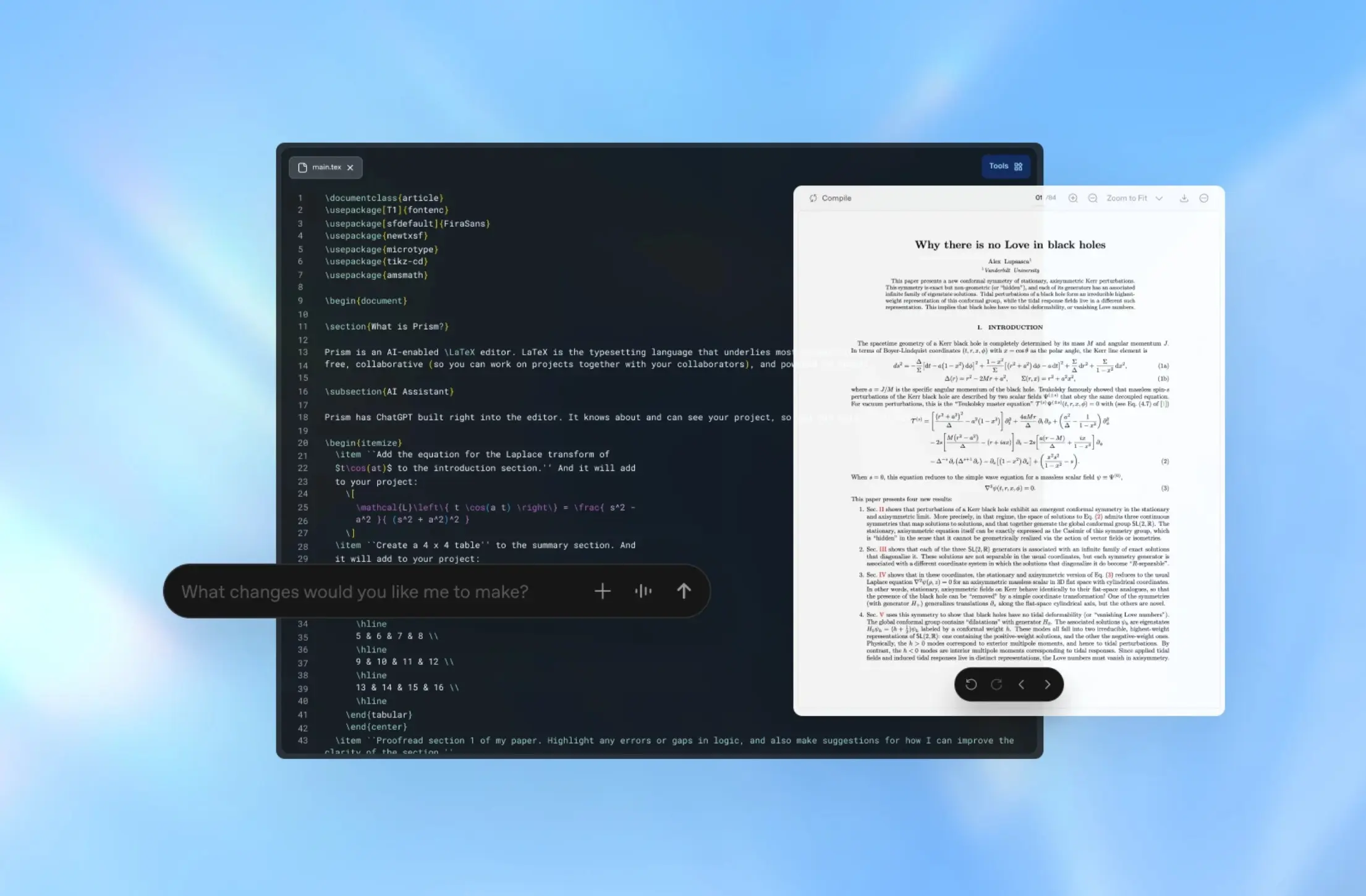
To target the research community, OpenAI today announced Prism, an AI-native workspace designed for scientific writing and collaboration. Prism is built on top of Crixet, a cloud-based LaTeX platform acquired by OpenAI. It is powered by OpenAI’s latest GPT-5.2 model and is available to anyone with a free ChatGPT personal account. OpenAI also said Prism will come to ChatGPT Business, Team, Enterprise, and Education plans in the coming weeks.
Writing a new scientific paper often means jumping between multiple tools including text editors, PDFs, LaTeX compilers, reference managers, and chat interfaces. Prism aims to bring these into a single cloud-based workspace where researchers can handle LaTeX editing, citations, figures, and real-time collaboration in one place.
With Prism, researchers can explore ideas, test hypotheses, and reason through complex scientific problems using the GPT-5.2 Thinking model. They can create and refactor equations, manage citations, and work with figures. Prism can also convert hand-drawn whiteboard diagrams into LaTeX, and it supports voice-based editing for simple changes.
💥 Today we’re introducing Prism—a free, AI-native workspace for scientists to write and collaborate on research, powered by GPT-5.2.
— Kevin Weil 🇺🇸 (@kevinweil) January 27, 2026
Accelerating science requires progress on two fronts:
1. Frontier AI models that use scientific tools and can tackle the hardest problems
2.… pic.twitter.com/cnLysHixuQ
Prism additionally focuses on collaboration, with support for unlimited collaborators. Because it is cloud-based, researchers can share a workspace and collaborate with others in just a few clicks.
OpenAI said that AI reshaped software development in 2025, and it expects science to see a similar shift in 2026, as AI starts speeding up discovery by reducing friction in everyday research work. This new Prism workspace is an early step toward that future.