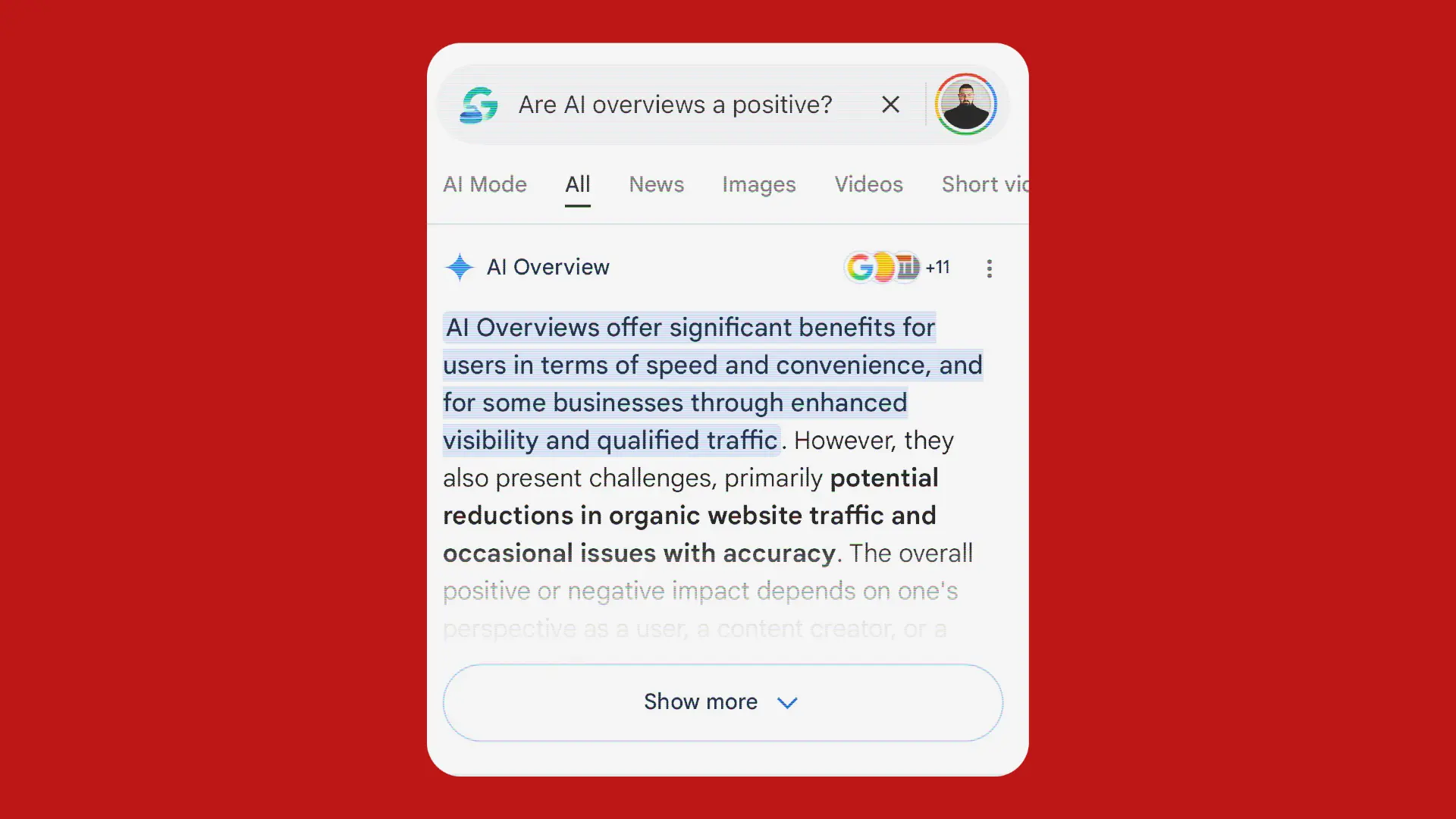
Google is putting billions into its new AI Mode for search. The company is currently integrating Gemini into everything from basic research to travel planning. However, not everyone is benefiting from this massive AI push.
Ahrefs conducted research in December 2025 that shows Google"s AI Overviews now reduce click-through rates for top-ranking pages by 58%. When an AI Overview appears in search results, the first organic result drops from roughly 7.3% CTR to just 1.6%.
This is a rerun of the original research. Ahrefs conducted the same study in April 2025, when it measured the damage at 34.5%. In roughly eight months, the click-through rate dropped by an additional 24%.
The report further shows that when AI Overviews appear, they’re on top position 91.36% of the time. This pushes organic content to lower positions, and encourages zero-click searches, which is when people come to Google for an answer and leave without visiting any of the search results.
On the surface, AI Mode serves readers well. It provides a convenient way for everyone to get the information they"re looking for without digging through multiple search results and reading long articles they don"t have time for.
Google claims that AI Overviews actually enhance the search experience for higher-quality, high-intent traffic to listed sources. The company insists that these summaries are just a starting point for users and actually help people discover more useful information than before.
But real-world examples paint a different picture. Both users and publishers are giving up something valuable for these AI Overviews, although on different levels. Users are giving up control, or rather what’s left of it, while publishers are giving everything they’ve got.
The legacy media

If you"re in the online publishing industry, these numbers come as no surprise. The introduction of Google AI Mode and constant volatility in search results have caused an absolute bloodbath for publishers of all sizes.
Many established websites lost traffic overnight and were essentially forced to shut down. New websites barely have a chance of breaking through if they rely solely on Google traffic. Even major publications were hit. iMore, a well-known Apple-focused website, ceased to exist last year due to a massive decrease in traffic. Even the Daily Mail saw desktop CTR fall from 25% to 2.79% when AI Overviews appeared, according to the Ahrefs report. No one is going unscathed through this transition.
Google"s vision for the future of search engines, with AI summaries as answers to every question, is threatening to turn traditional websites into legacy media. Just writing this feels surreal. I could"ve sworn it was just yesterday that websites were handing the "legacy media title" to traditional newspapers and TV. Seems like the time for websites to receive the torch from the original legacy media is coming.
But this transition is different in a way that creates a specific, never-before-seen limbo. Major media shifts in the past left room for old players to adapt. Newspapers expanded or transformed into web portals and even increased their numbers by serving fresh news to readers 24/7 instead of relying on paper sales. Moving from physical to digital format changed the way the media business operates but didn"t jeopardize its very existence.
What’s different now is that AI search still needs traditional websites as sources. Everything you see in one AI Overview is pulled from multiple real websites and summarized as a quick answer. Without actual websites, there would be no AI. Even its internal knowledge was scraped from somewhere on the internet.
The problem arises when AI Overviews undermine those same sources they rely on. Google does cite the sources inside AI Overviews, but then keeps the user on its own page. Although sources are listed properly, they occupy an insignificant portion of the interface. The majority of users don"t bother clicking on them. Click-through rates on cited sources hover below 1% in many cases. Publishers get attribution, but without any compensation or traffic.
For thirty years, the deal was simple. Google indexes your content, and you get traffic. That arrangement is now dead. And this time, the path forward for online publications is unclear.
What this means for users?
You could easily dismiss publishers’ animosity towards Google as a panic response to what feels like a direct attack on their livelihood. If users are getting what they want better and more efficiently than before, why should the change of landscape bother them? There’s no revolution without blood, after all, and publishers are simply paying the price of progress.
That argument sounds reasonable until you follow it to its logical conclusion.
When sites can"t monetize content, they stop producing it. Small and medium-sized publishers lose traffic and shut down. Only major publications that built direct audiences independent of Google can survive. This leaves information control concentrated in fewer hands than ever before. When a small number of major players produce the majority of original content, and Google"s AI pushes that content for billions of users, the whole thing loses diversity in perspective.
Users could end up with a strictly controlled stream of information. Not controlled through explicit censorship, but through economic pressure that eliminates alternatives. The convenience of AI Overview comes at the cost of losing access to the diverse pool of independent voices that made the web valuable in the first place.
still going strong pic.twitter.com/EaVvm3N0Co
— Ivan (@ivan_jenic) February 4, 2026
Furthermore, as quality loses value, quantity goes into hyper mode. A recent study from digital marketing firm Graphite shows that over half of new articles on the internet are now AI-written. For the first time in history, AI has overtaken human content production. That number will only climb in the coming years.
As the number of human-written content decreases, AI Overviews will simply be forced to summarize other AI articles. That could potentially lead to us receiving multi-layered AI answers from Google very soon. Picture this: AI that summarizes an article written by an AI that’s probably a rewrite of another AI article.
Displaying AI-generated text wouldn’t be a problem in itself if the presented info were accurate all the time. But let’s not forget that AI doesn’t think as humans do. It encodes input and returns the most logical output based on pattern-matching. For example, even with all the recent advancements, AI still can’t accurately spell words. Trusting it to form our entire opinion on a subject is risky. And verifying AI answers still requires going through sources, which, ironically, creates more work than just going straight to articles.
What does the future hold?

Looking at both parts of the equation, the direction in which web search is going looks bleak. It"s a collection of problems and contradictions masked under shiny new tools. And with so much AI infrastructure already in place, going back doesn’t seem like an option.
Both publishers and readers have already started looking for alternatives. But there are no clear alternatives. The entire world is so deeply rooted in Google’s ecosystem that trying to leave it poses its own set of problems.
Social media is already drowning in low-quality AI-generated content, and the sheer volume of bots on every network makes finding a human audience increasingly harder. Many creators are moving to newsletters or Substack to reclaim control, but these private channels lack the massive scale of a search engine.
Migrations leave everyone fragmented. Readers have to juggle dozens of different subscriptions just to find the variety they used to get in one place. Publishers simply can"t find the same massive audience on niche platforms that they once had on Google.
The obvious question remains: doesn’t all of this hurt Google, too? It probably does to some extent. But Google, just like the rest of the major tech players, is ******* that profits from the AI boom will far exceed potential losses caused by shaking up its legacy operations.
Big Tech is investing billions into AI. They’re building massive data centers, developing new AI models, and push them into virtually every service they provide. If the investments fruit yield, companies will achieve revenues never seen before. But if that bet proves wrong, they’ll have to figure out how to bounce back when the foundations they were built on are already destroyed.