Microsoft recently announced that it is dropping support for a Teams feature on Windows 11 and Mac PCs. The component allows connecting to external third-party hardware and apps. The company, at the same time, also highlighted some of the new features that were added last month in March 2026.
Oftentimes, with some of the announced changes, Teams administrators have to prepare their organizations" systems so that the deployment of such changes and upgrades goes smoothly. Admins are able to control and coordinate such actions from the Teams Admin Center, which is essentially a central hub that includes dedicated pages like dashboards and UI experiences for managing such operations and more.
Speaking of which, last year Microsoft announced that it was debuting a new feature inside the Teams Admin Center (TAC) called the Teams client health dashboard. In a nutshell, the Client health widget displays key health metrics like device crashes and launch failure trends for the last 28 days, which means an admin will be better able to track the issue, which should, in turn, make it easier to resolve the problem.
Following this, Microsoft has announced this week that it is rolling out another new Teams dashboard for admins in the form of a voice and face enrollment dashboard, which, as the name suggests, is designed to give administrators visibility into user voice and face enrollment data.
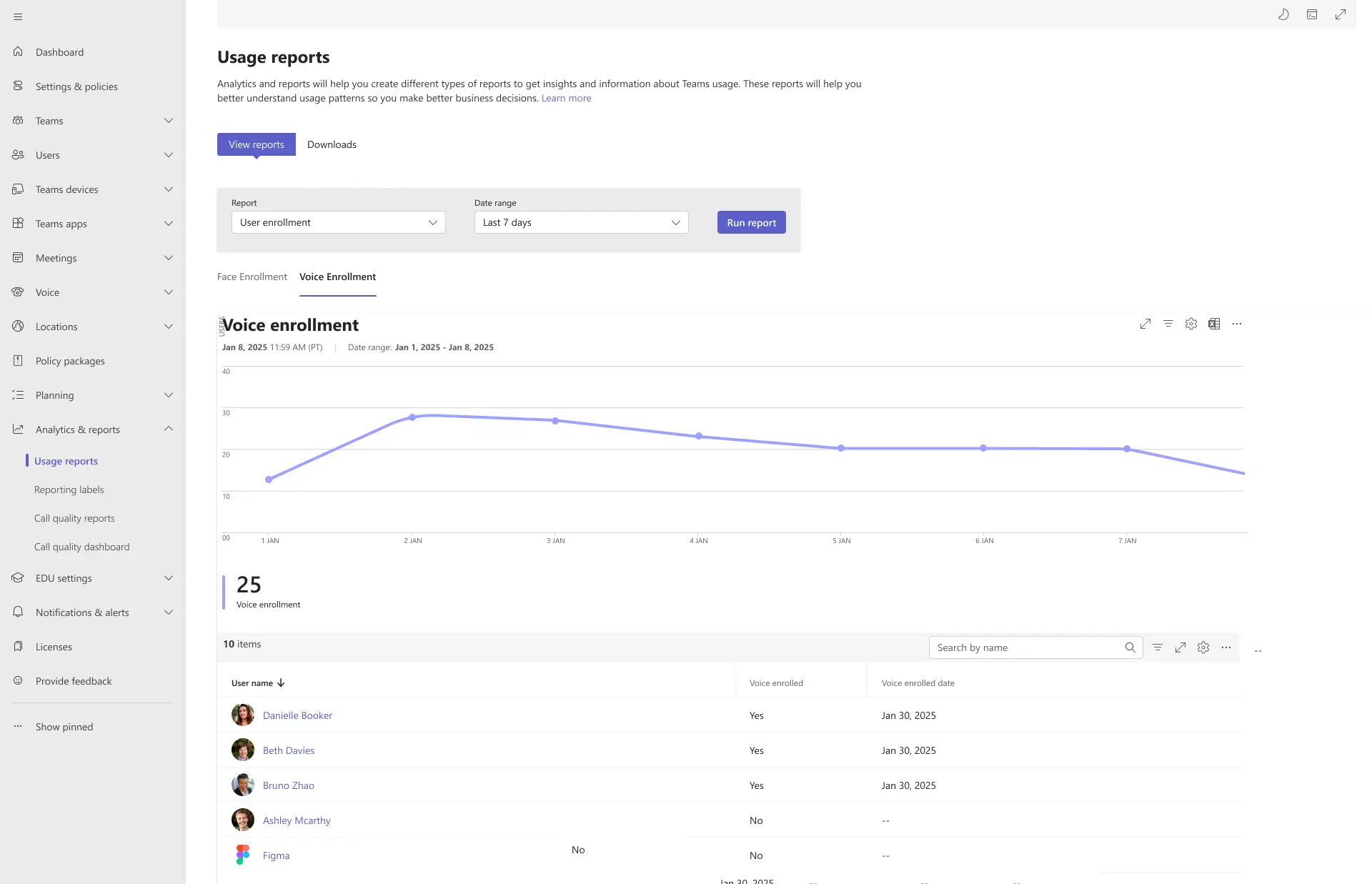
As expected, the update is designed to help organizations better understand the adoption of AI features such as speaker attribution, voice isolation, and face-based room experiences. Thanks to this new feature, Microsoft says admins can more effectively monitor how these new AI capabilities are being used across their environments. In addition to that, the update introduces direct controls for managing sensitive information. Admins can now view and delete end-user voice and face enrollment data directly within the admin center through this new dashboard.
Those who have access to the Microsoft 365 Admin Center portal can view the message here under ID MC1191921 on the company"s official site. The entry is also available at this link under ID 506750 on the Microsoft 365 roadmap website. The company says that it "will begin rolling out mid-March 2026 (previously early February) and expect to complete by mid-April 2026 (previously late March)." Thus, the new upgrade is rolling out now.