We learned a couple of months ago that PCIe 8.0 could land in two years time, around 2028. As such, up to eight times faster NVMe SSDs are expected, capable of reaching speeds of up to 128 GB/s unidirectionally. That is still some distance (time) away and currently, the most readily available drives for consumers are running on the PCIe Gen5 interface, which can deliver up to 16 GB/s.
However, enterprise devices have begun moving on to PCIe Gen6, with the promise of doubling the throughput compared to PCIe 5.0. Back in August of 2024, Micron launched the industry"s first PCIe Gen6 drive, which claimed read and write bandwidths of up to and over 26 GB/s.
Fast forward nearly two years, Micron, this February, began shipping its 9650 NVMe SSD, and in the two years, the company managed to further refine its technology such that the upgraded drive can now deliver up to 28 GB/s of bandwidth.
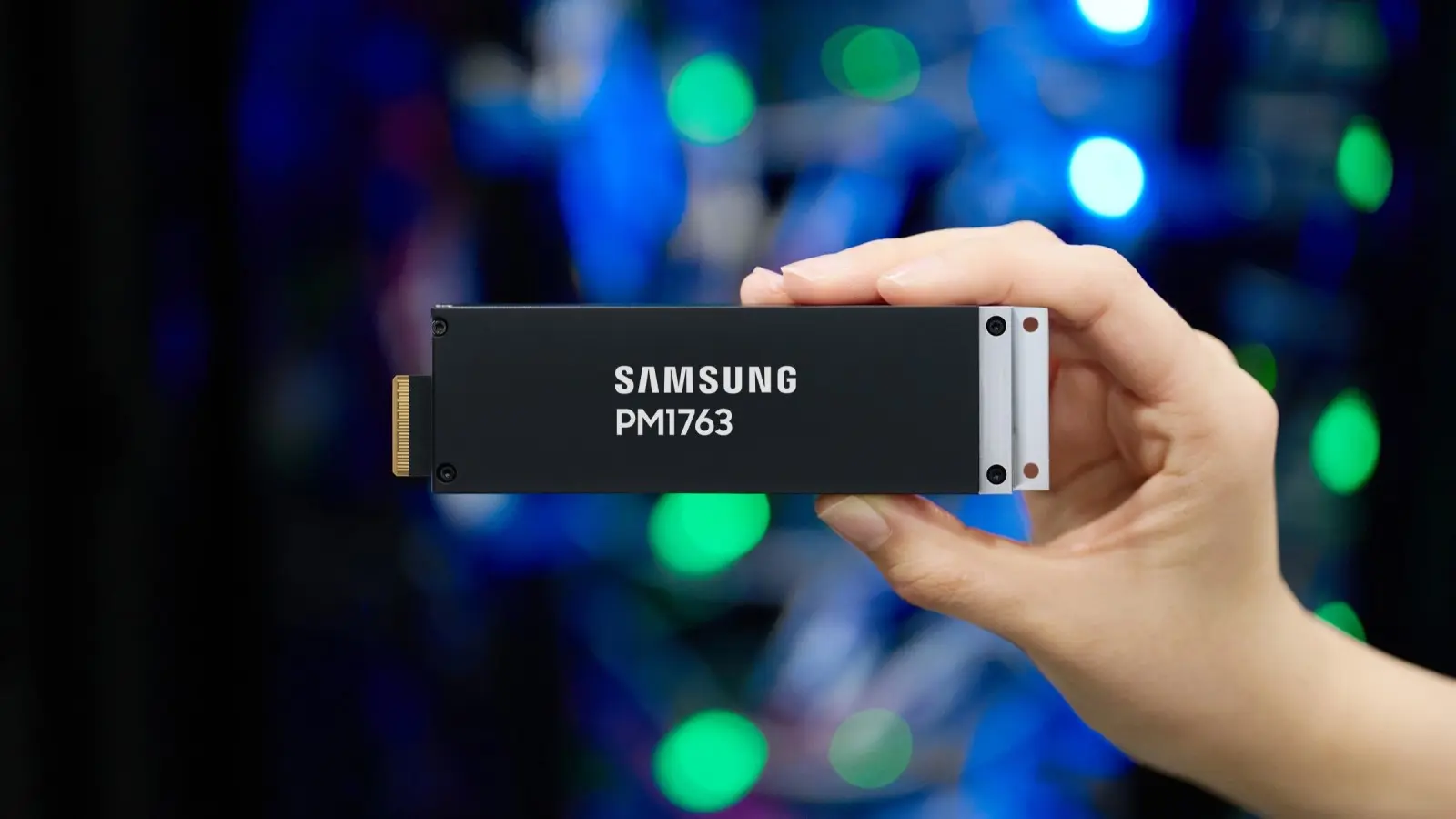
Following that, Samsung today has managed to just leapfrog Micron as it has released its new PM1763 enterprise SSD, the successor to PM1753. The latter was based on the PCIe 5.0 interface, and as such, the new PM1763 drive promises more than double the speeds of up to 28.4 GB/s. To be specific, the South Korean giant claims sequential read and write speeds of "up to 28,400 megabytes-per-second (MB/s) and 21,900MB/s, respectively" on the 16TB variant. The 4TB and 8TB will be likely be slightly slower.
The company has announced that it has begun "mass production" of the PM1763, but sadly, this is not for the common masses, like you and me. Instead, it is for data centers and enterprise workstations with a focus on heavy AI and HPC (high-performance computing) needs.
As you may already be familiar with, AI is the big hype nowadays among all the major big tech companies, which requires a lot of hardware, including RAM, GPU, and storage, and this is consequently leading to a massive shortage of consumer goods with little or no way to replenish the extreme supply-side issues.
Micron even completely killed off its Crucial consumer-facing brand just to focus on the extremely high-profit enterprise and data center market.
Samsung says that the PM1763"s performance allows transfer of a massive 40 GB LLM in as little as 1.4 seconds, and it is also said to be 1.8 times more efficient than the PM1753, so companies should be getting lower power usage alongside better performance. In cases where the workload demands it, the tech giant says it can sustain peak performance as it is optimized for liquid-cooled server environments via direct-to-chip (D2C) cooling technology.
Finally, in terms of security, the drive supports post-quantum cryptography (PQC) algorithms to protect against future quantum computing threats, as well as TEE Device Interface Security Protocol (TDISP), which can guard against vulnerabilities in virtual environments.