Following on from my review of the Luxsin X9 in May last year, I return with the latest model, the X8, with a few new tricks up its sleeve. For those that missed the previous review, Luxsin is better known via its sister company, Eversolo, and since the X9, I have seen a lot of positive momentum toward the brand as it establishes itself as a premium name in audio without the usual premium price that would otherwise accompany a device with this many features using these sorts of materials.
Luxsin"s community transparency and active presence across social media and forums alike has started to cement a loyal following. This is a direction not often seen from tech brands across industries.
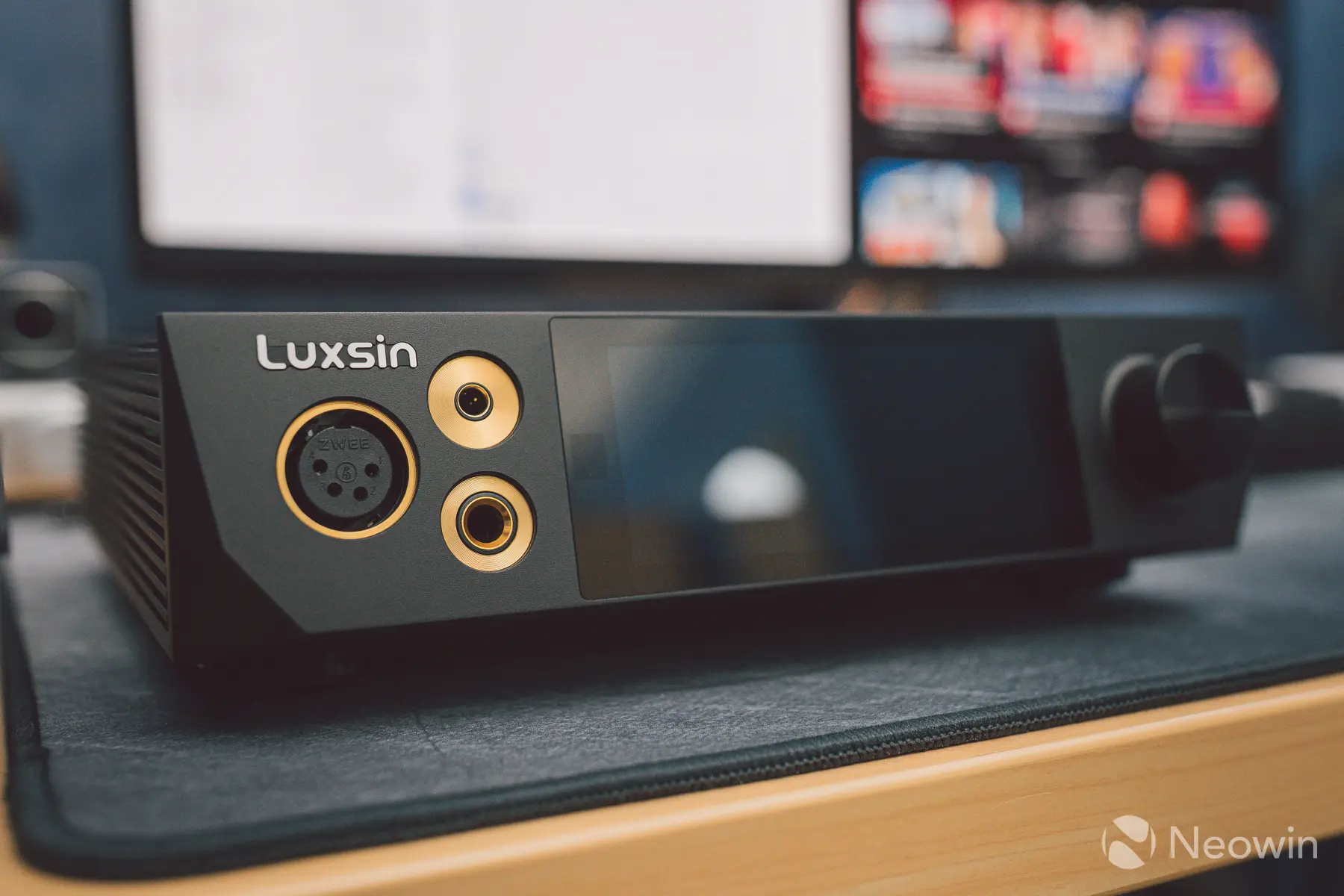
The X8 is once again a headphone amp, DAC and pre-amplifier combo box, but this time in a smaller housing than the X9.
Luxsin hinted on forums saying the plan for the X8 was to have something that was cheaper than the X9 whilst still recruiting the qualities that made the X9 appealing, from the 10-band parametric EQ (now with an AI assist, more on this later) to the premium build quality and styling that has now become a Luxsin signature look.
This time round we only have one colour, black, though unlike with the X9, an optional glass windowed top panel will be offered after orders ship to retailers some time from mid-February.
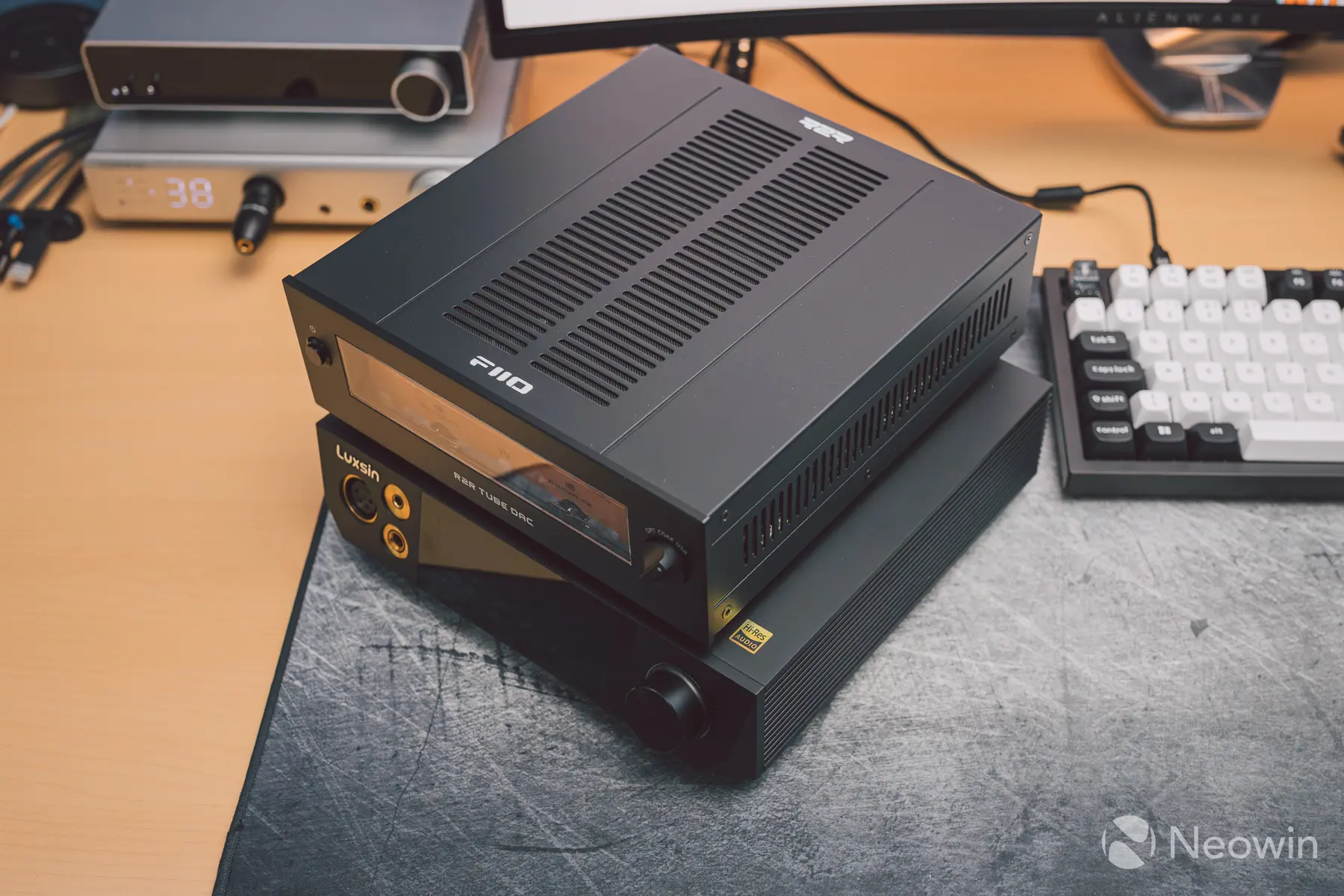
For those intrigued, above is a visual comparison. It is a bit wider than FiiO devices using the K15/K17/WARMER chassis, and is a little less in depth. Even still, I used right-angled cables to gain two more inches of desk space out of preference:
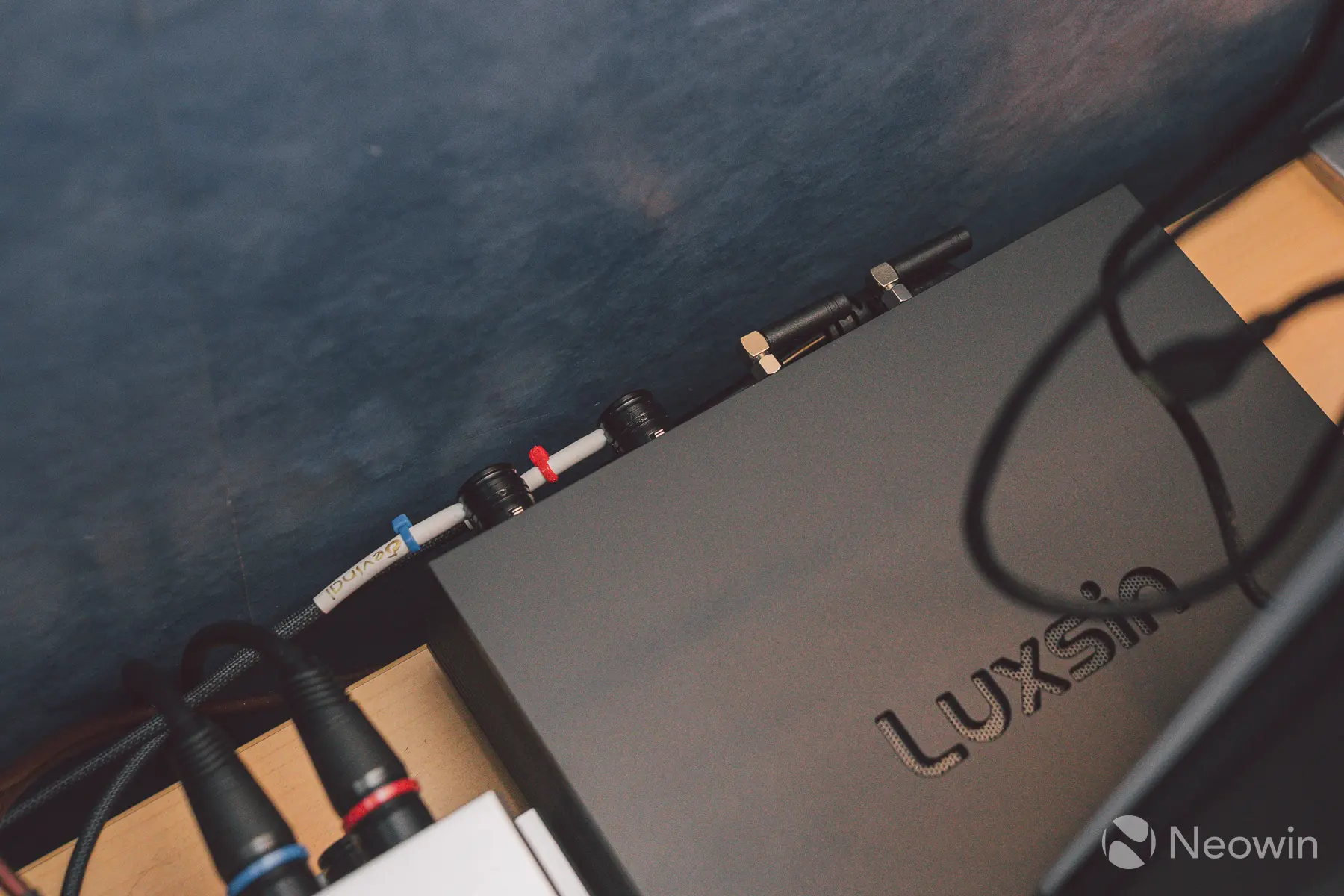
The bulk of my listening was done with the X8 configured as a DAC and headphone amp. Its balanced rear output was set to volume passthrough feeding a Topping A90 Discrete pre-amplifier with balanced connections then into a Topping PA7 power amplifier. The speakers are the TRIANGLE Comete 40th Anniversary, with HiFiMAN HE1000se and Sennheiser HD600 headphones.
The media source was via USB coming from a Windows PC playing via MusicBee in ASIO mode for DSD local file playback, as well as Spotify Lossless for streaming.
Here is a rundown of all the key specs compared to its bigger sibling:
| X8 | X9 | |
|---|---|---|
| Display | 4" LCD Touchscreen (960X400) | 4" LCD Touchscreen (960X400) |
| DAC solution | 8x Cirrus Logic CS43198 (True dual-mono parallel architecture) | AKM AK4191EQ + AK4499EX |
| DSP | Custom Digital Audio Core (Dual-core HiFi-5 DSP and ARM STAR architecture @ 500MHz+) | AKM 7739 |
| OpAmp | OPA1612 | OPA1612 |
| Amplifier | Texus Instruments TPA6120A2 (Class AB architecture) | Texus Instruments TPA6120A2 (Class AB architecture) |
| Processing & USB solution | XMOS (XU)316 | XMOS (XU)316 |
| Clocking | High precision clock | Dual femtosecond clocks |
| Bluetooth solution | Qualcomm SXW5125 - BT 5.1 | Qualcomm QCC5125 - BT 5.0 (aptX / aptX-HD / SBC / AAC / LDAC) |
| Wireless solution | WiFi 2.4GHz / 5GHz | WiFi 2.4GHz / 5GHz |
| Trigger support | 12V trigger in/out | 12V trigger in/out |
| USB-A input | Used for firmware updating only | Used for firmware updating only |
| USB-B/USB-C input | Windows (10, 11), Android, IOS, support DSD512, PCM 768KHz 32-bit | Windows (10, 11), Android, IOS, support DSD512, PCM 768KHz 32-bit |
| Optical/Coax input | PCM 192KHz 24-bit, DoP64 | PCM 192KHz 24-bit, DoP64 |
| IIS input | Yes, mode selectable | N/A |
| HDMI ARC input | N/A | PCM 192KHz 24-bit |
| Analogue input | N/A | RCA (unbalanced), max gain +10dB |
| Analogue outputs | XLR3 (balanced), RCA (unbalanced) | XLR3 (balanced), RCA (unbalanced), Subwoofer |
| Headphones output | Single ended (6.35mm): Balanced (4.4mm/XLR4): | Single ended (6.35mm): Balanced (4.4mm/XLR4): |
| Headphone features | Proprietary HP-EQ (Headphone Equalisation) Intelligenty AI enhanced PEQ system Automatic headphone impedance detection | Proprietary HP-EQ (Headphone Equalisation) Automatic headphone impedance detection |
| Power supply | internal ultra-low noise linear, dual-mode variable (12V and 15V) | Internal custom ultra-low noise linear |
| Energy consumption | 25 Watts | 25 Watts |
| Weight | 2.75kg | 3.72kg |
| Dimensions | Width: 236.8mm / Length: 236mm / Height: 64mm | Width: 300mm / Length: 206mm / Height: 65mm |
| In the box | Power Cable, USB-B cable, 3.5mm to 6.35mm adapter | Power cable, USB-C OTG cable, USB-B cable, remote |
| Price | €577 (ex VAT) / $699 / £699 (at the time of writing) Via your local audio retailer | €989 / $1103 / £989 (at the time of writing) Via your local audio retailer |
Interesting to note that the X8 is better specced in some areas. The biggest difference being the change in DAC chip used, as well as having twice the headphone output power compared to the X9, although both are capable of driving pretty much virtually any headphone regardless.
First impressions
When the X8 was first announced on forums, it was assumed that the entry point would be mid-tier for sound quality due to the use of a Cirrus Logic CS43198 DAC instead of AKM"s Velvet Sound flagship from the X9.
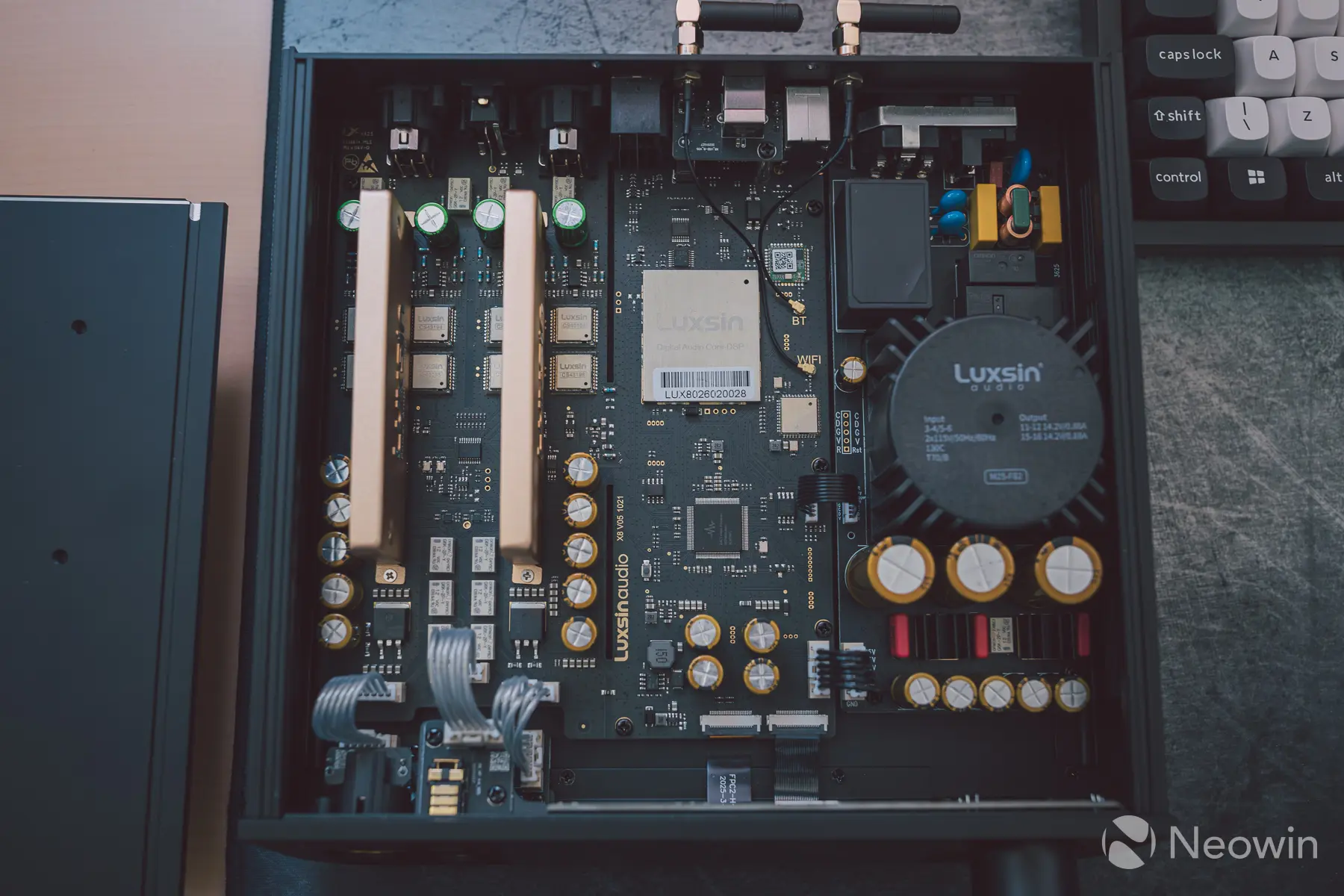
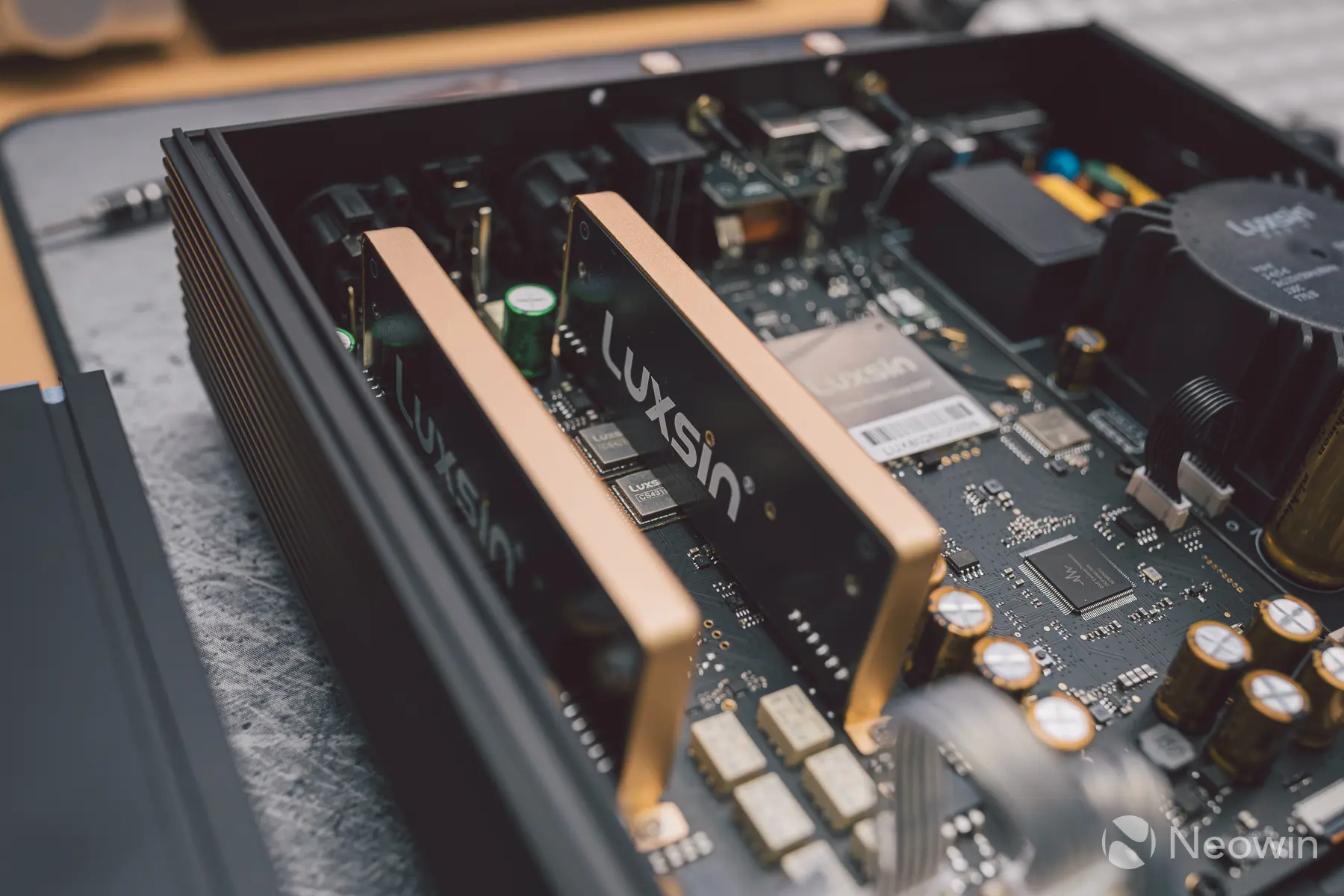
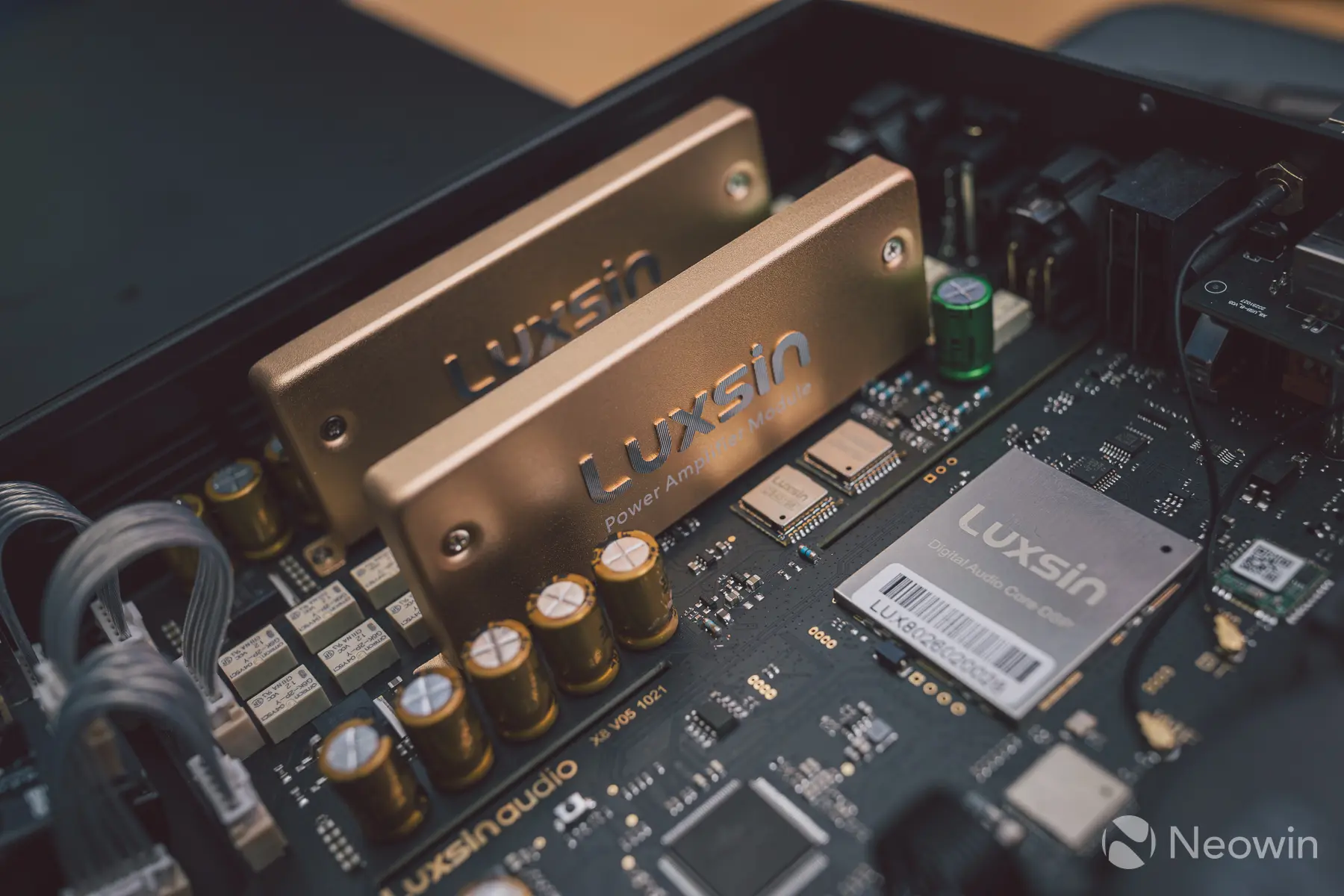
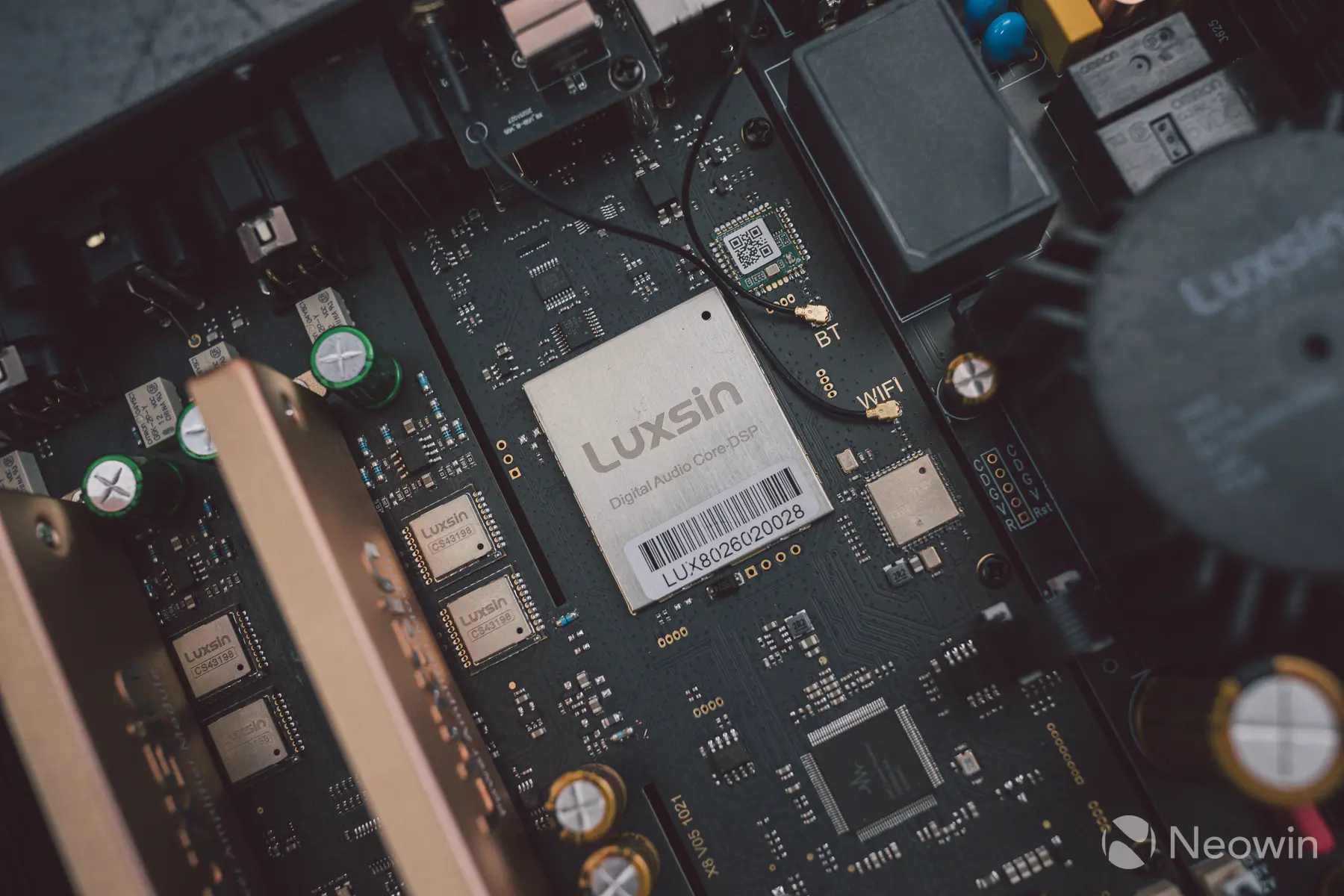
Don"t let the DAC swap misguide you, though, because the CS43198 is not only tried and tested, but there are eight of them in this implementation, four per channel in a dual-mono architecture and power amplification.
There is no other DAC on the market currently using more than four CS43198 DAC chips. The X8 also has an in-house DSP dubbed the "Luxsin Digital Audio Core"; this DSP houses a +500MHz ARM CPU handling all of the AI/EQ processing.
Another thing to note about Cirrus Logic, especially for those of us that are old school, is that the brand acquired the UK"s Wolfson back in 2014. This allowed later audio products from Cirrus to utilise Wolfson technologies.
"Cirrus integrated Wolfson’s technology and team, and now describes its business as spanning audio ICs and software for a wide range of consumer devices, referencing the Wolfson acquisition as a key step in broadening its footprint.
The combined company offers a larger catalogue of audio DSPs, codecs, amplifiers, MEMS microphones, and related mixed‑signal products for smartphones, tablets, wearables, and other portable applications." - Perplexity deep research
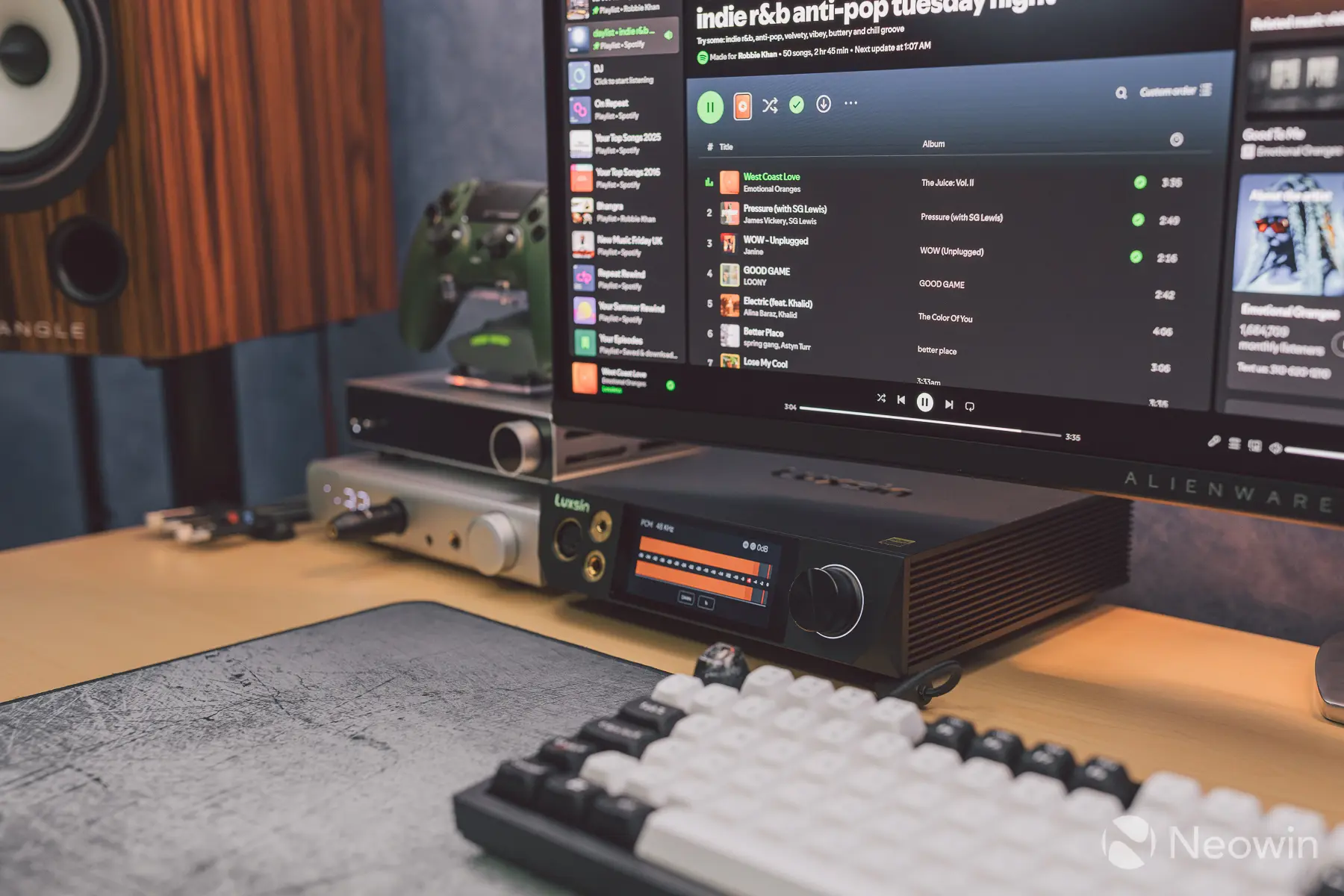
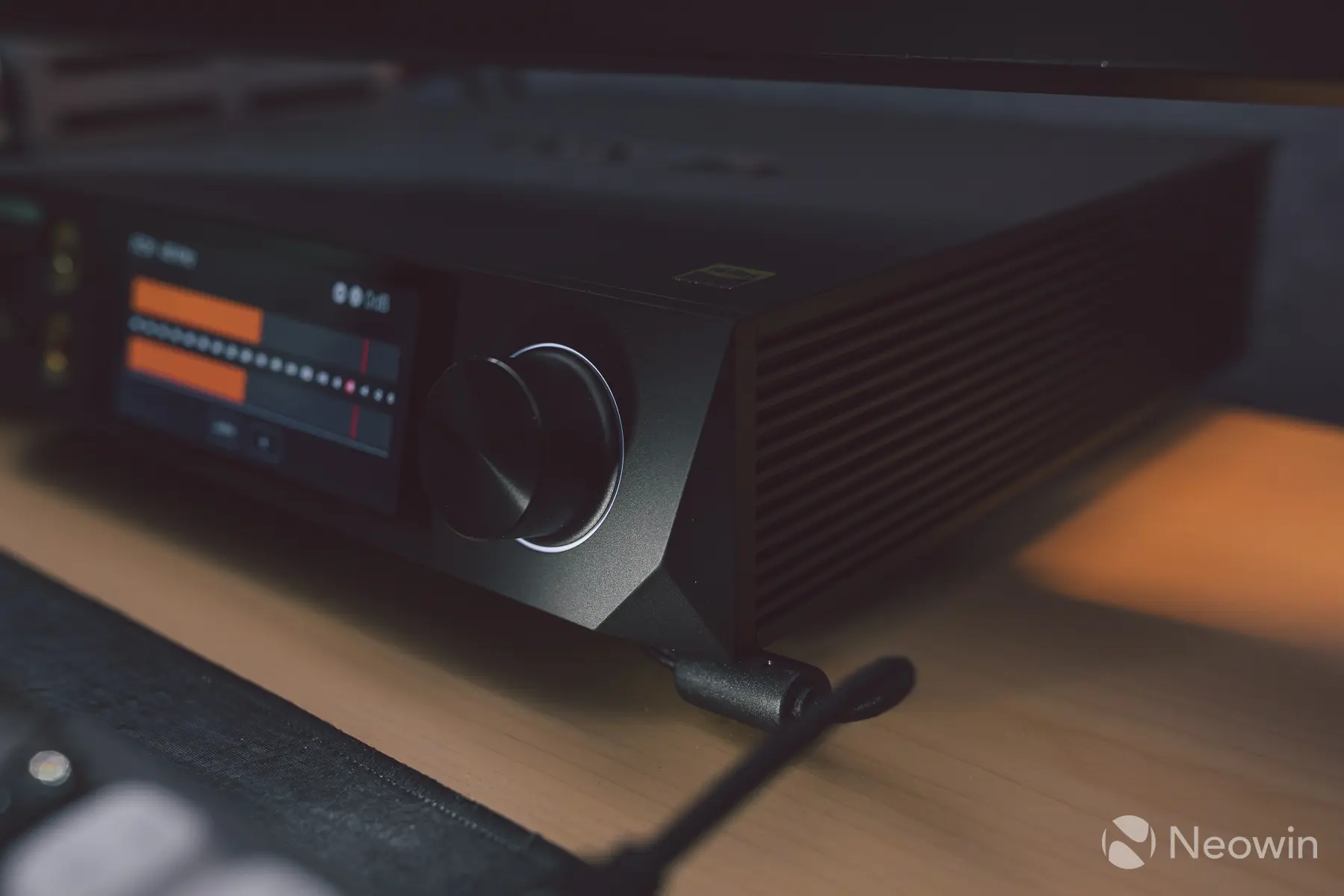
The rest of the package is just like what we see with the X9, a CNC machined Aluminium chassis, a machined volume dial that now functions as a button, and a 1080p capacitive touchscreen. From a visual point of view it looks like a juvenile X9. Dare I say it, I think it looks more sleek in black and an evolution over the X9 as a result.
The boot up time from standby is also fairly reasonable, it"s not quick, but it does go through various stages with relay actuations giving audible indication, take a listen:
There really is only one gripe from my first impressions, and that is the omission of a remote control. I don"t know how much of the cost this saved, but Luxsin has confirmed that it will offer a remote as an optional extra for those wanting it. It also confirmed that the remote is the same one that comes with the X9, and that an all-new remote is currently in development which will come with the next model instead.
As a DAC
I already knew what a quad CS43198 DAC is like based on existing devices using that config, along with the knowledge that these Cirrus Logic DACs employ Wolfson DNA. I had already formed an idea for what 8x CS43198s should sound like, and this expectation was met almost immediately after playing songs from my Spotify curated Hifi playlist.
Whilst it is true that a DAC should be as transparent as possible, the implementation of it is what gives a certain type of sound outside of physical DAC architecture types such as R2R, Sigma-Delta, Current Steering and so on.
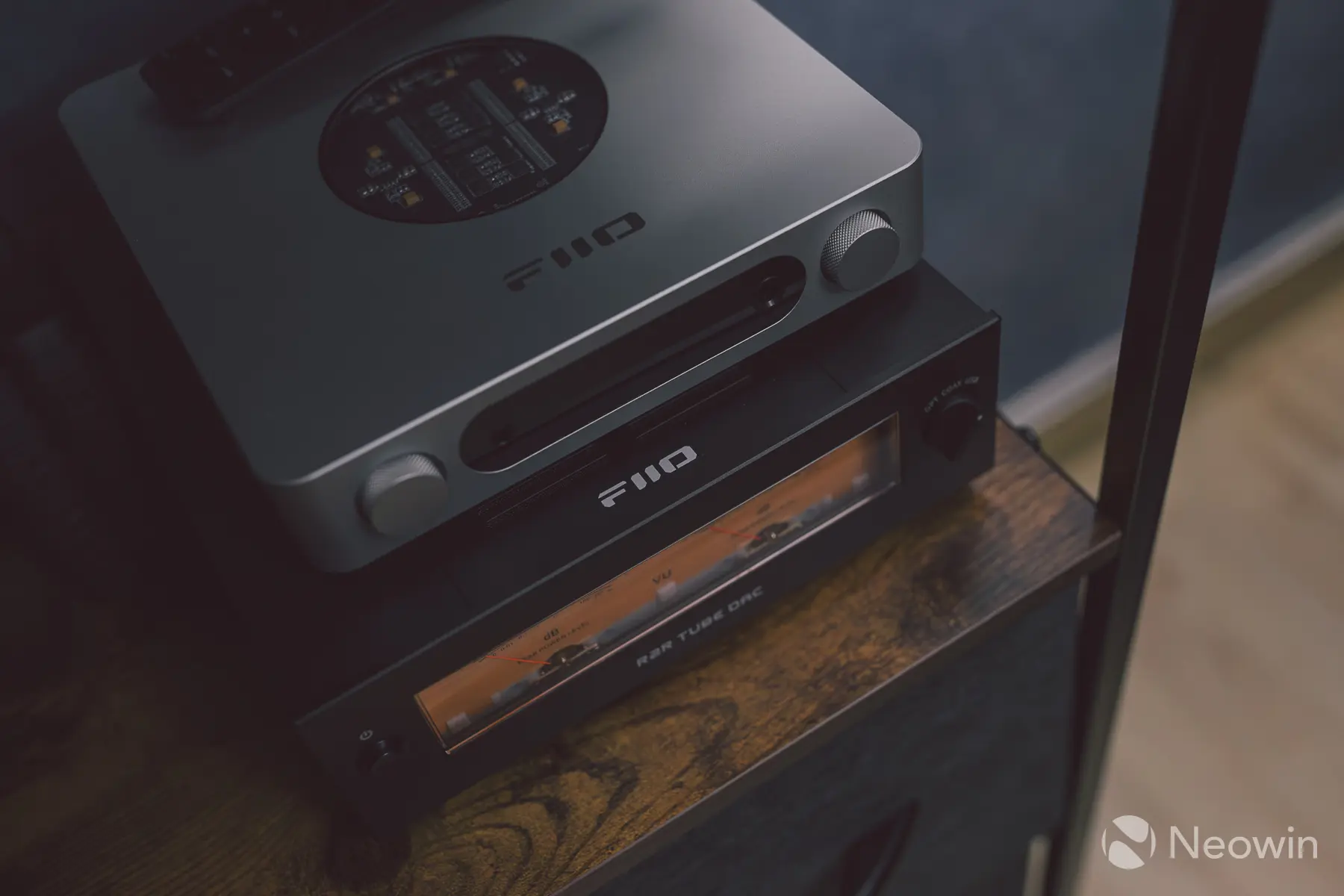
Comparing it as a DAC against both the FiiO K13 R2R and WARMER R2R Tube Buffer was interesting. The WARMER is my current benchmark thanks to its simplicity, price and full bodied sound. It got even better after upgrading the tubes, as did the K13 R2R after swapping to the external FiiO PL50 linear power supply.
Even still, the Luxsin X8 was able to nearly match the organic articulation of the WARMER, whilst retaining a tighter grasp of the lower end frequencies resulting in punchier and more immediate sub-bass response compared to the slightly laid back approach the WARMER has in this area where bass can have a slower roll-off. If anything, I would liken the X8"s lower end frequency presentation to embody a combination of the K13 R2R"s (with linear PSU) bass which is tight and punchy with a dominant slam when the music asks for it, and the WARMER"s near-holographic soundstage and upper frequency detail extraction from well-mastered music.
The Cirrus Logic DAC chip with Luxsin"s custom implementation in conjunction with the DSP produces a sound signature that is both modern and vintage at the same time to my ears. It is very easy to listen to for hours on end, and in fact, one free weekend I spent an entire day listening to music through speakers during the day and headphones during the night without a hint of fatigue. If I didn"t need to sleep or eat, I could have gone on for longer.
Only the WARMER has been able to do that prior to this. I have left out the X9 deliberately in this context purely because it is much more expensive whilst still sounding close enough to the X8, especially when enabling the De-emphasis DAC filter. I would pick the X8 if given the option of either model.
All listening tests here were conducted with the DAC set to NOS (Non-Oversampling) mode, and the parametric EQ and sound tuning fully bypassed. The pre-out volume was then set to passthrough which delivers a line level signal to the Topping A90 Discrete acting as the pre-amplifier to the speakers. The headphones were connected directly to the X8"s balanced outputs.
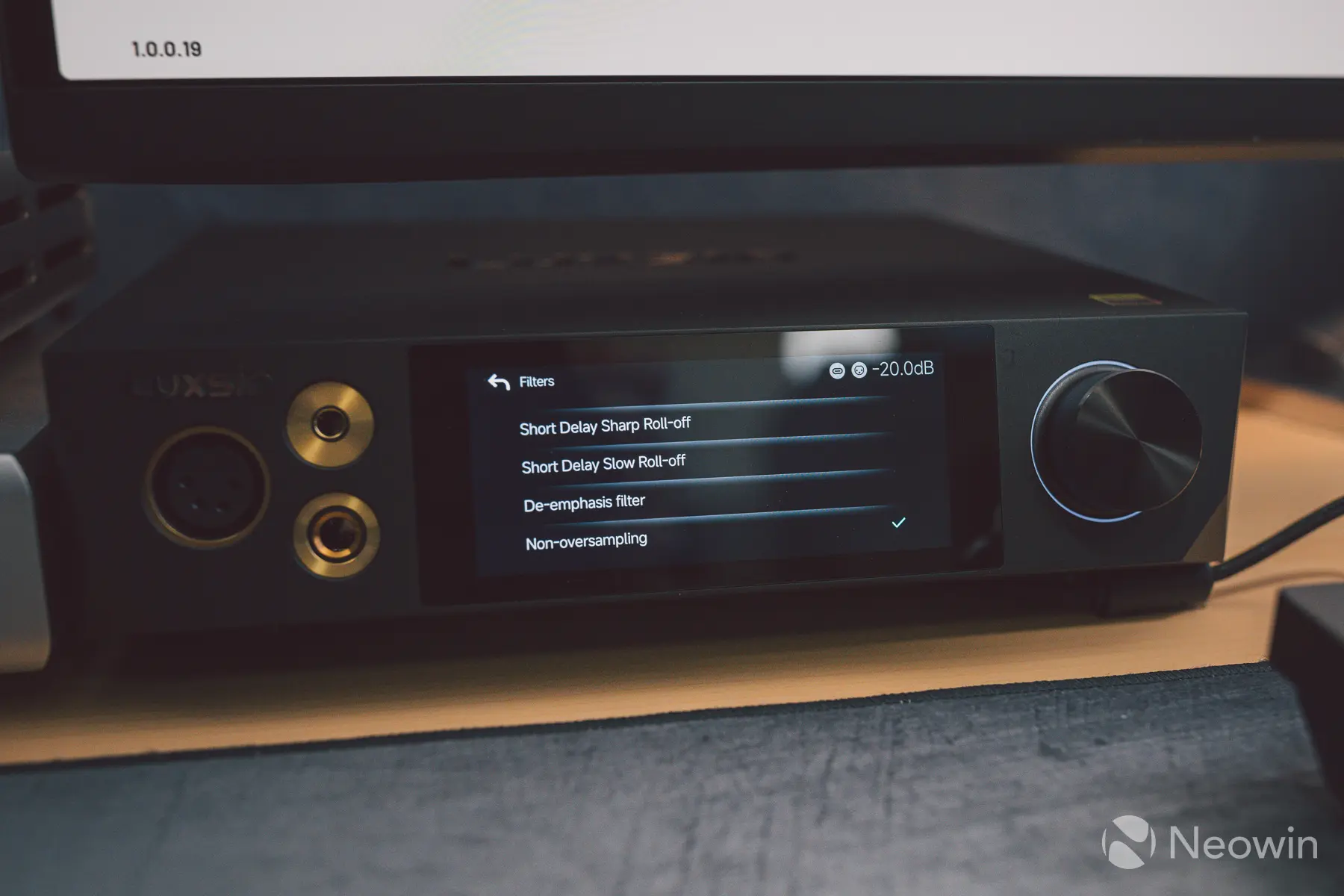
It still has the full bodied sounds from low down to the midrange, but the soundstage and upper end range feels more likely on my headphones and speakers compared to the X8. Your mileage may vary since system synergy is a real thing, and we all hear things differently, too.
The FiiO WARMER still produces a more holographic and immersive soundstage, though the difference is slight. This is notable considering the price difference, though bear in mind that the WARMER is a pure DAC, you will still need a headphones amp and pre-amp to connect up the rest of your outputs, so costs can escalate beyond the X8"s price.
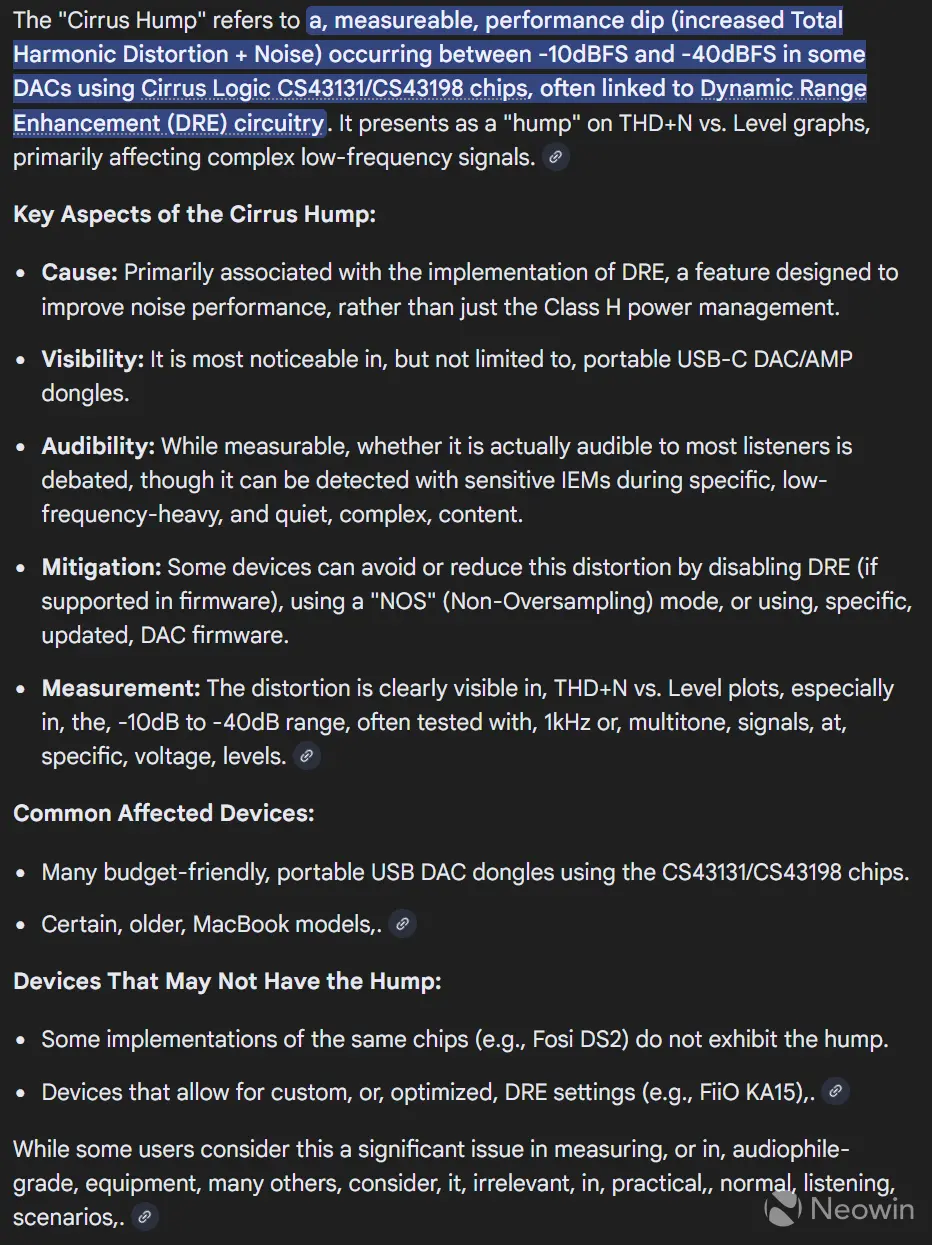
Lastly, as this ia Cirrus Logic powered DAC, it is worth mentioning the Cirrus Hump mentioned above in the Gemini round-up covering much of the discussion on forums. This is not something i have noticed manifest in the X8 through extensive listening to any music.
It is also worth noting that whilst the CS43198 is affected by the DRE hump, Luxsin has implemented the option to toggle DRE in the audio menu. This setting is off by default which mitigates the issue, along with the custom hardware configuration around the DAC chips in tandem I suspect.
As a headphone amp
With 4.5 watts available in full gain mode, there is more than enough grunt to power arguably any headphone money can buy currently. That"s not to say the X9 was underpowered in the headphone department, it too can power virtually everything. 4.5 watts isn"t the most power out there either, Topping"s DX5 II outputs over 7 watts per channel, whilst my A90 Discrete is 9.8 watts.
These are all crazy overkill figures, and whilst the output power is lower in low gain modes, there is no audible noise introduced in any of them should you need to run in higher gain modes for IEMs or demanding headphones.
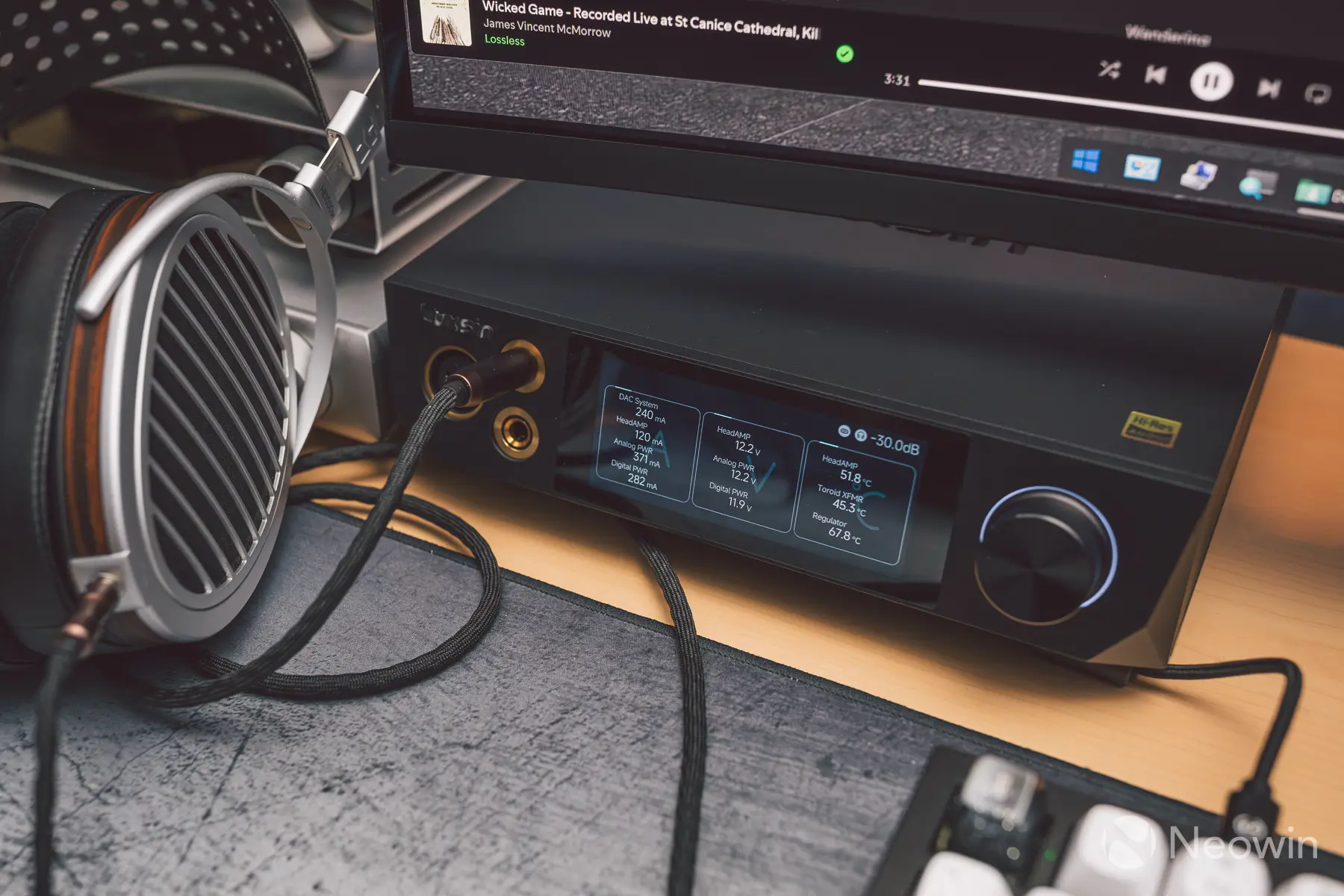
With my HE1000se, the dynamics, vocal timbre, sub-bass extension and energy of the X8"s headphone output sounds on par with the A90 Discrete"s headphone amp. The latter has more volume, and in the upper frequency ranges is ever so slightly elevated in sparkle/detail.
Adding the X9 into the mix, all three embody a smooth, warm and expansive soundstage with only small nuanced differences between them which ultimately will be music genre dependent and the quality of the mastering of any given release, not the format of the music being played or the platform being played on. I have tested back to back TIDAL, Quboz and Spotify Lossless in recent times and found there to be no audible difference if I could verify the mastering of the same release aligned.
We have reached a peak point in time where regardless of the cost of a DAC/amp, the quality is so good that a purchase decision really boils down to things like construction quality, additional connections, features and customer support. Audio quality only really factors in if you have a very specific taste in sound signature.
Some people like warmth and smoothness as this feels organic, whilst others like analytical/neutral as this can exhibit a more intimate presentation full of precise details across the frequency range.
As a pre-amplifier
The role of a pre-amplifier is to provide not only volume control and interconnect the source to the output, but also signal boost and noise reduction factors into it. Since the X8 can function as a DAC and pre-amplifier, I disabled the menu option Pre-out volume passthrough (when enabled, it delivers a line level output signal direct to the rear RCA and/or XLR balanced terminals). In my configuration, this meant XLR balanced out to the Topping PA7 power amplifier in order to drive the passive speakers.
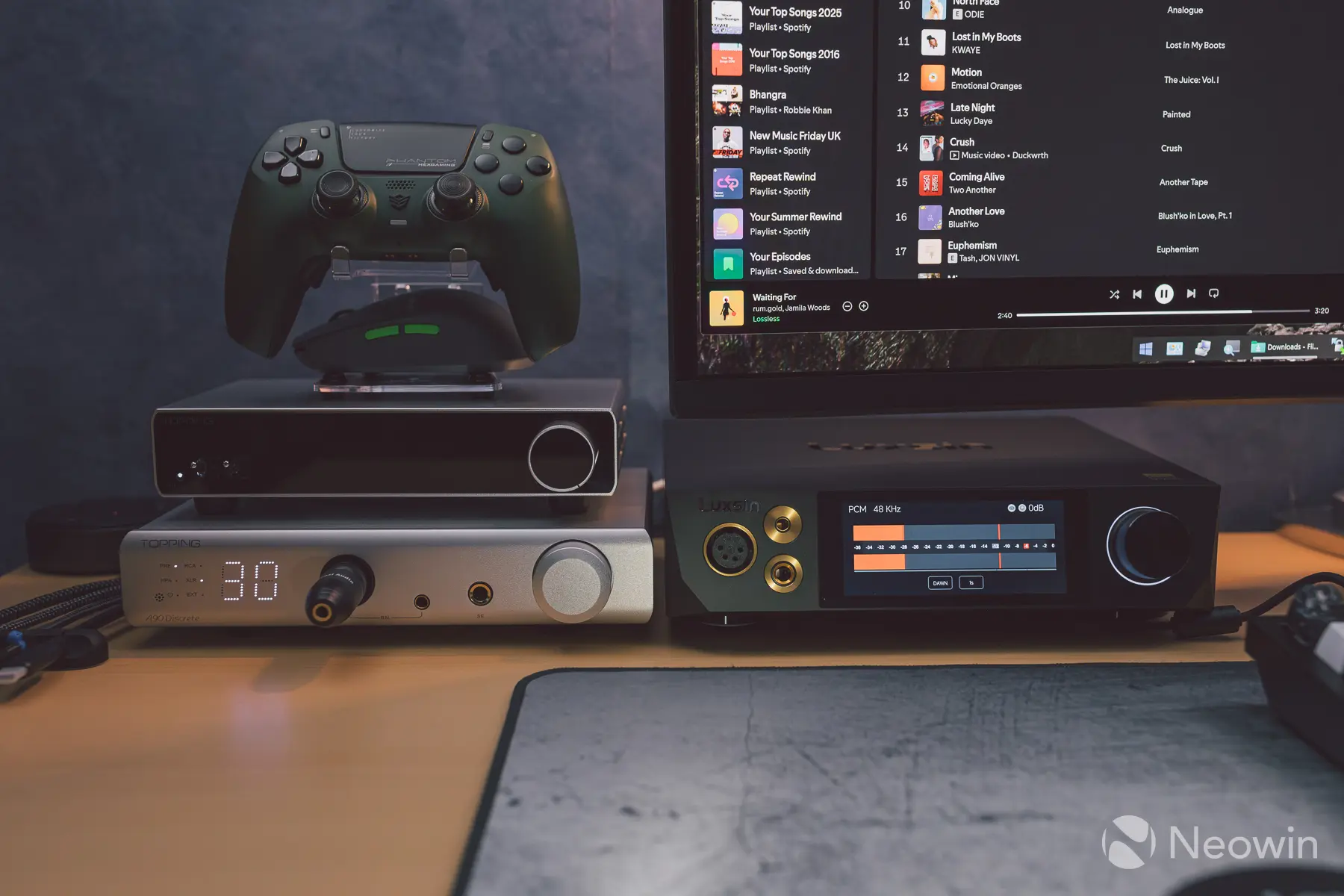
The PA7 was then set to its respective volume bypass mode since it has built-in volume control as I wanted all volume being controlled by the X8 with everything after not applying any volume mismatch. On other power amps without bypass modes, it" would simply be a case of putting the volume all the way to max.
I found that whilst the pre-amplification section of the X8 does a fine job, it does slot behind some older pre-amps like the A90 Discrete, and this is very audible. For example, the table below shows just how different the trio are as pre-amps. The A90 Discrete wins on power output level, along with lower noise values, not that noise in either of them is audible to human ears at any volume anyway.
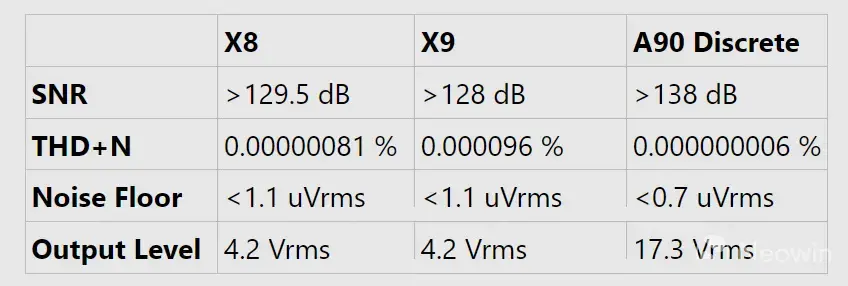
What this meant in practice was that the A90 Discrete at 40% volume (low gain) is as loud as the X8 and X9 at around 60% volume (X8"s pre-out gain set to high). That is a big difference, and not just a case of different manufacturers scaling volume and gain levels differently. Both the X8 and X9 have the same output Vrms as shown above, whilst the A90 Discrete is considerably higher.
Even still, using the dial on the Luxsin duo is very satisfying, if a little lighter in ratchet feel on the X8 compared to both X9 and A90 Discrete. And whilst the A90 Discrete and X9 have volume control handled by a mechanical relay array for precise channel balance and attenuation, the X8 has a digital volume control with a single relay in place which is purely for the click sound that many loved in the X9.
Here"s how it sounds compared to the A90 Discrete"s actual relay volume controller:
AI assisted Parametric EQ
The centre-piece of the X8 (and possibly X9 as Luxsin explores if the system can be ported over), nobody was quite sure how AI would work in a DAC/amp given that its implementation in various home tech is often poorly done leaving users frustrated and disliking AI even more. Comments on forums seemed expectedly negative at first, but now that it"s been seen in action, it does seem to be a step in the right direction and I"m hoping other brands take note so these systems can evolve for the better as time goes on.
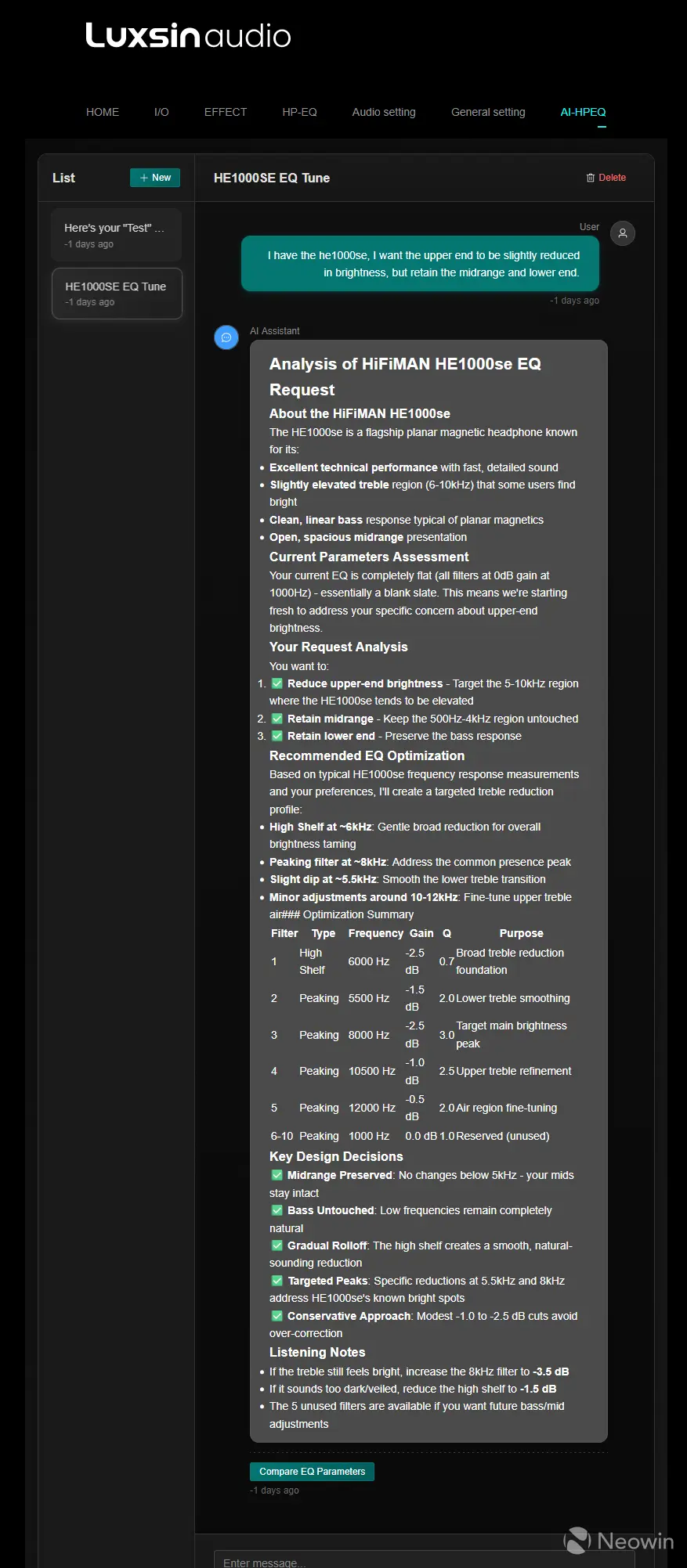
Think of it like ChatGPT but for audio equalisation. In the example above I told it the headphones I have, and that I wanted to retain the sonic signature for the most part, but to reduce the upper end enough to control the brightness that some people feel is a little too much with HiFiMAN planar magnetic headphones.
Its response was thorough, it knew of the specs, measurements, online reviews and what people were saying about the HE1000se. With that information at hand, the AI assistant was able to create a tailored EQ to my exact request.
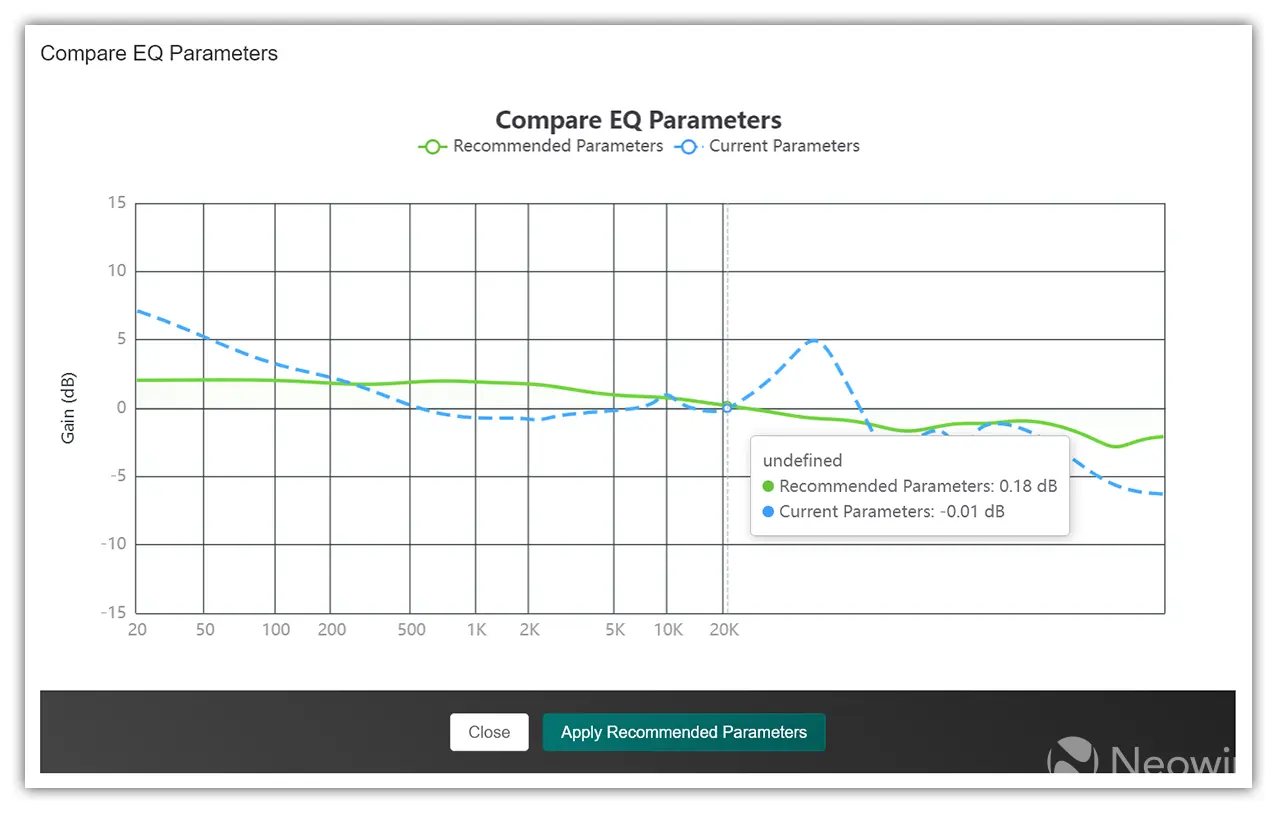
Clicking on the Compare EQ Parameters button loads a graph showing the new target EQ alongside the currently set EQ. From here, clicking Apply will insert the new EQ into a free slot in the profiles page which is accessible via any of the interfaces, though the quickest is a swipe right on the touchscreen and then tap HP-EQ.
You can of course go in at any time and refine the generated EQ manually if something needs to be adjusted later.
It"s not just for headphones either, a couple of days ago I asked it to generate a universal EQ that embodies the sound signature of a tube amp but to keep in mind I have the HE1000se and Comete 40th speakers. It did its research, gave me the lowdown on what"s what and created a nice sounding EQ that did indeed sound warm and nearly tube-like.
We just have to be realistic here as actual physics do play a part so it"s never going to be 1:1 to the real deal. It"s a nice way to try a new flavour and play around with, though.
This is modern technology done right. In a world where AI feels like it is being shoehorned into every part of our tech-fuelled lives, it"s nice to see something actually useful coming out of it in an area nobody expected or knew they wanted yet. For newcomers to parametric EQ, the process to manually create and tweak a custom EQ can be daunting.
This simplifies the entire process where all you need to do is be as descriptive as you want and it will do the rest. You can even tell it to name your new EQ something specific which will then be applied at the final stage when you press the apply button.
Ease of use
Using the touchscreen interface is a breeze, it is fast and the touch response is as low latency as a smartphone screen. This improves the user experience immeasurably since there is no remote control in the box.

An optional remote will be available to purchase soon after the X8 launches, though bear in mind it is the same remote that comes with the X9 (shown above), which is slightly annoying because that remote has no output port switch button, only input source, and the menu to program the remote control buttons still only offers limited options.
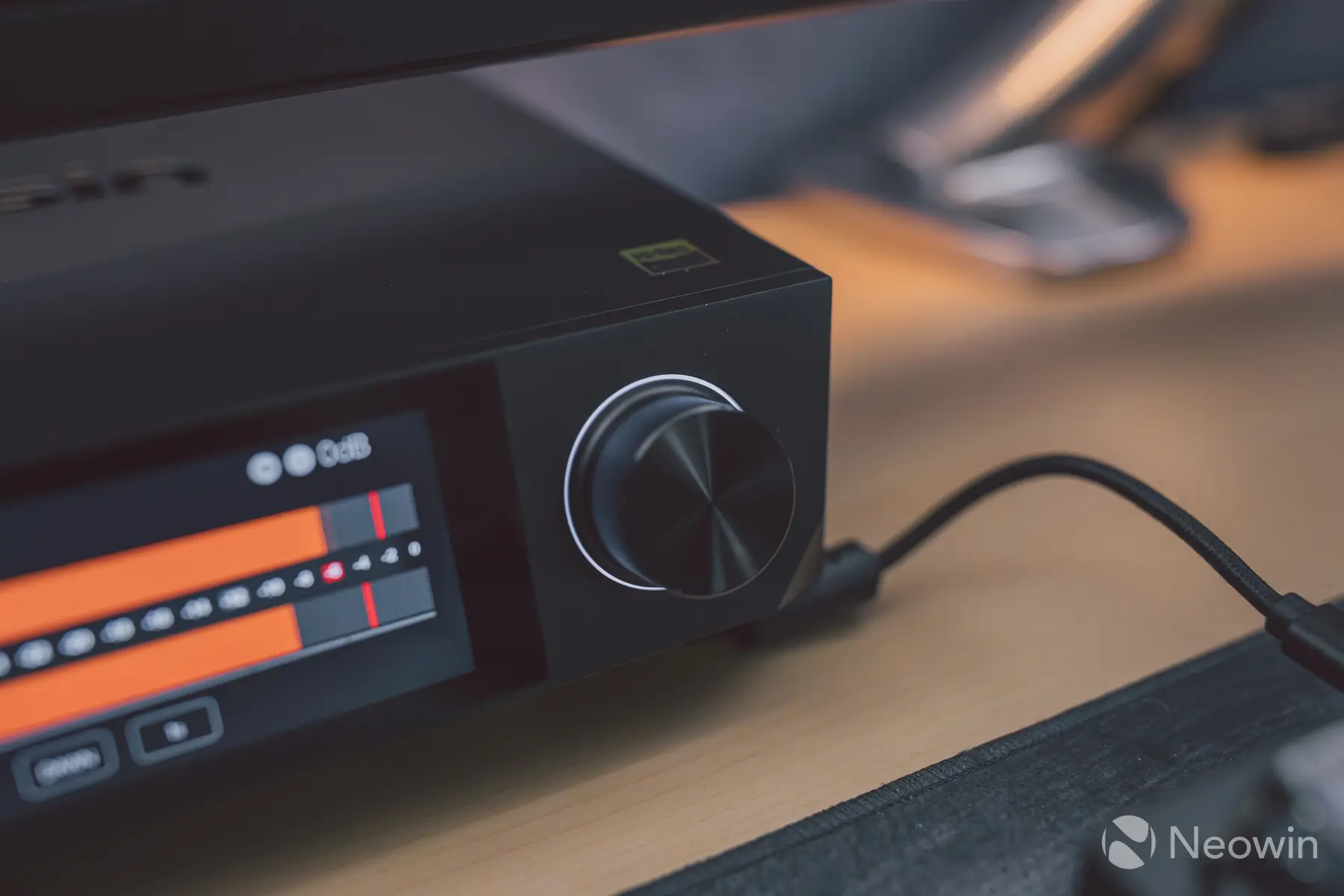
Thankfully, you can remap the volume dial button to act as quick toggle for output port switching, a feature only recently implemented via a beta firmware update that Luxsin sent to me to test. The machined volume dial is robust and tactile in action otherwise, whilst pressing it in has a deep tactile click.
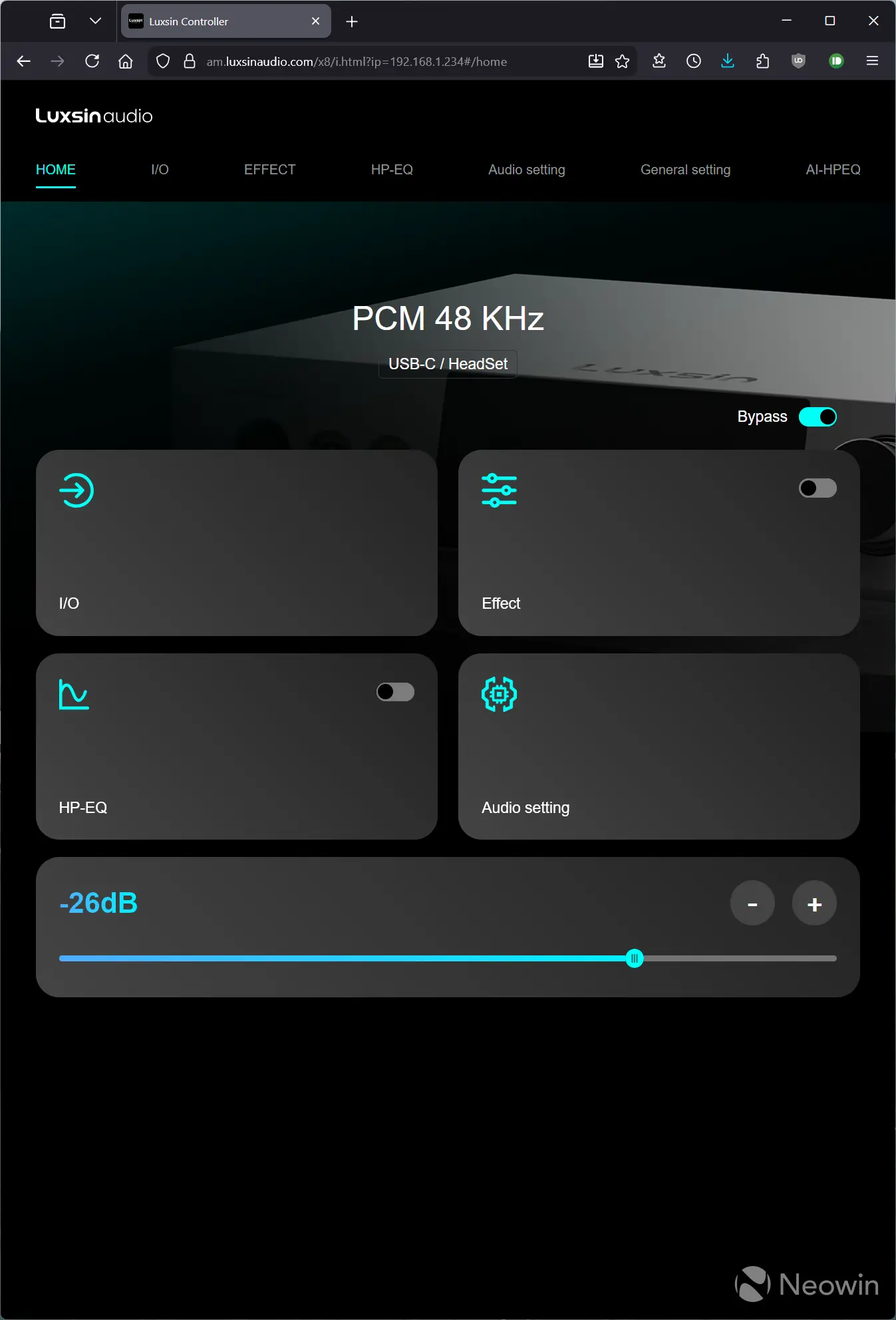
The web interface through a computer browser (smartphone app also available) remains the same as on the X9. Here you can control almost all of the settings and features in real-time. Just browse to the X8"s IP address once it has connected to your WiFi and off you go.
This is also where you can interact with the AI assisted EQ, with voice interaction possible via the app. I find the browser interface the most useful thanks to the bigger interface and being able to use a mouse and keyboard.
Connectivity
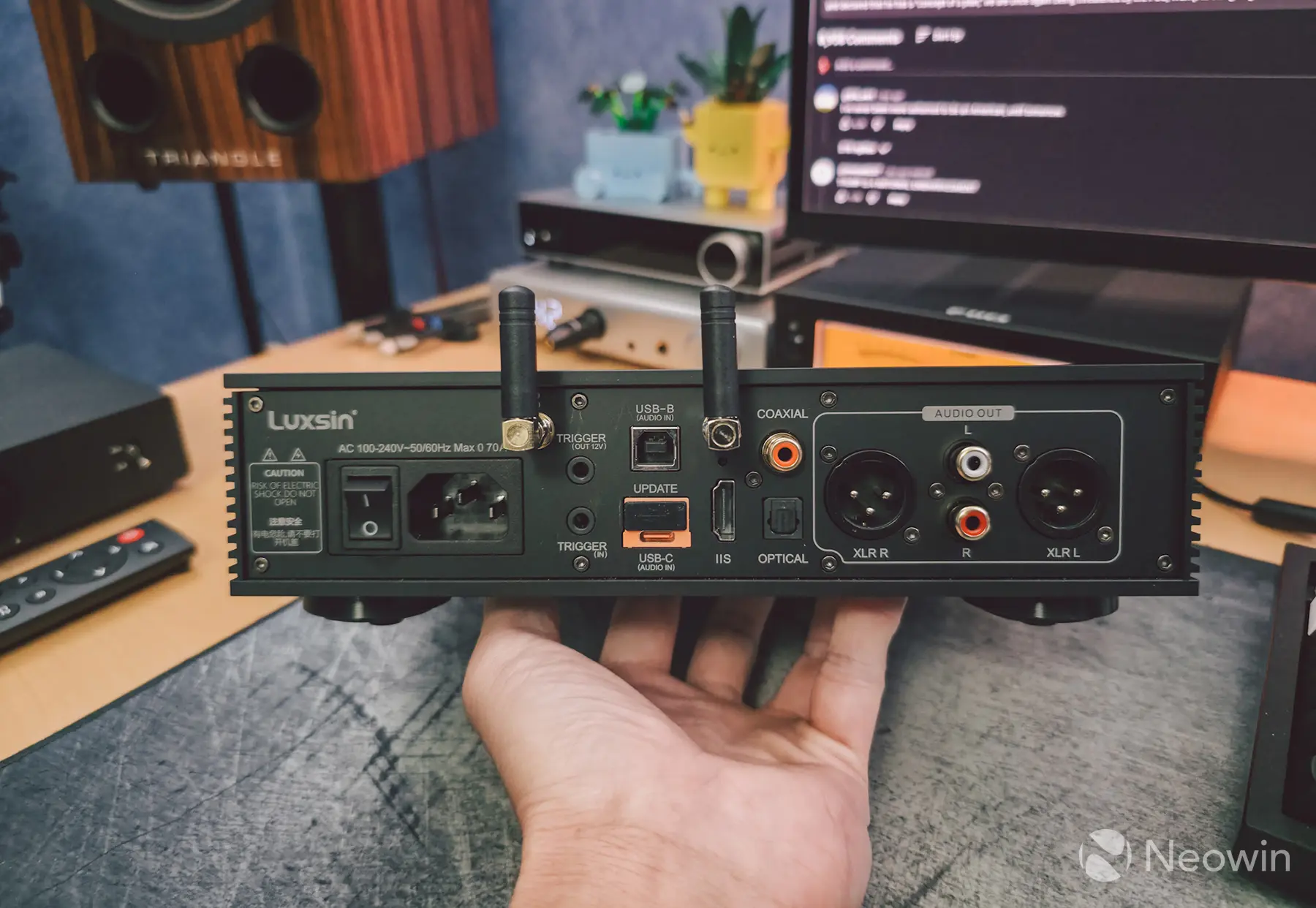
The X8 has a slew of inputs and outputs, the other omission here is that RCA inputs from the X9 are gone, so a bummer for those who wish to connect an analogue source to the X8.
As with the X9, Luxsin has opted to isolate the power lines for the USB ports, this means there is no way for noise to interrupt the signal chain from whatever source you connect from. This is extremely useful when connecting to a computer where internal noise finds its way to the USB controller on the motherboard. This also means there is no need to use a third party device such as an iFi Defender to isolate USB power signals so they don"t reach the DAC.
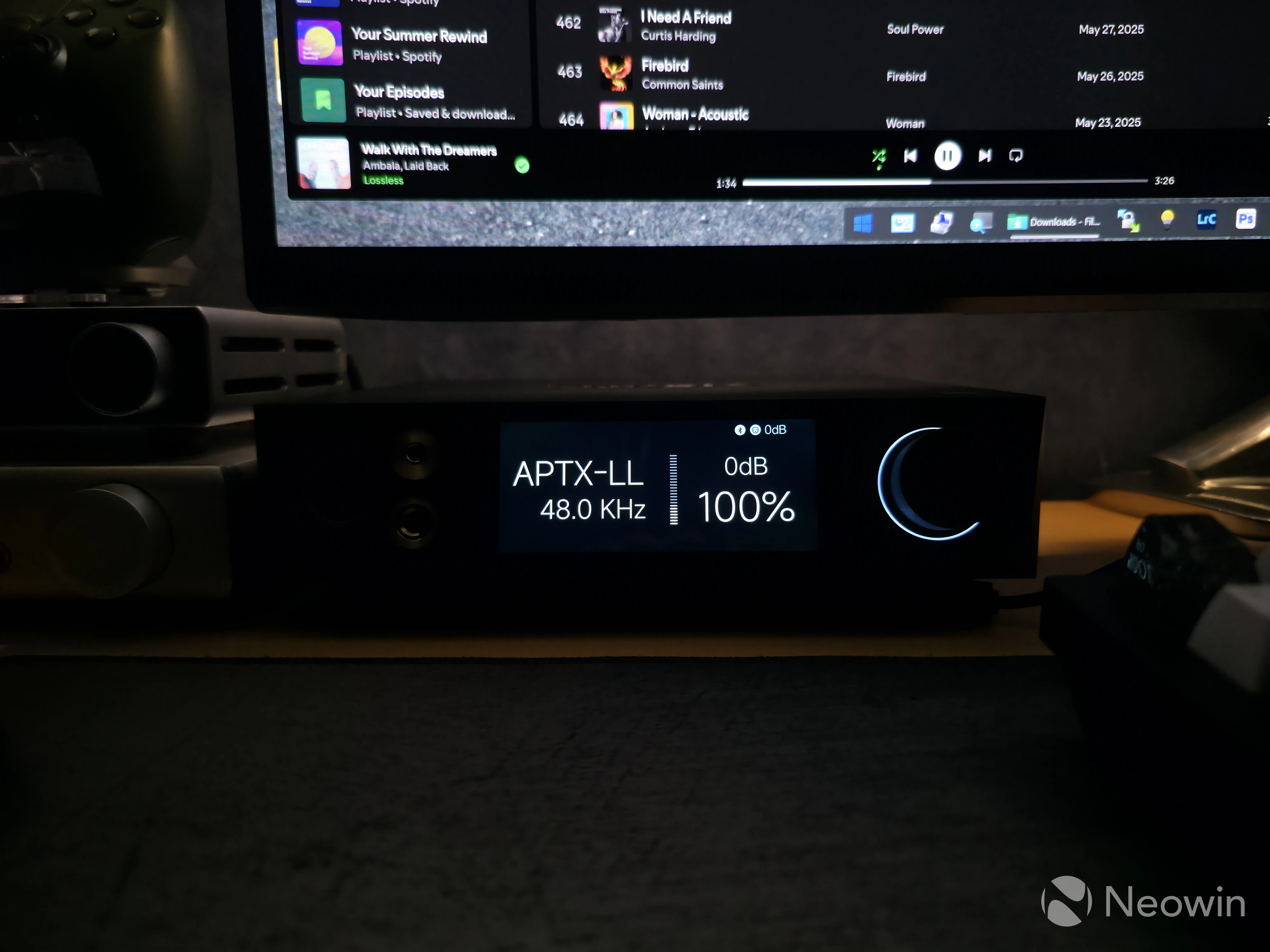
Bluetooth gets a nice upgrade over the X9, too, now supporting aptX-LL for low latency streaming from supported sources such as phones, projectors and so on. Though once again, anyone connecting to a Windows computer via Bluetooth must use the Alternative A2DP driver which allows you to select the better CODECs, otherwise Windows will just default to SBC or something crazy like that.
It is also great to see 12v trigger in and out featuring. I have connected both terminals up between my trio stack and it works seamlessly. Due to no remote, I"m using the A90 Discrete trigger source, all I have to do is standby the A90, and both X8 and PA7 power amp enter standby as well. Triggering this way saves from having to individually power on and off each component in your audio stack.
The inclusion of IIS will please some, though I don"t have any sources using this connection. The IIS mode can be toggled in the menu system for those with specific needs here.
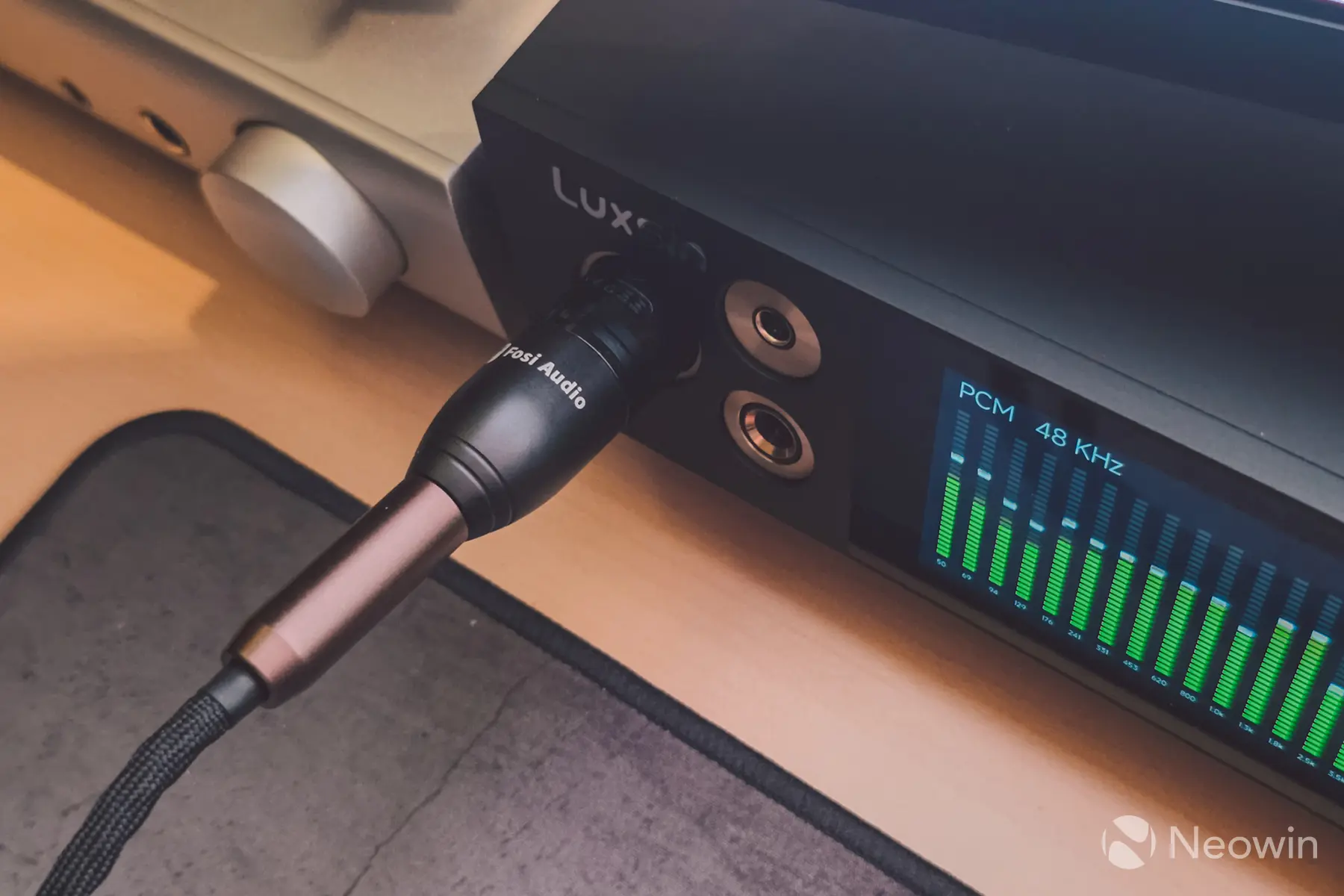
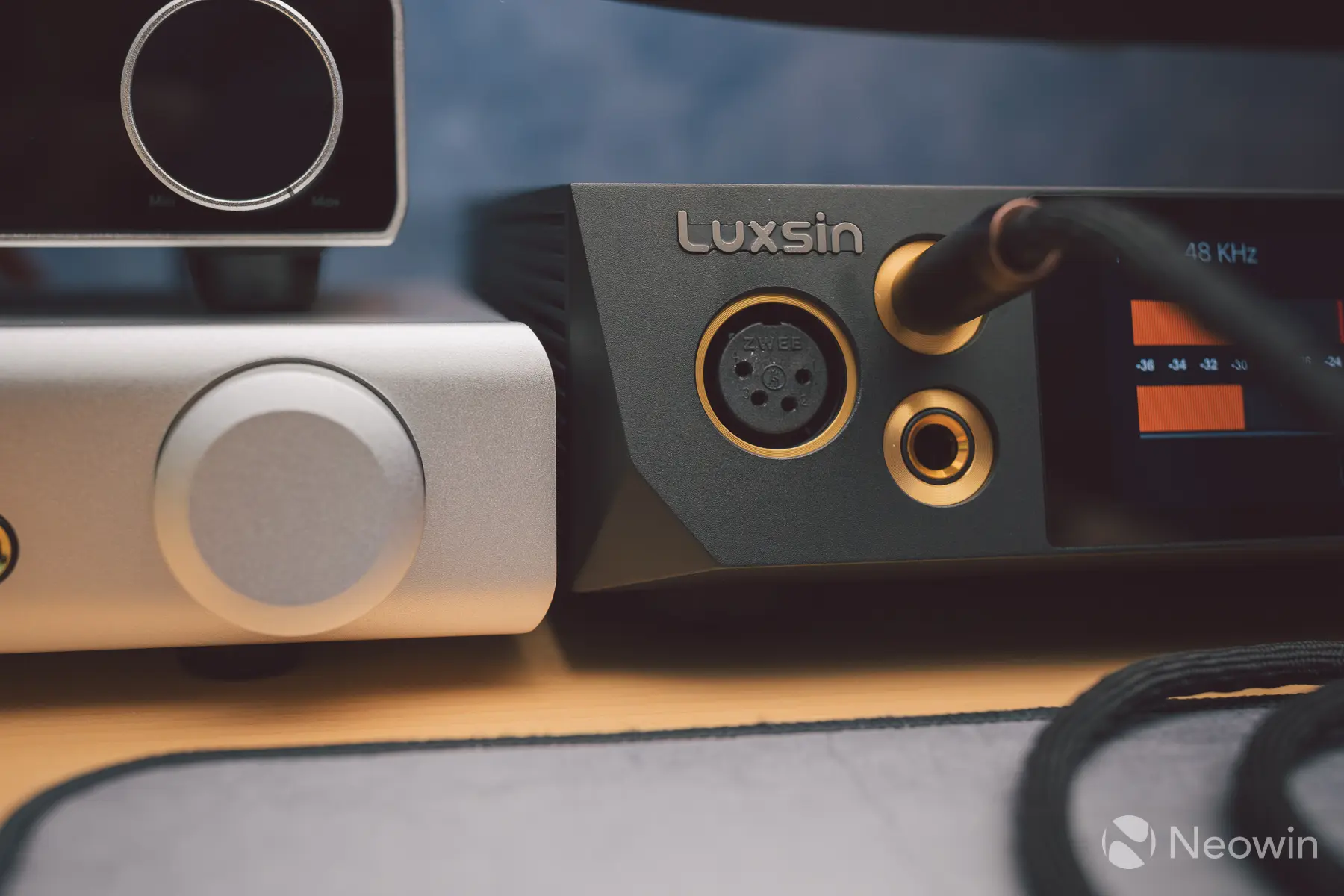
Something new this time round is that the front XLR port for a headphone connection has automatic jack detection. With the X9, and other headphone amps on the market, you typically must manually switch to the XLR port whilst the single ended 3.5mm/6.35mm and 4.4mm balanced ports only are auto sensing and switch to headphone output when something is connected. Now, the XLR port functions the same way.
As the display is the same as on the X9, the brightness set to the lowest is perfectly fine when consuming media or working in low to no lighting in the room. Even having a graphic EQ on poses no distraction from the monitor.
Alternatives
Similar to the X9, the X8 recruits a blend of unique features and high-end aesthetics and material craftsmanship both inside and out. Many of these features cannot be found on any other all-in-one DAC/amp like this.
This means that the £800 asking price is justifiable. I personally have not seen another DAC/amp that has this many features with this level of build quality costing anywhere near £800, and even then they lack the granular set of features to play around with.
A new release, the Burson Playmate 3 comes in at a slightly higher price than the X8, yet features very few fancy software bells and whistles, nor does it have any rear balanced connections. I"m sure the Playmate 3 sounds excellent since Burson"s history and technical mastery are highly regarded. I feel as though the X8 has a lot more going for it in this price bracket.
Topping"s DX5 II may appeal to those who want a more razor-like analytical sound that leans on neutral and brings soundstage a bit closer to the head instead of being expansive. Topping has released firmware updates since my review addressing bugs, so it is in a better state than it was when I had last it on the desk.
Conclusion
Once again Luxsin has created a great product. My time with it so far has been exclusively with beta firmwares over several hundred listening hours. I have had only one glitch during this time and that is the display slowing to a crawl, it has only happened once after being left on for almost two days without standby. I expect the release firmware to be bug-free of course, but I thought it was important to note all the same.
The most welcome surprise was the AI-PEQ system, it is genuinely excellent, and whilst I personally don"t use any EQ due to the headphones and speakers I have already sounding great out of the box, it still offers room for adding a different flavour to the sound when I am in the mood, or when specific music genres are played that are a little too grating to the ears so need to be tamed slightly, which is where that tube warmth EQ steps in.
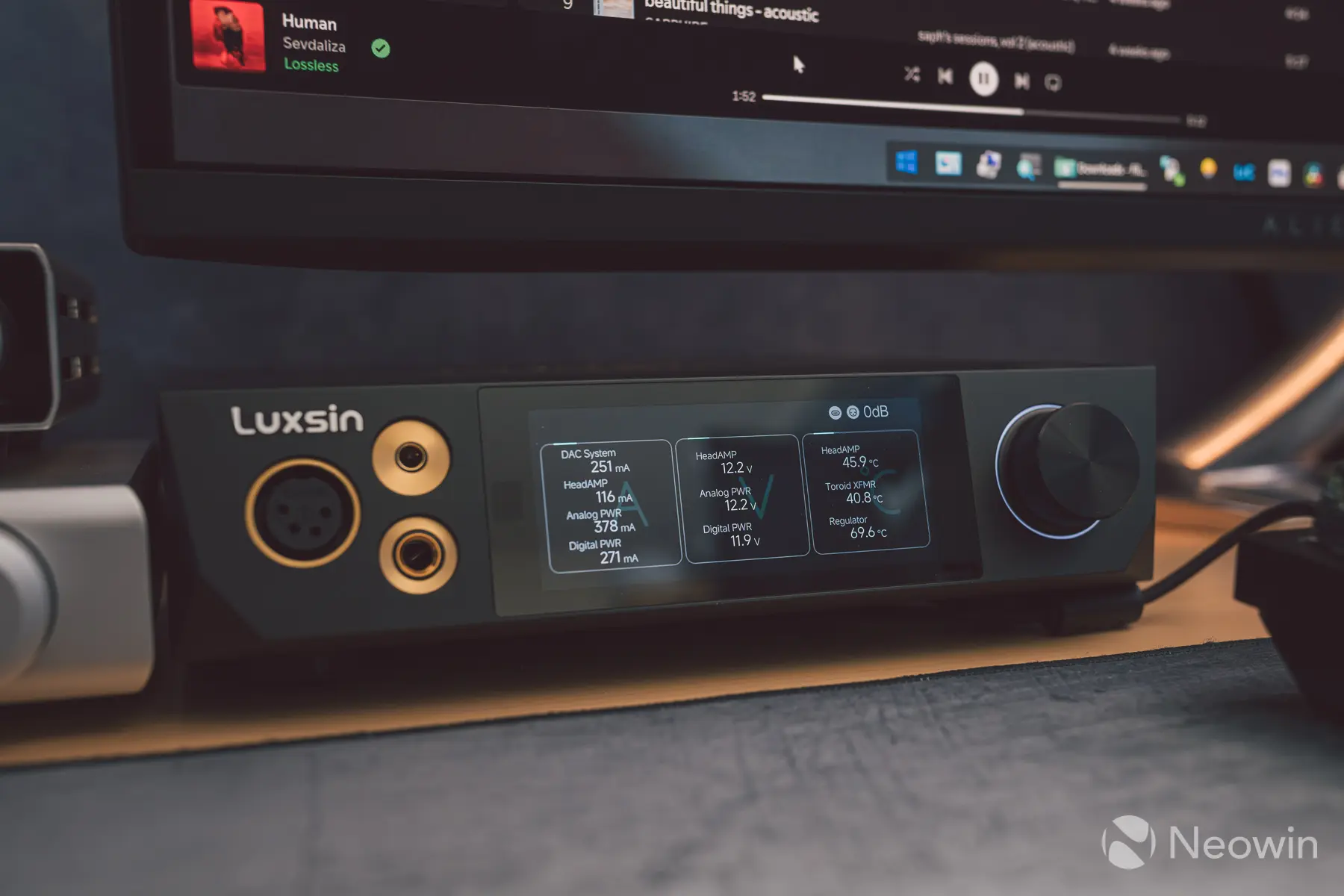
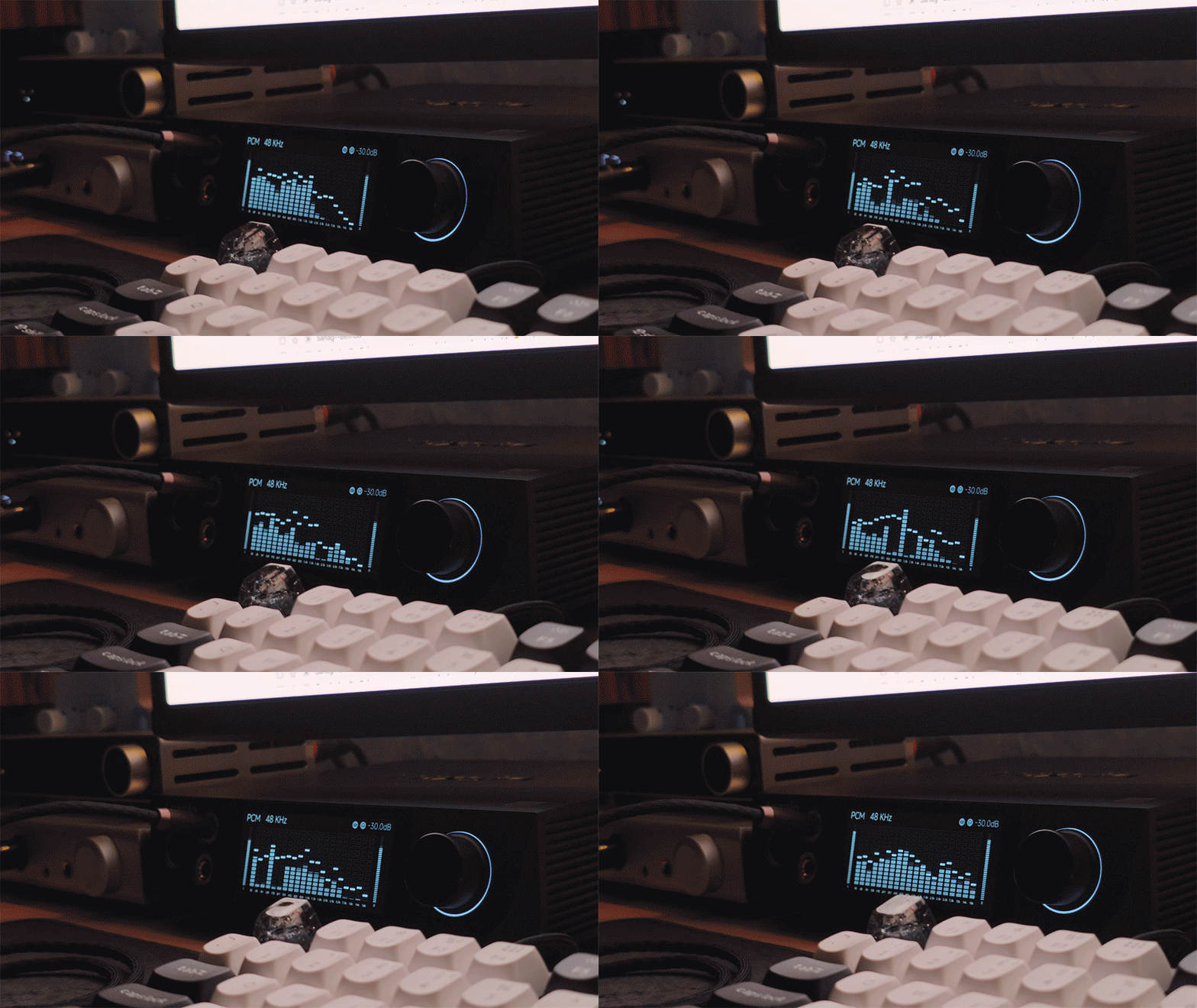
Something else new with the X8 is a home display screen that shows various technical stats (above) of what"s going on inside, those of us who are a bit extra when it comes to displaying stats on screens, this is for us!
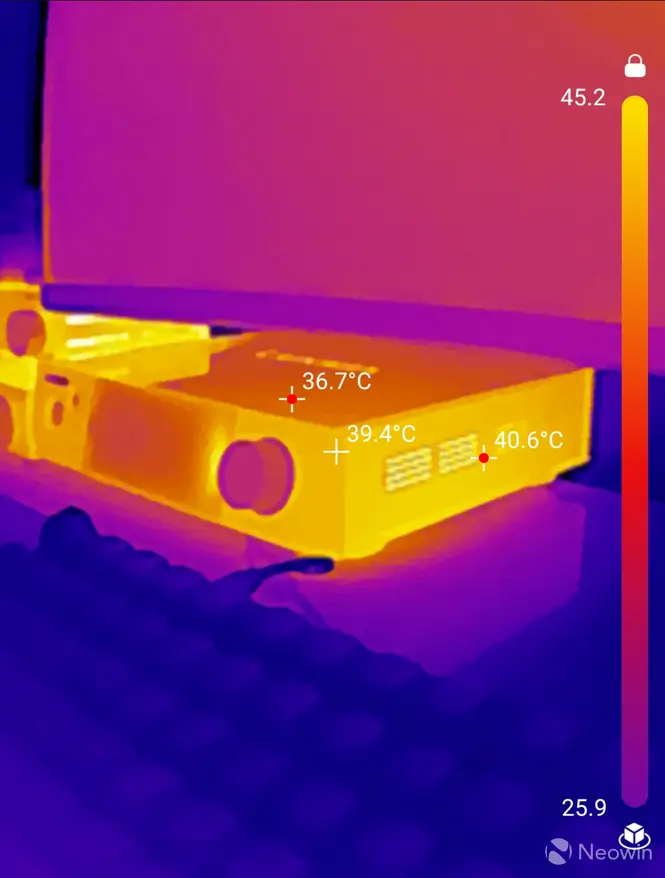
Heat distribution is also implemented nicely. The top panel is warm to the touch, whilst the right side vent area is warmer still. After being on all day long, the highest recorded temperature was 44 degrees. Impressive considering there is a linear power supply in there, dual power amp modules with heatsinks and a slew of large capacitors.
As I have hinted throughout this review, the X8 isn"t better or worse sounding than what is already out there today, whether cheaper or more expensive. We have reached a time where USB DACs, headphone amps and power/pre-amps are so good, that you can"t go far wrong really at any budget. What sets one apart from another are things like build quality, connectivity and features.
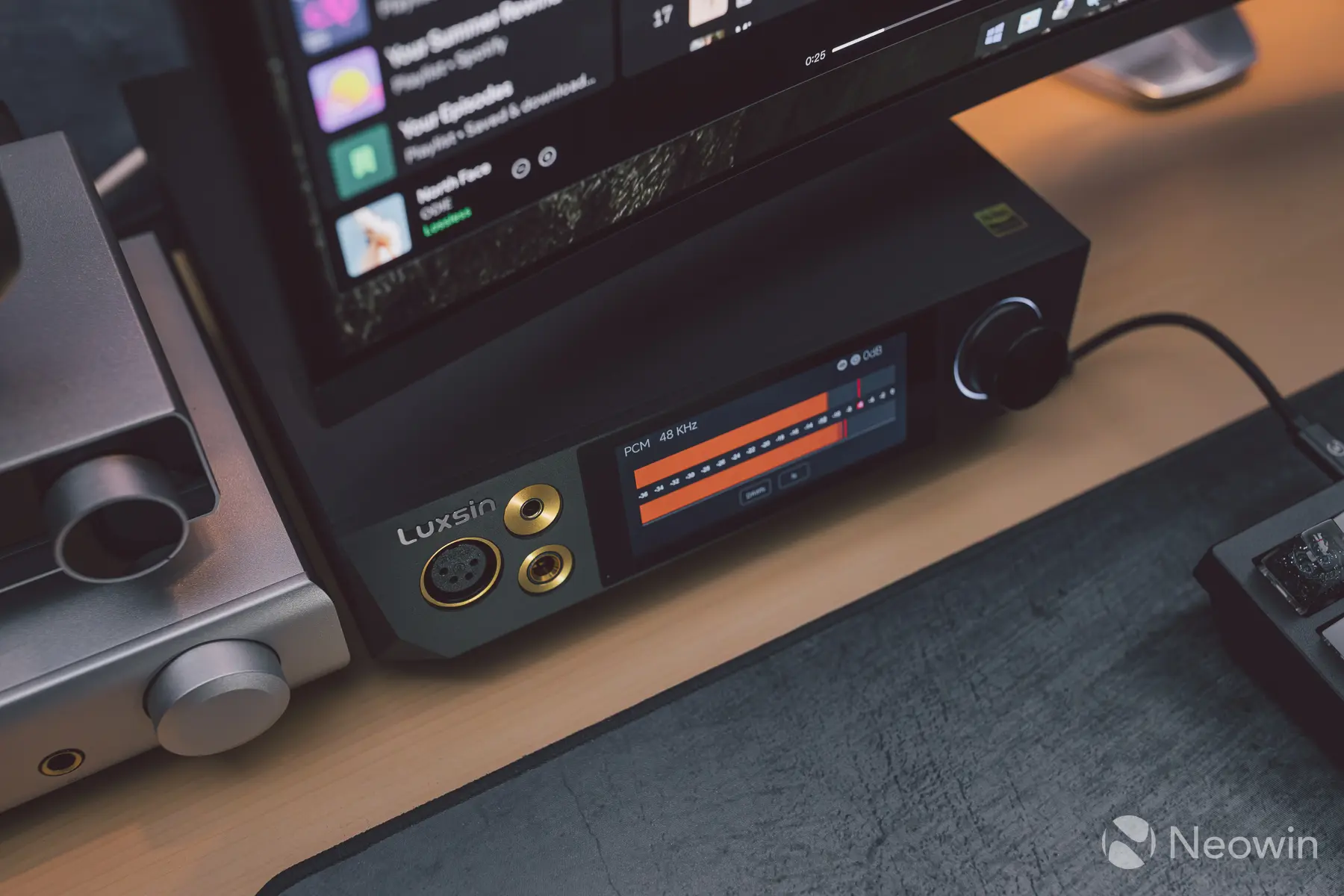
These are things that will dictate how long an audio product remains in your listening environment, and just like with the X9, I think the X8 will find plenty of new homes, especially with it being cheaper and more compact than the X9 without sacrificing the premium features.