
Back in April, Anthropic launched Claude Opus 4.7, its latest flagship model featuring improvements in complex software engineering tasks. Today, Anthropic announced Claude Opus 4.8, its latest flagship AI model and a direct upgrade over Claude Opus 4.7. The company claims that this new model brings improvements across coding, agentic tasks, reasoning, and knowledge work.
Here are the official benchmarks:
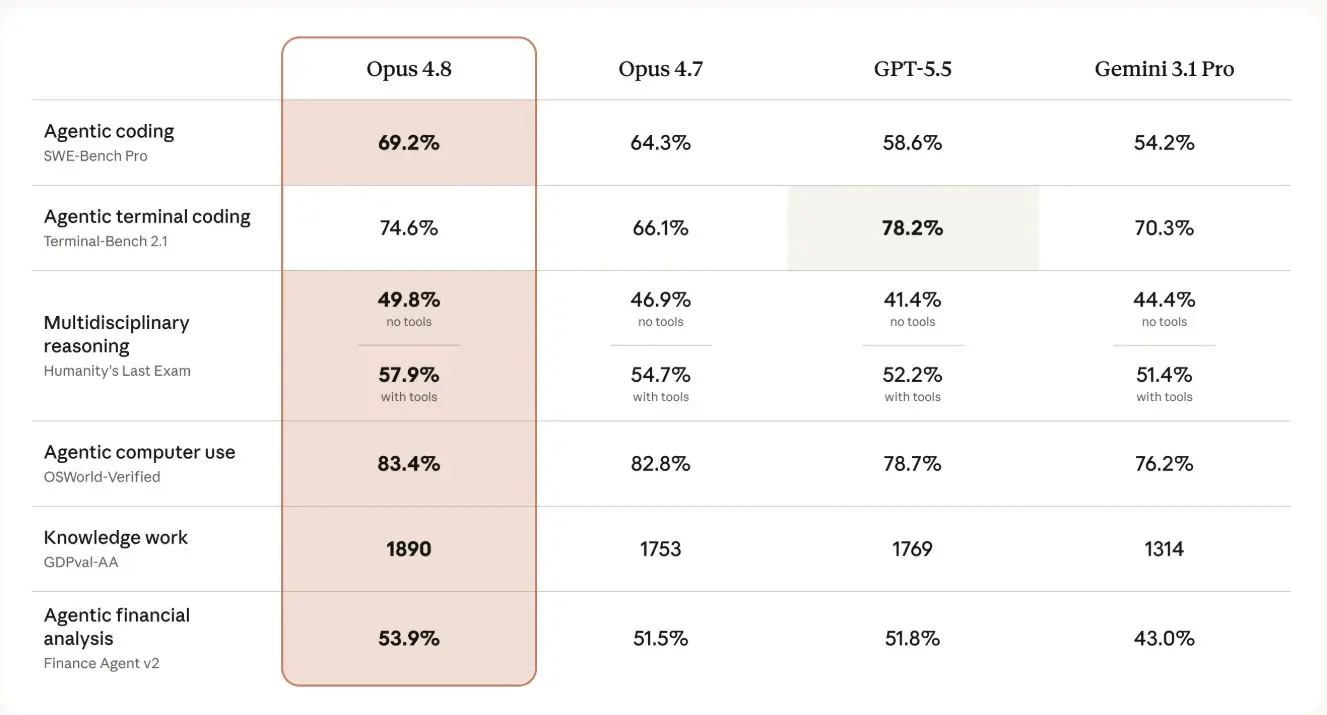
The new Claude Opus 4.8 model is available starting today across Claude endpoints. Developers can also access it through the Claude API using the claude-opus-4-8 model name. Pricing for regular Opus 4.8 usage remains unchanged, costing $5 per million input tokens and $25 per million output tokens.
However, Anthropic is cutting the cost of its fast mode. Fast mode for Opus 4.8 can run at up to 2.5 times the speed and is now priced at $10 per million input tokens and $50 per million output tokens, making it three times cheaper than previous fast mode models.
Anthropic mentioned in its announcement blog post that one of the biggest improvements in Opus 4.8 is reliability during agentic work. According to the company, Opus 4.8 is around four times less likely than Opus 4.7 to let flaws in its own generated code pass without comment. Opus 4.8 also demonstrated substantially lower rates of misaligned behavior compared to Opus 4.7.
Anthropic today also announced a major new research preview feature called dynamic workflows in Claude Code. This feature will allow Claude to plan large tasks and run hundreds of parallel subagents in a single session, targeting large-scale engineering work like codebase migrations. Dynamic workflows are available in the Claude Code Enterprise, Team, and Max plans.
Anthropic now allows users to control effort on claude.ai and Cowork, similar to features that OpenAI's Codex and ChatGPT have offered for months. A new control next to the model selector allows users to decide how much effort Claude should spend on a response. Opus 4.8 defaults to high effort, and users can also choose "extra" or "max" effort depending on the task at hand. Finally, the Messages API now supports system entries inside the messages array.
Anthropic also confirmed that it will bring Mythos-class models to all customers in the coming weeks.
















0 Comments
Load the comments and join the conversation!
Read the comments, ask the editors questions, show respect and join the conversation.