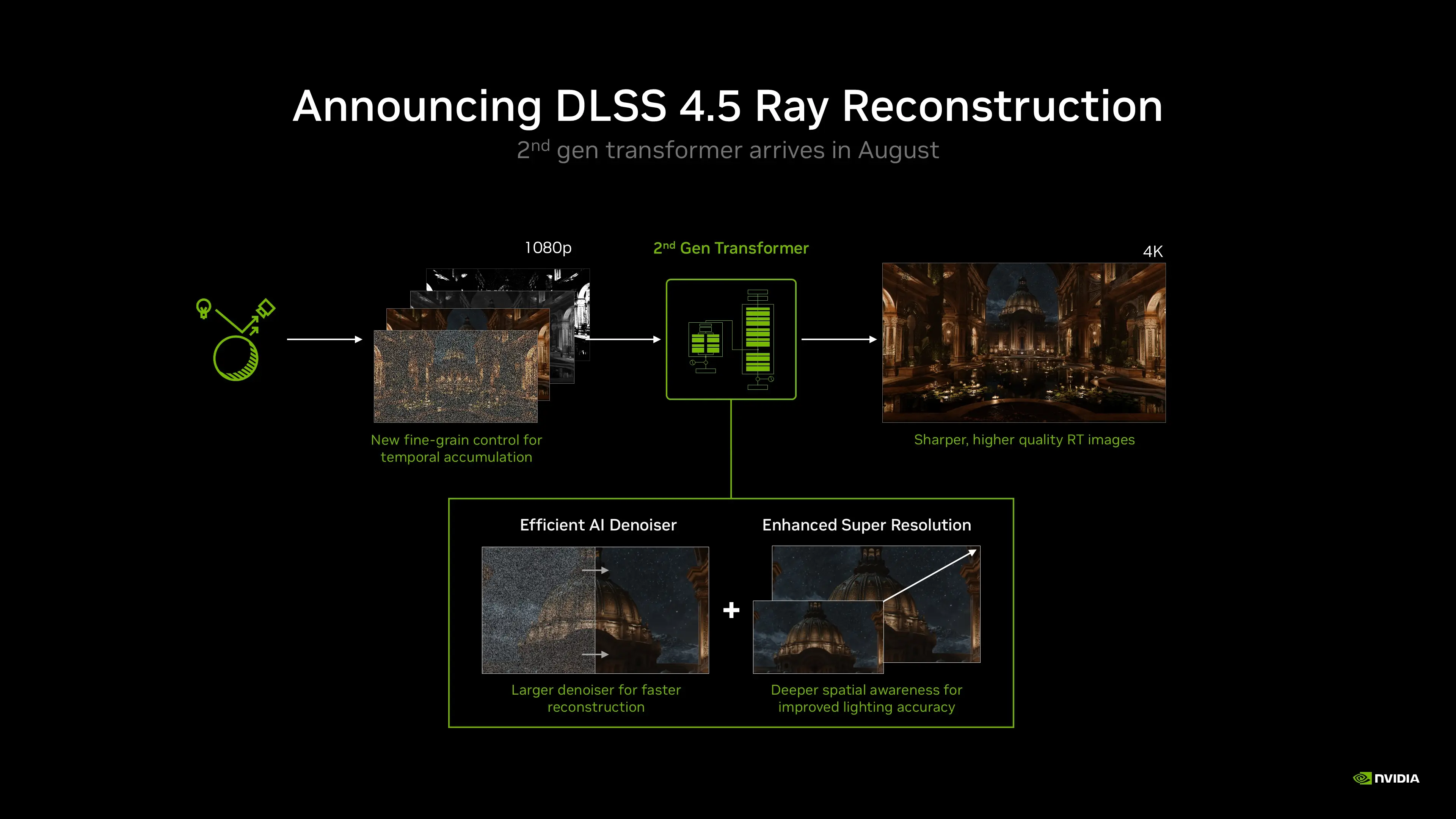
Nvidia already had a big announcement at Computex 2026, revealing its new RTX Spark ARM processors alongside Microsoft. However, it also had something new for gamers that are using its RTX hardware and DLSS tech, and it's spelling good news for those enjoying raytracing in games.
Today, the company unveiled DLSS 4.5 Ray Reconstruction, bringing an updated version of its transformer model that promises to deliver even better image quality than before in ray-traced and path-traced games.
"Replacing traditional hand-tuned denoisers, it uses an NVIDIA supercomputer-trained AI network to generate higher-quality pixels in the noisy parts of a ray traced frame where rays were not sampled," says Nvidia about this Ray Reconstruction implementation. "The model unifies denoising and Super Resolution into a single model, intelligently analyzing temporal and spatial engine data to reconstruct sharper, more stable, and higher-fidelity high-resolution images."
While touting a 35% and 20% better compute capability and parameters, respectively, Nvidia says the new tech will have similar performance to the last-generation model. Players should see better lighting and stability in their ray-traced games using this model without using the detail from the original image.
DLSS 4.5 Ray Reconstruction will be available sometime in August 2026. The update will be available across all RTX hardware generations, including the 20, 30, 40, and the latest 50-series Nvidia RTX graphics cards. It's unclear if the performance claims will apply to previous-generation cards too, however.
As for supported titles, at launch, 27 games, including Alan Wake 2, Indiana Jones and the Great Circle, Cyberpunk 2077, DOOM: The Dark Ages, and PRAGMATA, will be available for using the new Ray Reconstruction model. Outside of games, Nvidia announced that Blender Cycles will be integrating Ray Reconstruction as a new denoiser too, which should improve the interactive viewport's functionality. As Nvidia expands its DLSS tech further at Computex, at the same event, AMD also showed off how far its own upscaling solution, FSR, has come in recent months.


















7 Comments
Load the comments and join the conversation!
Read the comments, ask the editors questions, show respect and join the conversation.