
Google has confirmed that its redesigned Play Store billing and fee structure will take effect on June 30, 2026, in the United States, the United Kingdom, and the European Economic Area. The changes will let eligible developers offer their own payment systems or send users to an external website for purchases, while separating Google’s platform service fee from the cost of using Google Play Billing.
The rollout puts concrete dates and detailed rate cards behind the broader Android policy overhaul Google announced in March. That announcement followed a proposed settlement with Epic Games intended to resolve their long-running disputes over app distribution and payments, although the U.S. portion of the agreement still requires court approval.
Under the new billing choice program, developers selling digital content or services can display an alternative payment option alongside Google Play Billing. They may also direct users to their own websites to complete a purchase. Developers can use Google’s standard payment-choice screen or design one that complies with the company’s user-interface rules.
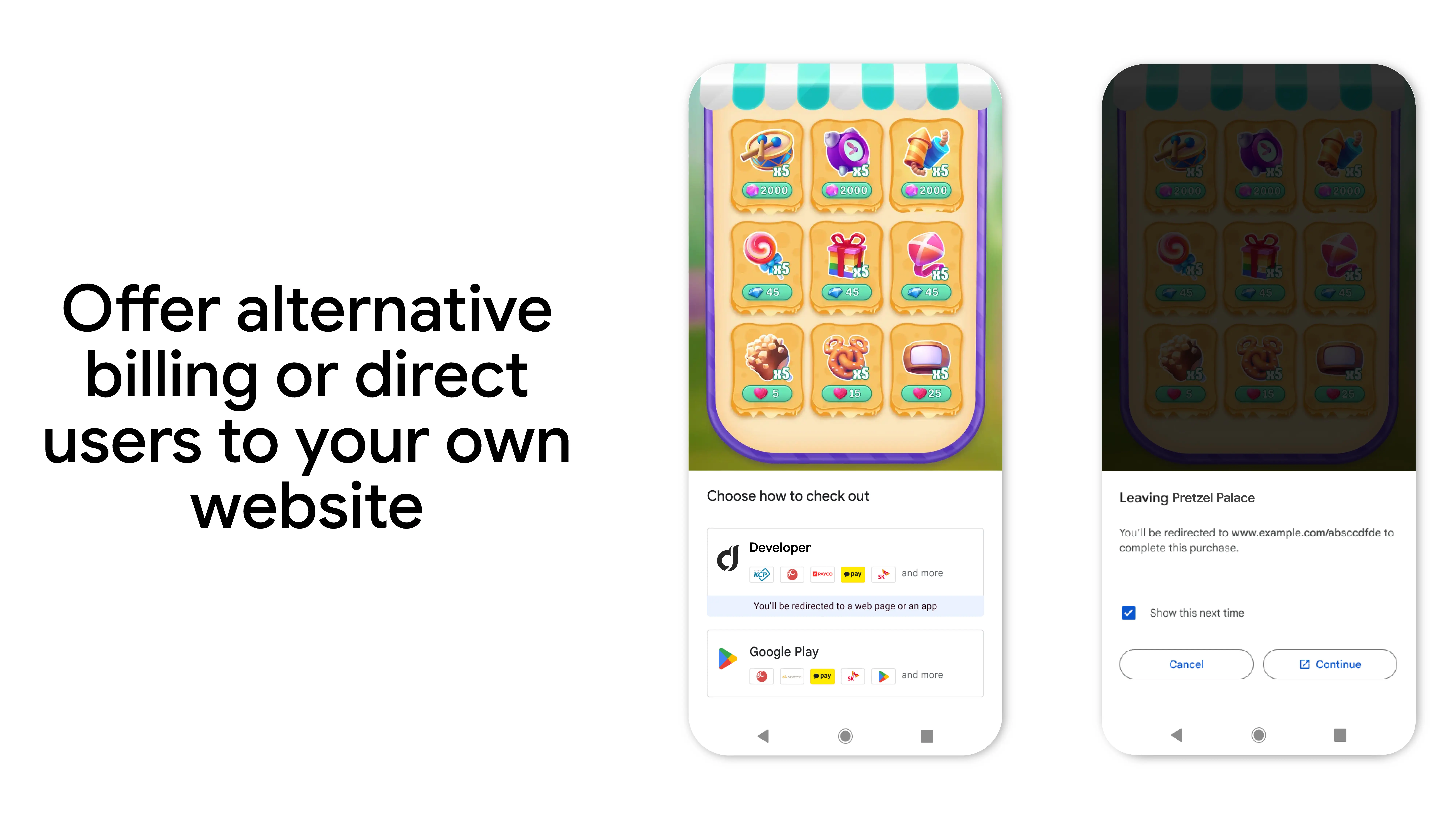
Choosing another payment processor does not eliminate Google’s cut altogether. The company will continue charging a service fee for transactions associated with apps distributed through Google Play, regardless of whether payment is handled by Google, an alternative provider, or a developer’s website. Google argues that this fee covers the value and infrastructure provided by Android and the Play Store.
For developers earning up to $1 million annually, the service fee will generally be 10 percent. That rate also applies to auto-renewing subscriptions. When Google Play Billing is used in the U.S., U.K., or EEA, Google will add a separate 5 percent billing fee, and developers processing payments elsewhere will not pay that additional charge.
This means Google’s familiar flat 30 percent commission is disappearing, but developers will not necessarily see a dramatic reduction on every transaction. An in-app purchase from an existing user processed through Google Play Billing can still reach a combined 30 percent. The biggest savings are likely to come from subscriptions, smaller developers covered by the $1 million tier, and companies able to move customers to their own payment infrastructure.
Google is also offering lower rates through its Apps Experience and revamped Games Level Up programs. Apps and games that satisfy the company’s requirements can qualify for 15 percent service fees on new-install transactions and 20 percent on existing-install transactions. The criteria include performance and reliability standards, support for additional Android device categories, and selected platform features. Those program rates are scheduled to become available in the initial markets and Australia on September 30.
For consumers, the immediate effect will depend on whether developers adopt alternative payments and pass any savings on through lower prices. For developers, however, June 30 begins a more flexible but considerably more complicated Play Store economy in which distribution, billing, install dates, revenue thresholds, and program participation can each affect Google’s final cut.
Google is also separately developing a Registered App Stores program designed to simplify the installation of qualifying third-party stores. That initiative is expected to arrive with a major Android release later in 2026 and will launch outside the U.S. first.
Google says the rest of the world will receive the changes by September 30, 2027, although billing rates for markets outside the US, UK, and EEA have not yet been announced.















0 Comments
Load the comments and join the conversation!
Read the comments, ask the editors questions, show respect and join the conversation.