
As is often the case, the latest Windows 11 Patch Tuesday update is said to be causing issues for several users as they report a wide variety of bugs. Although Microsoft does deserve blame on many occasions, credit where credit's due, the company has been fast to act recently as it patched a major critical network flaw with a hotpatch update KB5084597.
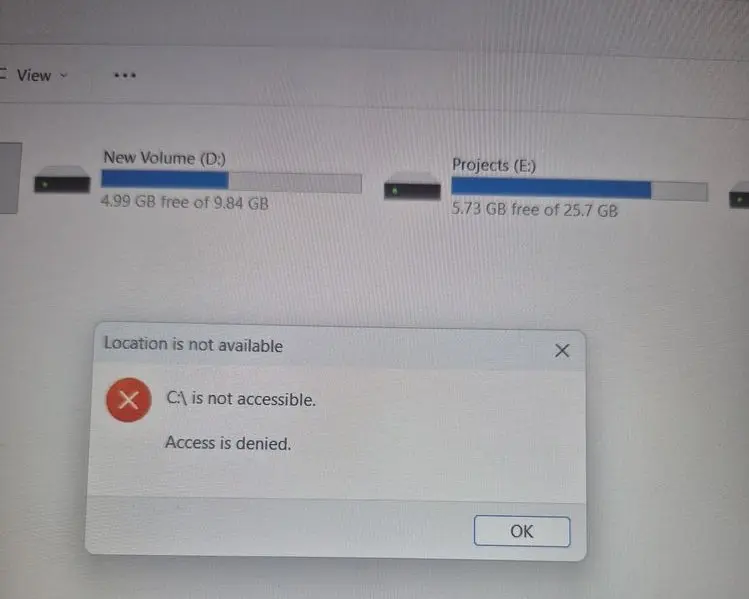
Besides that, Microsoft has also made the necessary changes to fix a major bug wherein user access to C drive got denied. When the Redmond company first reported the issue, it was also confirmed that the bug was likely isolated to Samsung devices only and that it was a result of a compatibility conflict or something of that sort.
As such, Microsoft has confirmed that the affected application was removed from the Microsoft Store to prevent further downloads. The company has added that it was Samsung's fault and the recent Windows 11 updates were not to blame for this major mishap.
It writes: "Microsoft and Samsung investigated these reports and concluded that the symptoms were caused by an issue in the Samsung Galaxy Connect app. While the reports coincided with recent March Patch Tuesday timing, investigation confirmed the issue is not caused by current or previous Windows monthly updates. The issue has been observed on Samsung Galaxy Book 4 and Samsung Desktop models running Windows 11, versions 24H2 and 25H2, including NP750XGJ, NP750XGL, NP754XGJ, NP754XFG, NP754XGK, DM500SGA, DM500TDA, DM500TGA, and DM501SGA.
The affected Samsung Galaxy Connect application was temporarily removed from the Microsoft Store to prevent further installations. Samsung has republished a stable previous version of the application to stop recurrence on additional devices."
Microsoft adds that it is still collaborating with Samsung on the issue and further details will be provided later as the investigation progresses.
Following the issue, a user on Reddit Theangelo2 did some further digging and uncovered that the problem could have been happening due to a broken discretionary access control list (DACL) implementation on Windows images on these Galaxy devices. Hence it looks like Microsoft's blaming of Samsung software is righteous.













Not what's being discussed in the article, but Samsung Magician has been broken in Canary builds for a while now.
I don’t do any Insider stuff but Magician never opens for me.
interesting.. do you know if canary builds switched to the new native nvme driver?
I haven't looked, but it's that or an API change.
So who was responsible for the QA testing before it was released?
Are they supposed to test the update on EVERY hardware make and model in the world? This is isolated to a VERY specific hardware/software combination. I think that, for this one, this is not on Microsoft. This is bound to happen from time to time with so many combinations out there.
Samsung
I think you misunderstood my point. I'm not blaming anyone, I'm asking how it happened.
Samsung provides hardware. That hardware uses the Microsoft OS.
So Microsoft releases an update. Did they provide it to Samsung to do the testing before it became a public update? Did Samsung have the QA in place to make sure that it was going to be compatible with all their hardware? Or should it be up to Microsoft to do the testing across all hardware that they supply software to?
An Operating System is just as integral as the hardware that it works on. I'm not placing blame on either side on that, I'm just trying to do an AAR.
So the question remains: where did the QA faulter?
In this case Samsung is also the provider of software, since the application is made by Samsung. Microsoft cannot test it with every manufacture's software out there, so I think this one's on Samsung.
Of course. Once again, I'm not placing blame on either party at this point.
But again, Microsoft is the original provider, and software engineers create programs according to what Microsoft gives as a groundwork. Then Microsoft releases an update that changes the ground that the software was designed upon.
My point is that once again QA hasn't been done properly. And to be fair I am looking at Microsoft because their QA recently has been shabby, to put it lightly.
I guess what I'm getting at is this: a problem occurred, who needs to fix this one and who needs to make sure that it doesn't happen again?
Got it, sorry. I thought you were referring to "who tested to update (the Windows update) before releasing it?" I see your point.
Samsung
Samsung created buggy software.
it's not possible for Microsoft to test every hardware\software combination in the world. amount of possible combination are impossible to phantom.
if samsung engineers did everything correctly, than this wouldn't happen.
MS still holds some of the blame. As always.
so if your fridge catches fire because your fridge was defective, do you blame the person that build the house? I guess the builder should have tested every type of fridge ever for sale to tell you which ones might catch fire.
If we assumed that Samsung Galaxy Connect completely adhered to all Windows platform standards and a Windows update had this effect, then sure, that is on Microsoft.
However, with nearly all software compatibility issues I have seen, the fault ends up being with the software not following those development standards.
Just think of all those Vista UAC issues with programs that tried to write documents and settings in whatever folder they fault like. Microsoft had standards for that going back over 10 years at that point, they were just not always followed.
With Vista it was more of an annoying nag, having to constantly push Yes on UAC prompts, but lets imagine for a second that it fully broke the application. In that case, who would you be suggesting should have done the QA to resolve that issue?
Ok, but something broke the system. An update was made that made the software incompatible with the new update.
Did Samsung not do the proper QA? Were they notified and presented with the update before it got into the wild so that they could test it with their current software?
Based on the fix MS just published, which requires reestablishing user access in NTFS, it sounds like Samsung was doing some crazy stuff. There is no reason any app should change NTFS permissions for the root of the C drive!!
This is my very rough understanding of what happened (don't quote me on this stuff, still filling in some gaps with guesses). It looks like Galaxy Connect made a NTFS permissions change to the C drive, likely with the intention of allowing its own auto-updater to install updates without asking for admin rights. It sounds like the security descriptor was corrupted at the time the application was installed, which didn't break access right away because the low-level hashes still worked. It sounds like this MS update triggered an NTFS continuity refresh, resetting the low-level binary hashes to match the descriptors.
Assuming some of those guesses are correct, it was a ticking timebomb waiting to go off. Any number of things could have started that refresh process. In fact, I suspect some number of users did see the problem early, but it would have happened in such small numbers that no root cause analysis was ever done.
In this case; I suggest the only fault MS has is that the OS should have blocked the app from making those changes in the first place. Even with admin rights, you shouldn't have access to make system breaking changes like that. That is almost as bad as using admin rights to format the C drive while Windows is running, something you could do in the past, that you no longer can.
Blame game. They won't acknowledge about going backwards everyday.
MS is really not at fault here https://redd.it/1rtx0wm
A definite Microsoft problem not having proper QA before publishing whatever update to public ... or probably they fired most QA engineers and started to use customers for the purpose. 🤔
Samsung is bundling their app into their distribution image. They could use a post-install script that could have safely failed when the app was not found but they hard-baked it. I'm not a MS fan, but this case is entirely on Samsung.
so you expect Microsoft to have few billion computers in some giant building to test every possible combination of hardware\software in the world?
possible combination are impossible to calculate.
Its OEM brands responsibility to create their software correctly.
So MS have to QA every bit of software out there then... er... no.
It's a big step forward for n00bs when they realize that any software they run can exhibit troublesome bugs, that everything that goes wrong is not the fault of Windows--or the motherboard, which is the other big go-to for n00bs who experience problems. Fortunately, everyone eventually graduates from the n00b class if they hang with it. I've been running 24H2 and 25 H2 for many months, and have had no problems with Magician, or with Samsung drivers.
But I'm running 26220.8062, atm, which is a Beta channel 25H2 build--if you run Dev or Canary builds you can expect a plethora of bugs... Years ago I was in the Dev channel but dropped back to the Release Preview channel because I got tired of builds refusing to install and got tired of hitting the "Pause updates for 1 week" button...
 Beta channel is as far up the bug chain as I wish to go these days. Insider's has come a long way from its origins.
I've been on Dev channel for years, without problem. But I'm also an excellent troubleshooter. If you decide to try Dev again, and get stuck, reach out -- I'd love to help you solve any problems there!
Oh please, the app connects a phone to a PC, not a low level drive tool. Someone PLEASE explain how that leads to drive C being inaccessible in ANY way that legitimately could make it Samsung's fault.
If it was Magician that was the issue, I would buy it. But connect? That seems mighty sus to me.
Yes but what is Samsung's punishment for such a critical issue? Revoke their Windows OEM license. Defender can mark their app permanently as malware.