
While typical ransomware would usually just ask for payment in the form of Bitcoin, a newly discovered in-development variant actually asks victims to further spread the malware and infect others in order to decrypt their affected files.
Dubbed 'Popcorn Time', the malware was discovered by researchers at MalwareHunterTeam. This new crypto-malware gives two choices to those who are infected: either pay a ransom of 1 bitcoin (equal to $780), or take the more sinister road of trying to infect two other people, and have them pay the ransom instead to be able to obtain a key. To make things worse, if a user enters an incorrect decryption key for at least four times, the ransomware will start deleting files permanently.

Aside from the many file extension it will encrypt, the ransomware's source code was updated to include files Documents, Pictures, Music, and Desktop directories.
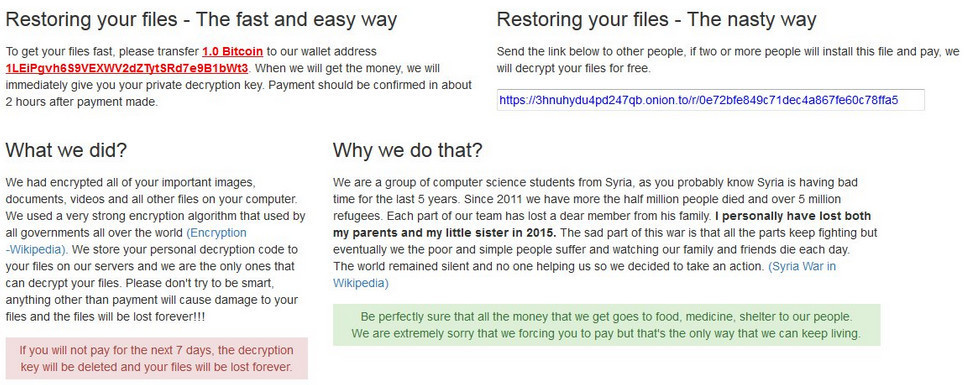
According to information provided by MalwareHunterTeam, the ransomware creators claim to be a group of computer science students from Syria, where a war has been going in the last five years. This reportedly caused a high death toll in the country, as well as famine for survivors. With this in consideration, the developers are assuring the victims that payments will go to food, medicine, and shelter to the people in the country. "We are extremely sorry that we [sic] forcing you to pay, but that's the only way we can keep living", the note states.
Popcorn Time ransomware is still in development, so it's unlikely that the software permeates in the near future. However, with these nasty software in existence, it pays to be careful with what we do on the internet, to be able to keep our computers safe from any harm.
Source: MalwareHunterTeam via ZDNet | Blue padlock image via Shutterstock
















27 Comments
Load the comments and join the conversation!
Read the comments, ask the editors questions, show respect and join the conversation.