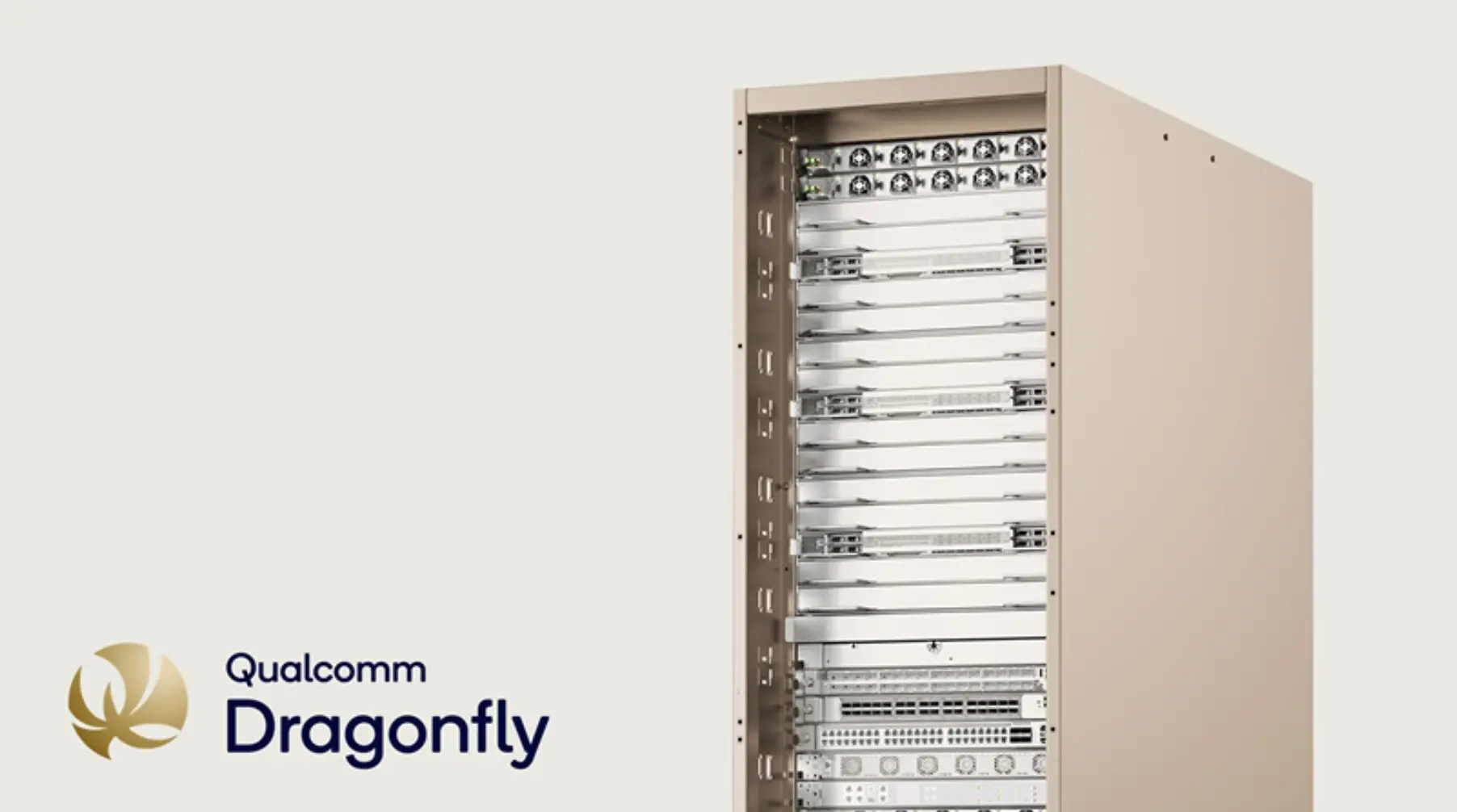
Microsoft, Google, Amazon, AMD, Meta, Apple, OpenAI, and several others have been developing their own chips for AI infrastructure. However, NVIDIA still remains the dominant player in the market. Today, Qualcomm announced a major expansion of its data center infrastructure portfolio to better compete with NVIDIA.
The new lineup includes the Qualcomm Dragonfly C1000 CPU, Qualcomm High Bandwidth Compute technology, the Dragonfly AI300 inference accelerator, new connectivity products, and custom silicon solutions. Qualcomm claims that this new lineup improves performance per watt, token throughput, and total cost of ownership for AI data centers.
The Dragonfly C1000 is a new data center CPU built with Qualcomm’s custom Oryon cores. This chip will feature more than 250 cores, frequencies above 5GHz, and a chiplet-based design. Qualcomm claims that this new C1000 can deliver more than 2x better performance per watt compared to existing server CPU offerings based on specifications.
The Dragonfly C1000 will support PCIe Gen 7 with more than 2TB/s of connectivity, along with CXL, advanced RAS features, and both air and liquid cooling. Qualcomm expects the Dragonfly C1000 to be commercially available in 2028. Additionally, Qualcomm and Meta announced a multi-year, multi-generation agreement under which Qualcomm will supply Dragonfly C1000 data center CPUs for Meta’s next-generation server fleet.
Qualcomm also announced High Bandwidth Compute, a new near-memory computing architecture designed to address AI’s memory bandwidth bottleneck. HBC Gen 1 will debut with the Dragonfly AI250, which is expected to sample in mid-2027. The AI250 will deliver 133TB/s per card, an 18x increase in effective memory bandwidth compared to the AI200 with LPDDR5X.
The new Dragonfly AI300 with HBC Gen 2 is a rack-level AI inference platform from Qualcomm. Qualcomm claims that the AI300 can deliver 4x to 8x better performance per watt compared to existing GPU-based architectures based on memory bandwidth per watt per card. The Dragonfly AI300 is expected to be available in 2028.















0 Comments
Load the comments and join the conversation!
Read the comments, ask the editors questions, show respect and join the conversation.