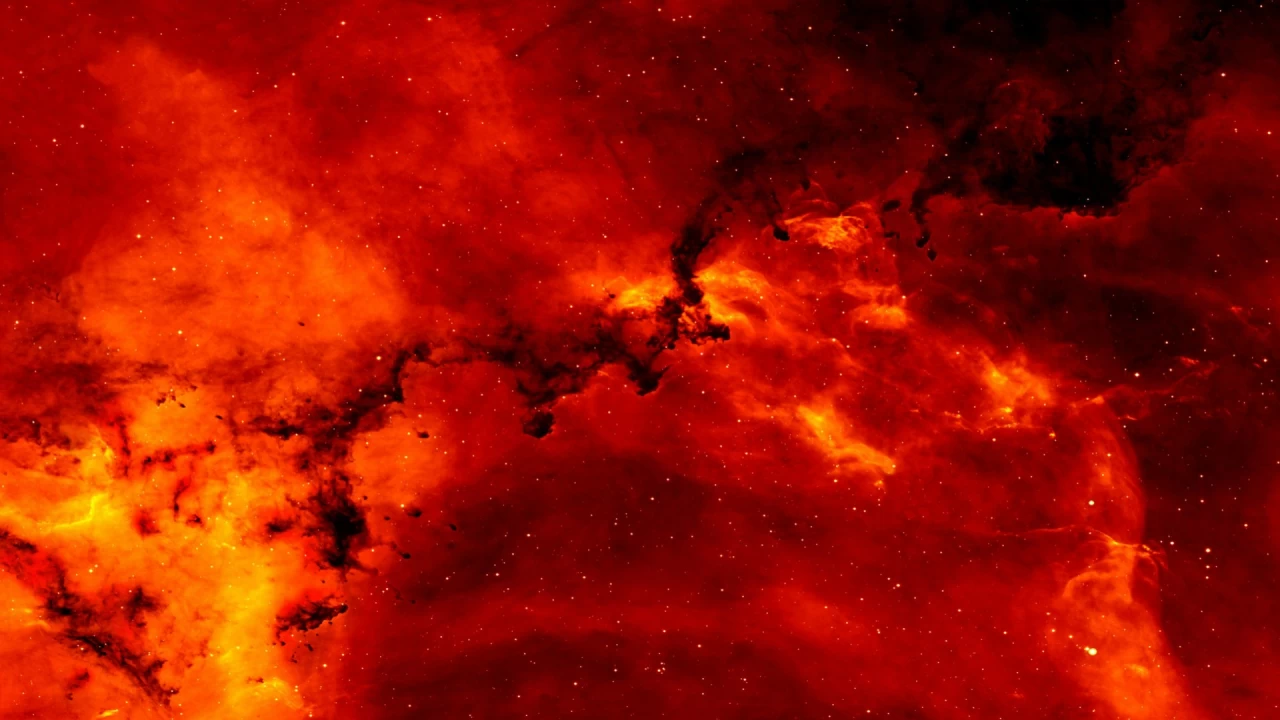
Astronomers using the Subaru Telescope in Hawaii have identified a distant small body beyond Pluto, adding a fourth member to the rare group of objects known as sednoids. A sednoid is a rare type of trans-Neptunian object with a highly elongated orbit and a distant perihelion, meaning it never comes close to Neptune. These bodies likely preserve evidence of the Solar System’s early formation and outer dynamics.
The object, officially designated 2023 KQ14 and nicknamed “Ammonite” by the research team, follows a highly elongated orbit on the outer edge of the Solar System. Its discovery provides new insights into the formation and evolution of the Solar System and raises questions about the existence of the hypothetical Planet Nine.
Ammonite was first detected in March, May, and August 2023 as part of the FOSSIL project (Formation of the Outer Solar System: An Icy Legacy), which employs the Subaru Telescope’s wide-field prime-focus camera, Hyper Suprime-Cam. FOSSIL, launched in 2020 by an international team led by researchers from Japan and Taiwan, aims to investigate icy bodies that preserve traces of the Solar System’s earliest planetesimals. The project’s name reflects its goal of uncovering “fossils” of the Solar System’s infancy.
Follow-up observations in July 2024 with the Canada-France-Hawaii Telescope refined Ammonite’s orbital path. Additional searches of archival data revealed the object in images from the Dark Energy Camera on the Blanco 4-meter telescope in 2014 and 2021, as well as in data from the Kitt Peak National Observatory in 2005. These findings extended the observational record to 19 years, significantly improving the accuracy of its orbit.
Numerical simulations conducted by the FOSSIL team, including those run on the National Astronomical Observatory of Japan(NAOJ)’s computing cluster, indicate that Ammonite has maintained a stable orbit since the early stages of the Solar System, at least 4.5 billion years. Although its current orbit differs from those of the other three known sednoids, models suggest that their orbits were closely aligned about 4.2 billion years ago. This divergence implies that the outer Solar System is more diverse and complex than previously thought.
The unusual orbit of Ammonite also places new constraints on the Planet Nine hypothesis. Some astronomers have argued that the clustering of sednoid orbits could be explained by the gravitational influence of a large, unseen planet far beyond Neptune. However, Ammonite’s misaligned orbit reduces the likelihood of this explanation, suggesting instead that if Planet Nine exists, its orbit must lie farther out than earlier predictions.
The Planet Nine hypothesis proposes the existence of a large, unseen planet in the far outer Solar System, possibly 5–10 times the mass of Earth. It was suggested to explain the unusual clustering of orbits of distant trans-Neptunian objects, which appear influenced by a massive body’s gravity.
Another possibility is that a planet once present in the Solar System was ejected, leaving behind the unusual orbital patterns observed today. Ammonite’s location, far beyond the reach of Neptune’s gravitational influence, makes it particularly valuable for studying the Solar System’s early history. Objects in this region are thought to preserve evidence of ancient events that shaped the outer Solar System. Because spacecraft missions have so far explored only limited regions, wide-field surveys such as FOSSIL are essential for expanding knowledge of these distant populations.
The discovery of Ammonite highlights the Subaru Telescope’s unique capability to detect faint, remote objects. With only four sednoids known to date, each new detection provides rare and critical evidence about the Solar System’s distant frontier. Ammonite, with its stable orbit and long observational record, is expected to serve as a natural archive of the Solar System’s infancy, offering clues to both its origins and its long-term evolution.
The International Astronomical Union will assign a formal name to 2023 KQ14 in the future. Until then, astronomers will continue to monitor Ammonite and search for additional sednoids, with the aim of building a more complete picture of the Solar System’s past.
Source: Subaru Telescope, NAOJ
This article was generated with some help from AI and reviewed by an editor. Under Section 107 of the Copyright Act 1976, this material is used for the purpose of news reporting. Fair use is a use permitted by copyright statute that might otherwise be infringing.
















3 Comments
Load the comments and join the conversation!
Read the comments, ask the editors questions, show respect and join the conversation.