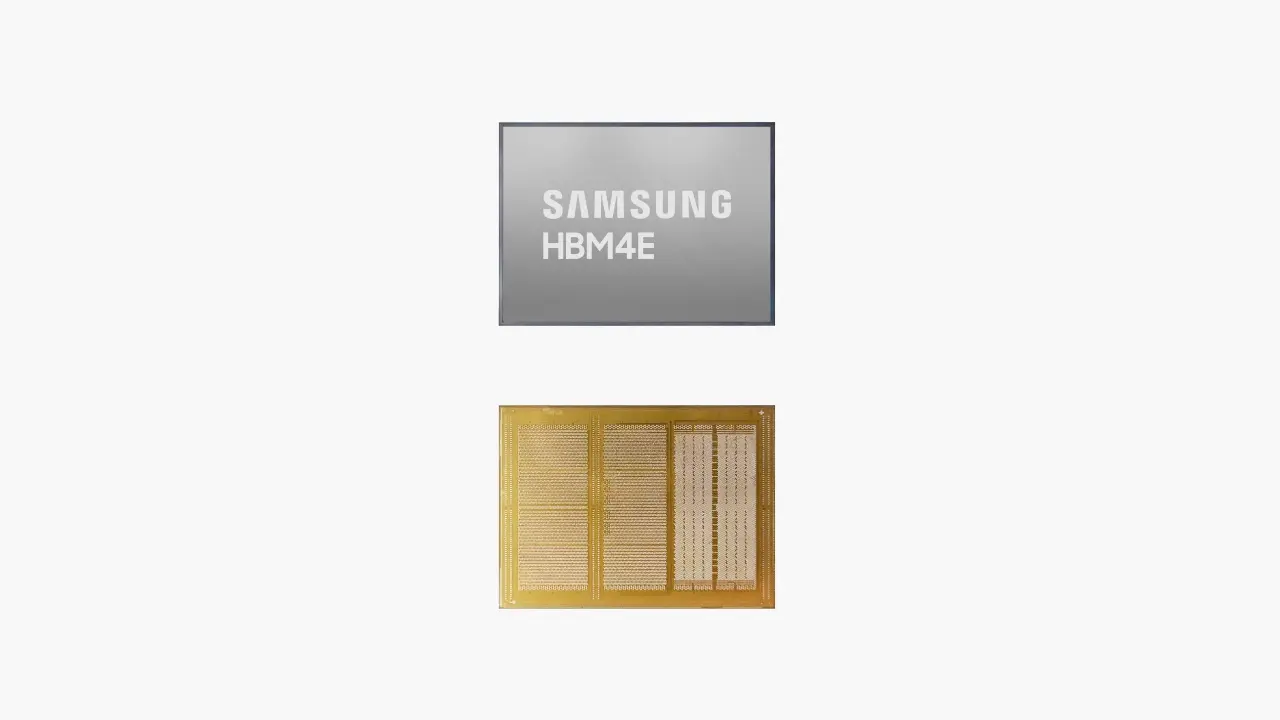
Samsung has announced that it is extending its HBM roadmap by shipping HBM4E samples to global customers who run massive AI networks. This comes about a month after the company reportedly paused mass production of its flagship 10nm DRAM, since the costs outweighed the returns, and the expected yields were too low.
HBM (High Bandwidth Memory), if you do not know, is a specialized memory architecture that stacks Dynamic Random-Access Memory (DRAM) layers vertically and places them directly next to the processor to accelerate things like AI and advanced graphics.
Samsung launched HBM4 back in February 2026, several months after delivering early silicon to clients like NVIDIA and AMD for quality verification testing. With that launch, Samsung became the first in the industry to initiate mass shipments, delivering performance leaps with system-in-package speeds of 11.7 Gbps.
The new HBM4E utilizes the company's sixth-generation 10-nanometer-class DRAM process alongside a 4-nanometer logic base die from Samsung Foundry. This design delivers a stable pin speed of 14 Gbps that can scale up to 16 Gbps, representing a 20% increase in performance over standard HBM4.
Each stack delivers up to 3.6 terabytes per second of memory bandwidth, assisting processors in running massive large language models. Samsung packages these chips in a 12-layer, 48GB capacity configuration, offering 30% more memory capacity than previous iterations.
Low-power design techniques and optimized packaging structures improve energy efficiency by 16% and reduce thermal resistance by 14% to ensure that next-generation data centers can dissipate heat efficiently during heavy workloads. Samsung also plans to expand the lineup to include both 32GB and 64GB configurations later this year to satisfy different customer requirements.
Samsung's HBM business has proven to be quite lucrative, at least according to its most recent earnings call for the first quarter of 2026. Financial reports showed that the semiconductor division brought in approximately $38.9 billion in operating profit, driving total company profits to $41.4 billion. Memory demand, specifically the high average selling prices of conventional DRAM and the rapid adoption of HBM, generated the most profitable quarter in the company's history. Executives noted that customers are already booking out capacity through 2027.















0 Comments
Load the comments and join the conversation!
Read the comments, ask the editors questions, show respect and join the conversation.