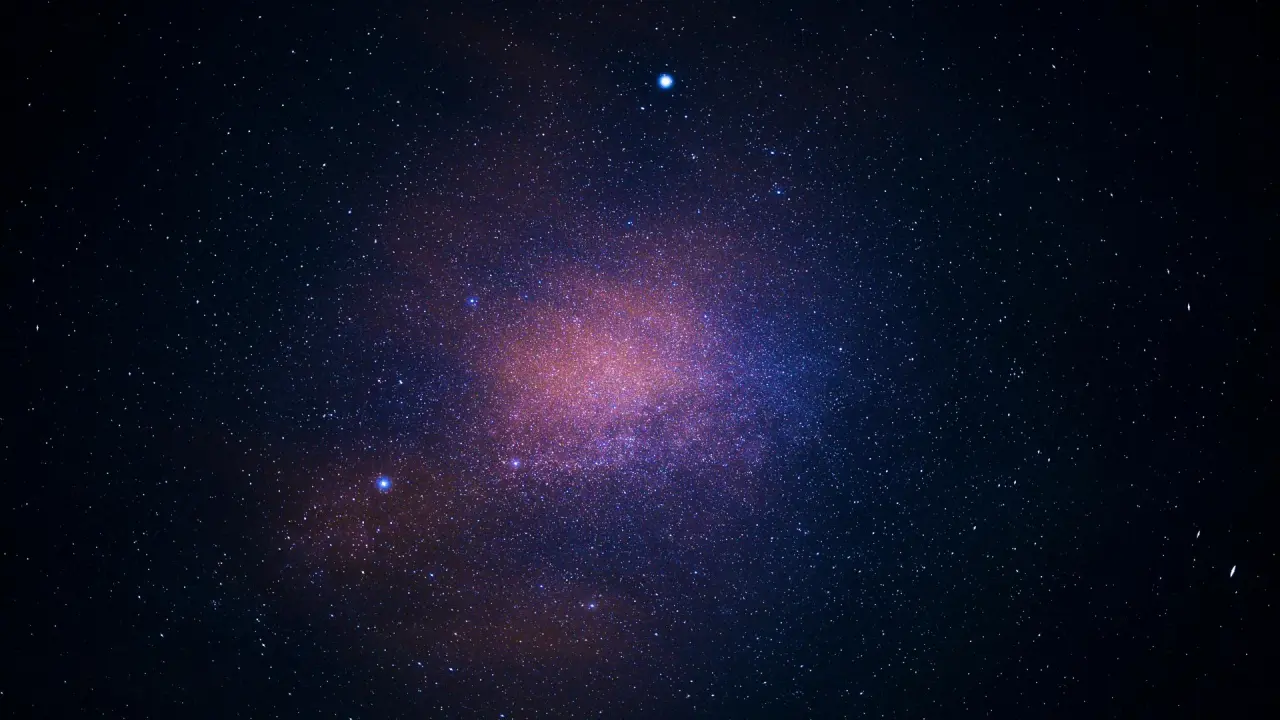
A new study has suggested that the universe might not be as perfectly balanced as scientists once thought. For decades, the standard cosmological model, known as the Lambda-CDM model, has assumed that the universe is homogeneous and isotropic when viewed on extremely large scales. “Lambda” refers to dark energy, the unknown phenomenon believed to drive the accelerated expansion of the universe, while “CDM” means cold dark matter, an invisible form of matter thought to move relatively slowly compared with light. The model is built on the cosmological principle, the assumption that the universe should look roughly the same in every direction and have matter distributed evenly overall. But recent evidence points to something different: the universe could instead be “lopsided.”
The key issue is something called the cosmic dipole anomaly. To understand this, it helps to begin with the cosmic microwave background (CMB), the faint microwave radiation left over from roughly 380,000 years after the Big Bang, when the young universe cooled enough for light to travel freely through space. The CMB is one of the strongest pieces of evidence supporting modern cosmology because it preserves a snapshot of the early universe. Although the radiation is remarkably uniform, it contains tiny temperature variations known as anisotropies. One of the most important is the dipole anisotropy, where one side of the sky appears slightly hotter and the opposite side slightly cooler. Scientists have traditionally interpreted this pattern as the result of the Solar System moving relative to the universe’s “rest frame,” producing a Doppler-like effect.
If that explanation is correct, then distant galaxies and quasars should display a similar dipole pattern. This idea was first proposed in the 1980s by cosmologists George Ellis and John Baldwin and later became known as the Ellis-Baldwin test. The expectation was that the dipole measured in matter would match the dipole observed in the CMB in both direction and strength. However, the new study found that while the directions align, the amplitudes do not. In other words, the variation seen in distant matter appears significantly stronger than current cosmological models predict.
To investigate this discrepancy, the researchers analyzed more than 1.4 million quasars and around half a million radio sources. Their findings reportedly exceed 5σ (“five sigma”) significance, a statistical standard commonly used in particle physics and cosmology. A five-sigma result means the probability of the observation occurring purely by random chance is extremely small—roughly 1 in 3.5 million. CERN used the same threshold when confirming discovery of the Higgs boson because it greatly reduces the likelihood of false detections. According to Professor Subir Sarkar, “This issue can no longer be ignored. The validity of the FLRW metric itself is now in question!”
The FLRW metric—named after Friedmann, Lemaître, Robertson, and Walker—is the mathematical framework used to describe an expanding universe under Einstein’s theory of general relativity. It assumes the universe is homogeneous and isotropic on large scales and forms the backbone of the Lambda-CDM model. If observations reveal large-scale asymmetry, then the FLRW description may no longer accurately represent cosmic structure.
This matters because the standard cosmological model also relies heavily on the existence of dark energy, which is estimated to account for roughly 70% of the universe’s total energy content and is used to explain why cosmic expansion appears to be accelerating. Yet dark energy remains hypothetical, with no directly confirmed physical explanation. If the universe is not truly isotropic, then some evidence interpreted as proof of dark energy could instead arise from incorrect assumptions about the geometry and structure of the universe itself.
Dr Sebastian von Hausegger added: “If distant sources are not isotropic in the rest frame in which the CMB is isotropic, it implies a violation of the cosmological principle … which means going back to square one!”
The cosmic dipole anomaly has received far less public attention than the Hubble tension, another major disagreement in cosmology concerning measurements of the universe’s expansion rate, known as the Hubble constant. Measurements based on the early universe, especially from the CMB, produce lower values than measurements based on nearby supernovae and galaxies. But while the Hubble tension challenges calculations of cosmic expansion, the dipole anomaly strikes at something even deeper: the assumption that the universe itself is statistically uniform on the largest scales.
Looking ahead, several major astronomy projects could help determine whether the universe is genuinely asymmetric. The European Space Agency’s Euclid satellite is mapping billions of galaxies to study dark energy and cosmic structure. NASA’s SPHEREx mission will survey the entire sky in infrared light to investigate galaxy formation and the origins of cosmic structure. The Vera C. Rubin Observatory will repeatedly scan the southern sky to study dark matter and transient cosmic events, while the Square Kilometre Array (SKA), an enormous international radio telescope project, will probe the large-scale structure of the universe with unprecedented sensitivity. Advances in machine learning may also help scientists develop new cosmological models capable of explaining these unexpected observations.
For now, the study suggests the universe may not be as simple, symmetric, or evenly distributed as scientists once believed. If future observations confirm these findings, researchers may need to rethink not only the standard cosmological model, but possibly even the role of dark energy itself.
Source: The Conversation, Oxford University
This article was generated with some help from AI and reviewed by an editor. Under Section 107 of the Copyright Act 1976, this material is used for the purpose of news reporting. Fair use is a use permitted by copyright statute that might otherwise be infringing.

















2 Comments
Load the comments and join the conversation!
Read the comments, ask the editors questions, show respect and join the conversation.