
Windows 10"s tenth birthday is just around the corner, and so is its end of support date. The OS launched on July 29, 2015, and although it faced a rocky start, it eventually found its footing and went on to be installed on over a billion PCs within a few years. As we approach a decade of Windows 10, we thought it would be an interesting idea to take a walk down memory lane and have a look at 10 features in the OS that just never took off for one reason or the other. Please keep in mind that the list below is not in any particular order, so it is not numbered:
Cortana
Let"s start with the most obvious one: Cortana. This digital assistant - sharing its name with a popular AI character from the Halo series - was rumored back in 2013, and although it first came to Windows Phone 8.1 (R.I.P.) in 2014, Windows 10 was the first desktop operating system to include it as a feature in 2015.
Although Microsoft publicized it heavily as a personal assistant with a personality to match against mobile competitors like Siri, customers just weren"t a fan of the idea of talking to an AI model on their PCs at that time. Coupled with the limited capabilities of the assistant (especially its focus on U.S. customers while pretty much ignoring everyone else) and Microsoft"s frequent pivots in strategy, interest in Cortana just began to fizz out by 2019, leading to its death in 2023.
Groove
Microsoft launched Groove in Windows 10 as a competitor to iTunes and Spotify, and a replacement for Xbox Music. On the surface, it did exactly what it said on the tin, but that also became its downfall since there was no differentiating factor. It was too much of a hassle for people who were well-entrenched in their music ecosystem to migrate their existing libraries to a whole new service just for the heck of it, despite Microsoft doing regular giveaways and massive discounts. Eventually, Groove Music sung its swansong at the end of 2017, with customers being migrated to Spotify.
Sets

Now this is an interesting one. In 2017, Microsoft revealed that Sets were coming to Windows 10. This was meant to be a new interface for UWP apps (initially) allowing multiple instances of an app to be open in one window, similar to a web browser. The company began testing this UX in Insider builds, but could never get it just right. Eventually, it was silently killed off without ever being launched. That said, at least some of that vision survived with tabbed File Explorer in Windows 11.
Windows Timeline
.jpg)
Windows Timeline was pitched as a revolutionary continuity feature in Windows 10 back in 2017. The idea behind it was that Windows would maintain an activity history of everything you do on your PC, and then enable two additional capabilities. One was to "go back in time" to a previous activity, and the other involved syncing your activity to another device so you could pick up from where you left off, regardless of your hardware. However, this feature never quite hit its desired level of popularity and Microsoft eventually disabled its headlining synchronization capabilities. Although Timeline is still a part of Windows 10 (launch it through the Win + Tab combo), it"s a scaled down version that only maintains local history.
Live Tiles in Start menu
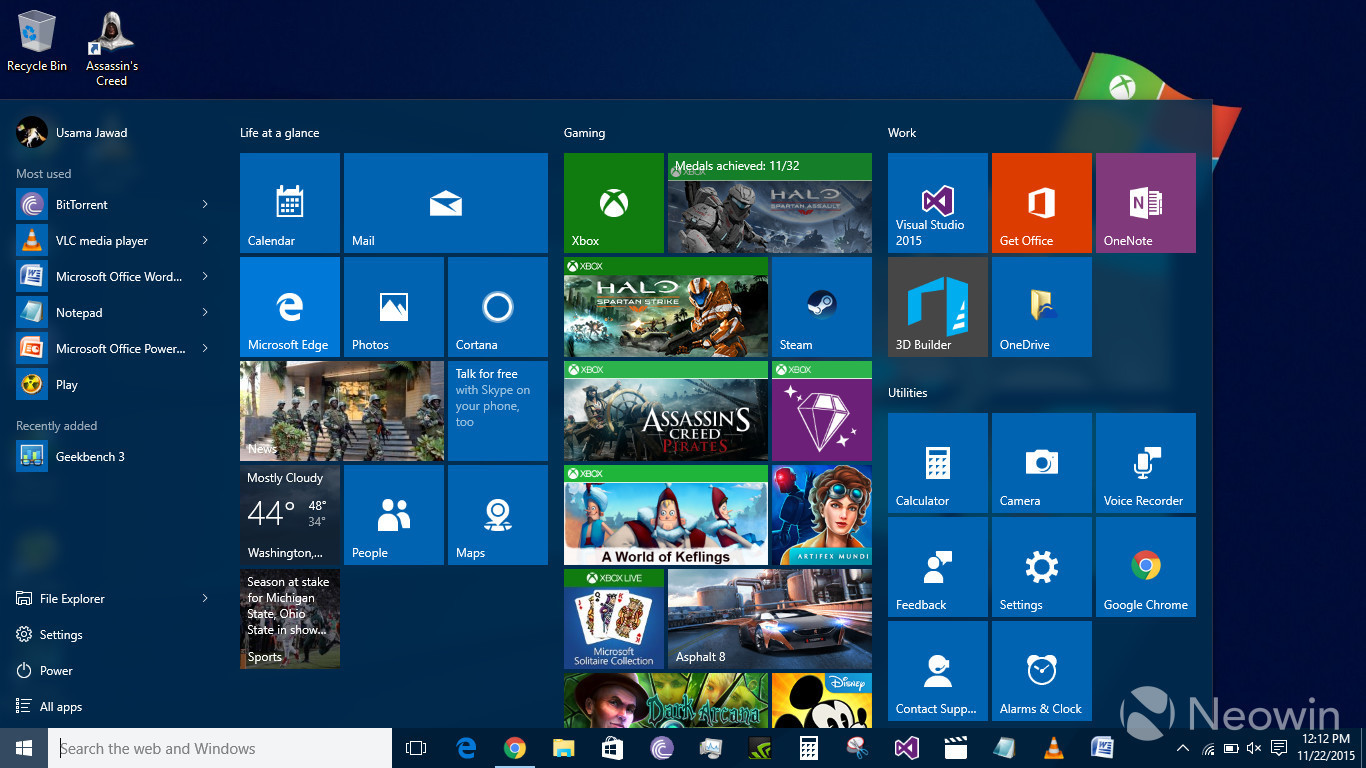
Live Tiles have always had a controversial history, some adore it while others absolutely hate it. It is important to note that Live Tiles isn"t a concept that was introduced in Windows 10; in fact, they were first introduced in Windows Phone 7, before making their way to Windows Phone 8, Windows Phone 8.1, Windows 8, Windows 8.1, and Windows 10.
However, what we"ll be focusing on is the implementation of Live Tiles in the Start menu of Windows 10, which basically combined the classic Start menu with this UX to appease both categories of customers. You would think that Microsoft would be successful in making both groups happy, but the issue was that Live Tiles weren"t actively supported by developers and most just ignored it. Of course, fans of the interface still enjoyed them, but it"s clear that they weren"t in the majority since Microsoft completely did away with Live Tiles in Windows 11.
Paint 3D
Before Microsoft went all in on AI, its fascination was 3D and Mixed Reality aspects in Windows. To that end, it launched Paint 3D in Windows 10, hoping to fascinate everyone with 3D capabilities. However, just like we have in the current case with Copilot, there was a lukewarm reception to the idea. We don"t really have statistics regarding how many people actually used it, but the number is likely quite low, which is why Microsoft ended up retiring the Windows app just last year.
Windows 10 in S mode
This is just something that randomly came to my mind last week and also served as the baseline for why I wanted to write this article. Windows 10 in S mode was announced at an education event back in 2017 as "Windows 10 S", but it later received Enterprise and Pro SKUs too. This is a locked down but performance-focused version of Windows 10 where you can only download software from the Microsoft Store and can only leverage Edge with Bing as a search engine.
Windows 10 S was meant to be a competitor to Google"s ChromeOS and Microsoft marketed it quite heavily for a long time, but it seems like it faded into the background over time. This might be because of low interest due to confusing SKUs, a steep upgrade price to switch out of S mode, and just too many restrictions. At that point, most organizations would rather just use Intune to manage their tenant devices. Windows in S mode is still alive (there is a Windows 11 version too), but no one talks about it anymore; the last article we wrote about this was back in 2019.
Legacy Microsoft Edge
Microsoft Edge is not the most popular browser out there, but it does have its fanbase. However, Edge in its current state is much different than what was offered through Windows 10, at least from an infrastructure perspective. Edge originally launched with Microsoft"s in-house EdgeHTML rendering engine, but in 2018, Redmond decided to ditch its own implementations in favor of Google"s Chromium initiative. This was very controversial at the start as there were pros and cons to both approaches, but it did emphasize that Microsoft had not been able to capture the Windows 10 user base despite its best efforts.
The Chromium-based browser officially launched in 2020, and Microsoft has stuck with it since then, which implies that the company made the right decision.
Continuum
Continuum was at the center of Microsoft"s marketing push for Windows 10, when the company still had a mobile OS. For those of you who are new to Redmond"s world, this was Microsoft"s initiative to "convert" a Windows phone into a desktop PC through a physical dock. The company launched the Lumia 950/950 XL in India with a free Continuum dock and even had HP join in on the fun. But this never quite became mainstream due to the low market share of Windows phones in general, and the service died a quiet death along with Microsoft"s mobile efforts.
Univeral Windows Platform (UWP)

In 2014, prior to the launch of Windows 10, Microsoft had this grand vision of enabling developers to build an app once only, and have it run across different platforms including Windows, Windows phone, and Xbox. The company made some tangible headway in this area when it announced Windows 10 and the idea of having a single app store for all its products, powered by the Universal Windows Platform (UWP).
Microsoft did manage to onboard some developers and even built tools to migrate apps built for other operating systems directly to Windows, but it failed to convince the vast majority of developers. Interest in the technology began to wane further along the years as developers realized that the ability to build one app for multiple products and form factors wasn"t as easy as Microsoft had made it seem. The tech firm itself published guidance in 2021 about how to migrate from UWP to the Windows App SDK. Right now, interest in UWP is at an all-time low, and as we discovered yesterday, even WhatsApp is ditching UWP in favor of a Progressive Web App (PWA).
This is the first story in our new "10 Years of Windows 10" collection, in celebration of the operating system"s tenth anniversary, falling on July 29, 2025. Over the next few days and weeks, you"ll be able to find more content on this topic in our dedicated section available here.